
Translated material
Wardrobe
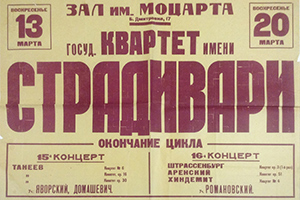
On October 1, at the Stanislavsky and Nemirovich-Danchenko Theater-not on the stage, but in the semi-male space of his musical living room-a musical and exhibition project called "Mozart's Concert Hall" starts. Such a concert venue existed in about this place in the 20-30s of the last century, which the theater recently learned thanks to a random find. The employee of the Museum and Exhibition Department of the theater Katerina Vakhramtseva tells how everything was.
Once, a folder was found in the closet of the Museum of the Stanislavsky and Nemirovich Musical Theater named after Stanislavsky and Nemirovich-Danchenko, which none of the current employees had ever seen. In the folder - the posters of the Mozart Hall for 1927. It is known that he was in the building of the theater on Bolshaya Dmitrovka, 17. The name of the hall is mentioned in the theater chronicle, but when you look at the posters, you understand that the activity of this concert venue is a completely unexplored period in the history of Russian academic music.
One evening, Alexander Mosolov accompanies his “four newspaper ads” on the piano, another evening he plays a sheet. Young Shostakovich first performs the first -written first piano sonata (OPUS Twelfth). There are new works of Bartok, Kazellla, Malipierro, Miyo, Hindemit, Yarnaakh, Herre, Whithorn, Pulenka, Stravinsky, Small, Strassenburg, Gliera, Abraham. Next to some surnames-a note “for the 1st time”, sometimes “performed by the author”.
At the posters preserved in the Museum - 126 performers. Among them are famous musicians and completely forgotten. Someone died in the war, someone went along the party line, someone was repressed and shot. But in the late 1920s, they all made concert programs, and today amazing those with what ease and freedom they combined-or, if you use the actual dictionary of the era, mounted-centuries, names, names.
It is fascinating even a simple reading of the list of performers. Drago-Davignon, Stepnoy-Samarsky, Mundel, Hamburg-surnames from life, the fragments of which have long been erased into dust. But it seems that today we live again, if not her, then something amazingly similar. You are very much attached to some of these people humanly. Two or three biographical facts, even without photography from a personal file, is enough for a living person to appear in front of you.
The searches in archives, funds, periodicals of those years have begun and continued. We began to look for relatives and descendants through social networks in order to supplement the mean mention of details.
After reading the surname of Kereteleva (in the poster, an instruction is “at the piano”), our theater artist said: “Oh, this is the name of my wife’s boss!” A phone call - and a miracle happened: Ekaterina Fedorovna Kereleva (in girlishness - Vonlyarsky) turned out to be a princess, the wife of Prince Mereleva, who defended a dissertation about Schopenhauer in Switzerland. After the revolution, she worked as a teacher in the Moscow Art Theater and the Musical Studio Nemirovich-Danchenko, wrote plays under the pseudonym K. Murr. And her grandson, Dmitry Dievich Ukhtomsky, was a hereditary prince and worked as a button at the Bolshoi Theater (and then served as a scout in Iran). This prince-butaf was the father of the head of the wife of our artist.
Now we are facing her photos, a book with a gift inscription of Balmont and several documents about work in a music studio.
Her grandson was a hereditary prince and worked as a button at the Bolshoi Theater (and then served as a scout in Iran).
Another story. The cellist Viktor Kubatsky spoke in the Mozart Hall as part of the Stradivarius quartet created by the Government Decree in 1919. In the same year, a state collection of rare and ancient instruments was organized, to which Kubatsky was most directly related. Working as the head of the musical part of the Bolshoi Theater, he was enrolled in the requisition commission for the seizure of musical instruments. As the initiator of the creation of the Lunacharsky commission explained: “The musical instruments we need on the shelves do not lie. They will have to be sought and identified . The commissions have difficult and painstaking work. You can’t do without the Chekists in such a case. ” And here is the Chekist Prokofiev (composer’s namesake) and the cellist Kubatsky went to Odessa to requisition the collection tools, which later sounded, including in the Mozart Hall. The cellists play an important role in the cultural policy of each era.
On one of the posters in the corner is a small inscription: "Administrator Keldysh." The surname is known and widespread. Maybe a relative of Mstislav Keldysh, President of the USSR Academy of Sciences? The older brother. Alexander Vsevolodovich Keldysh dreamed of becoming a dramatic artist all his youth, but became an administrator of the state -minded. In 1938, he was convicted as a French spy, spent more than a year on Lubyanka. At this moment, screaming in power took place - Yezhov was removed, Beria was appointed, a revision of a number of cases began, and the charges of espionage were removed. But soon the Keldysh was charged with new charges, this time of anti -Semitism (which is especially funny, taking into account the fact that his first wife was a Jewish). Nevertheless, he was justified and released from the courtroom.
And a similar story is behind every name. The more you recognize them, the more I want to share. And we decided that the hall is worthy of the reconstruction that have an exhibition that have an exhibition, and our contemporaries are good concert programs.
The reconstruction of the Mozart Hall should not be exclusively museum. Our task is to make a priority program to predecessors addressed to contemporaries. This is an attempt to create the same living and free space for chamber concerts today, which arose in the 1920s in the Mozart Hall, and to work not for the cultural industry, but for culture-after all, the predecessors somehow succeeded. Save and reconstruct what can be saved is an act of spiritual gratitude.