
Translated material
"Frustration is a faithful student's companion"
Gleb Napapenko: You and I have experience in teaching in two art schools: we taught together in the “Base”, you read the history of modern art at Rodchenko’s school for two years, and this year I will read it, and I already participated in an interview with applicants. At the same time, we both are not “masters”, artists who come to study students like the masters of contemporary art. And, looking at what is happening a little from the side, but at the same time from the inside of the art schools, we find a meeting of two desires: the desire to become an artist and a desire to make an artist out of a person. Here you can immediately ask yourself: is it not problematic to ensure the idea of ensuring a guaranteed happy meeting of these desires? That is, to create some place where artists make and where can you come and become them?
Alexandra Novozhenova: Yes, these two tasks contradict each other. Because the desire to make an artist is a desire to professional in the process, to produce a working unit. And the desire to become an artist is, on the contrary, the desire to go into some otherworldly profession space. And therefore, the desire to become an artist and the desire to make an artist produce paradoxes as part of the institutions where they are faced. Although there are people who, in their desire to become an artist, coincide with the desire of the institution, but, as a rule, this is a rather paradoxical relationship.
Naplyenko: This paradox can be described in other words as a fantasy of emancipation, rash from students and the idea of subordinating to some reasonable canons of production by teachers.
Novozhenova: Yes, and that is why those artists and photographers who are gaining workshops at the School of Rodchenko are wondering about the applicant about the applicant about the applicant-whether this person will be able to work as part of their teaching method. And if it seems to them that a person is too insane, too aggressive or, conversely, too hidden on his mind, then they often do not associate with such a person.
The student comes and says: "You are hateful, but take me."
Naparenko: At the entrance interview at the Rodchenko school, for example, applicants are all the time as asking: "What can we give you?"
Novozhenova: When I went to graduate school, they gave me advice: it does not seem to Overqualified - “excessively qualified”. The same applies to the applicants to Rodchenko. A school or university should be able to process you.
Naplyenko: As soon as you sat at the table of the selection committee by the teachers, this logic seems reasonable. Yes, you think, the institution should work, it should enter the material that will give it a maneuver for work, will not give too much resistance and will not require too much help ... but at the same time you catch yourself on the opposite feeling: that there is something suspicious in this conviction, because it instantly algorithmizes and instrumentalizes the process of becoming the artist. Of course, this is criticism from the idealized position of the opposite side of the table - an imaginary applicant, not spoiled by a cultural industry, dreaming of impossible free art. But in this split that I experienced, participating in an interview, there is a certain truth about art as a whole ...
Of course, applicants are not so innocent and independent, many people know well what specific masters want from them, and they want to like them.
Novozhenova: Applicants want to appeal at any university, but in other universities there is no this imperative of sincerity, which suggests art. And here the game includes relations with the requirement of institutions, and there may be all sorts of options - for example, a student comes and says: “You are hateful, but take me.”
- To be on the side of successful? Or on the side of the back? - Or on the side of successful garbage.
Naplyenko: But in such a position there is something with which art, in theory, should deal with. This is something that does not happen at a regular university that is engaged only in knowledge. Contemporary art should be friends with the discharges of social and career success ... Yes, again this is a romantic position, but nevertheless I ask myself: what other position can be taken in relation to this conflict? Be on the side of the successful? Or on the side of the back?
Novozhenova: Or on the side of successful garbage. The issue of success is already in introductory views. At the Rodchenko school, they are always looking for “something” in the portfolio, which is ready to develop into style. Moreover, this “something” is always connected with some skill, the skill that can “something” to arrange-and bring to its owner “success”. But there are a bunch of people who still go to school, although they do not have something “something”-they act simply because their preliminary skills, developments in the portfolio, their behavior at the interview inspire the teachers with the hope that they can work with them and do something of them. And at the Rodchenko school, therefore, there is immediately a division into people who have “something”-their own medium, their own theme, their own shape, their object, making them “successful” students, even if they are not particularly developed-and people who have nothing and therefore exist in some suspension of tasks, search, wandering stupidity and, on the other hand, such idle veracible. When I and I and I organized the seminar “Introduction to the Professional in Rodchenko. XXI century ”, then most of the students who went to us were just in uncertainty, without this notorious“ something ”. People who cannot find their object and a way to handle it fall in school in a crisis situation.
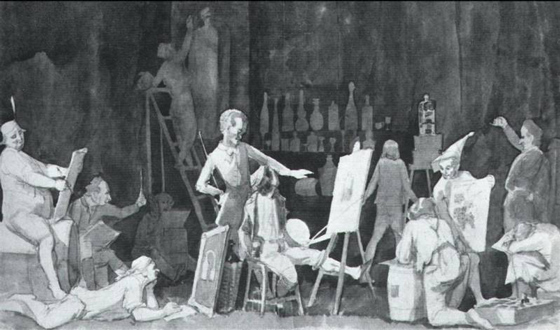 Pavel Fedotov. The drunkenness of academics
Naparenko: What place can I take as a teacher in relation to this situation? When you sit in the commission in the process of an introductory interview, you especially do not have options for maneuver. But what to do next? For example, on views during the educational process. This is a completely different genre. I admit, views both at the Rodchenko school and in the “base” in which I took part, for me were traumatic experience. If at the interview I understood the logic and rezons of teachers and was able to solidarize with it and see wisdom in it, then at educational views I usually had an extremely vast impression of how teachers with students communicate.
Novozhenova: At the introductory interviews, teachers act themselves as authors-the authors of their workshops who need to select the team, and therefore they can somehow sympathize with. But on the views during training, the situation is different, here the author is a student, it is assumed that an assessment should be made to what they have done. That all teachers are trying to do. But the problem is completely different.
NAPENKO: What?
Novozhenova: Not what the student did , but in what he does . What does this person do at all? What does he practice? He would probably like to find out. You can try to judge from the point of view of the product, but is it appropriate in relation to student work? After all, you can ask a completely different question: what is the practice that a person indulged, which he carried out? This is a question about what a person wants - and he almost never knows what he is doing. And it would be valuable to try to listen, point out something and say: “Ah, that’s what you did and do!” It can be a surprise for him.
The futility of friendly councils on the principle of "oh, I had a similar problem, and it helped me."
NAPENKO: an unconscious arises here. At the entrance interview, the problem is not so acute, because the main question that needs to be solved there is the question of joint existence: this master with this student can do something together. And then the question that you formulated - what the student does with art arises. And this is a question that is much more rooted in the everyday existence of a student as a subject, in his intimate relationships with what he brings to view as his work ... And what was most upset at views - in response, he usually receives a series of automatic, as it seemed to me, rhetorical moves from taking viewing teachers. One of them is to fit the history of art by the type “O, this was already with such and such an artist”-and further the list of names depending on the tastes of the commentator. Thus, the subject of the subject occurs through the premises in some already legalized register of art achievements. Another genre is the fast advice of the teacher, how it would be better to do this work. Such advice also ignores the author of the author from the perspective of some ready-made solution ...
Novozhenova: “Look at these authors, they work with the same material, but much more successful ...” or vice versa: “Great, almost like such and such!” Or: "And here to add red!" I call it "teachers are crazy." In this darkness, teachers plunge into a somnambulic trance of imaginary interpretations from a height of their authority in this dark room in Rodchenko. And in front of them is a student who brings supposedly the most expensive to view. “Allegedly”-because very often this is still an imitation, so that the student is behind. To expose the student a victim is somewhat naive, often it is a rather cunning Pinocchio who is trying to deceive everyone and invest in viewing work as little as possible ... not so much work as mental energy. Your desire.
NAPENKO: Students hide something from the commission. How to give something to view-but at the same time give nothing?
Novozhenova: This is a common situation for students who want to be presented on viewing, but at the same time they are completely not ready to imagine anything. They flirt with the commission to give her what she wants to make a compromise and the study dance is continued.
Naparenko: take into account all the requirements.
Novozhenova: But do not invest too much desire. This, of course, is only one of the options. But whatever object appears on viewing - teachers begin to very actively interpret what it can mean ...
Everyone said what needs to be done so that his work became work, but no one asked what his problem was.
Naparenko: And thereby they continue to discuss the requirements, but do not raise the question of desire. There is some kind of desire in the objects presented, but it is hidden, but what refers to the register of requirements, relevance, professionality ... And then teachers begin to endlessly articulate something in this register.
Novozhenova: Do not even articulate - they begin to say everything in a row! The most common student method of creating works is an assembly, very easy to produce thanks to graphic editors and programs like 3 DMAX : you can glue bacon, shoes, credit card and excavator ... And these rather arbitrary assemblies provoke whole streams of reasoning about what they can mean. Then the question is asked: "So, this is a criticism of the consumption society or its approval?" And there are situations when an empathic teacher sees the meaning that others does not see in the work, and the student at such a teacher immediately sinks. Like: Yes, exactly how I myself did not understand ...
I see the meaning in another - to look at the student several views in a row. It is always found that there is a structure of work that it reproduces over and over again. Perhaps it is developing, but nevertheless, watching it, you can say something. For example, one student simply constantly returns the completed task. It is fixated on commenting on the educational process, but in these of its completed tasks there are very few mental investments, he usually chooses the most elementary solution to the task. Since the tasks are changing, he seems to do different things - but in fact the same thing.
There was another story. A student who could not finish the diploma for three years. He had only four photographs, he could not develop them into a series over the years, and the series was what is required to exhibit at a diploma exhibition. It is not enough to have a certain application, you need to show how you will embody it into the product. He had no idea how to turn it into a product, and he came over and over again with these four photographs, all the time put them in a different order and reinterpreted before the commission. He was given advice-to expand the series to 10 pieces to get a sequence, or, conversely, reduce it to one, so that it was one photo, or something else ... And I asked him to watch after another portion of the tips: “Listen, and what, in fact, is your problem? Why can't you finish this thing? " He answered something there, it is not so important that-but in the same year he defended himself. And he asked me to be his reviewer. Since before everyone said what needs to be done so that his work became work, but no one asked what his problem was. And I was in this situation very pleased with myself. Masters, as artists, have a very specific practical experience in turning developments into finished “work”, which, as it seems to them, can simply be adopted by students. This gives rise to aggressive stylistic influences of teachers on students inside the workshops. The most successful artists like Sergei Bratkov are inclined to give the most specific advice.
NAVPENKO: I want to say a few words to justify the viewing situation - with all her streams of comments. This is a miniature semblance of a situation of existing art in a public field. Some people come, flaunt something, then there are many other people and begins to say and interpret something. The moment of parting the author with an object that breaks away from the personal history of his creator and begins to live a public life is what is valuable in viewing. Therefore, by the way, I like that in the “base” all views in a playful way are presented as an “internal exhibition”.
The problem with viewing is that in addition to the function of public presenting objects in it, in theory, there is a task to help students, which is not worth it at a regular exhibition. But this task of helping on views is often understood very simplified-to give advice, to recall who had the same situation ... It is very similar to the futility of friendly councils on the principle of “oh, I had a similar problem, and it helped me that is often given to a person who fell into a difficult life situation. However, there are more wise friends.
Do not respond directly to the student’s demand, including the requirement of love, but to support the doubt that brought him to the art school.
Novozhenova: This is a question of a teacher’s relationship with a student. Recently, on this subject there was a scandal about love and sex between teachers and students in the 57th school. And the question can be posed as follows: is teaching without love transfer - transfer in the psychoanalytic sense of the word? For example, the most successful teacher at the Rodchenko school is Kirill Preobrazhensky, who, apparently, does not consider teaching without transfer, without personal relations with students - not necessarily love, but necessarily extremely extremely intense. And this transfer, sometimes negative, attraction and repulsion, love and hatred are cultivated from the very beginning of training. Such is his method of production of artists - the most traumatic for someone who is subjected to processing, but at the same time the most productive in terms of creating “successful graduates”.
And about ours with Nastya Ryabova, according to rumors, Preobrazhensky told the students: “They will not help you artists.” It was insightful. We really do not have the instrument with which he does artists.
Naplyenko: Here again the question arises of different ways to answer the initial request of students-to find some place in contemporary art. The most pretty here is the position close to the position of a psychoanalyst-not to respond directly to the student’s demand, including the requirement of love, but to support the doubt that led him to the art school. And do not plug this shortage with ready -made answers or their body (as in the case of teachers who enter into love relationships with the students, and as Jung once made Freud's covenants), but to support his desire. An exemplary example seems to me a story with a question for a student who could not finish the diploma project - “So what is your problem?” This question indicated the independent significance of the fact that something was stalled with him, and did not try to somehow cover this fact.
If we are talking about the idea of learning modern art, then its strangeness is that there is skill, skills, knowledge that can be taught, and there is a specific attitude to skill that contemporary art claims - a paradoxical attitude related to the loss of skill in the industrial and post -industrial era, with criticism of virtuosity ... and this is the attitude of modern art towards skill with attitude towards skill in similarity with relations with relations. Psychoanalyst for knowledge: yes, knowledge is important, but there is something else that you can’t know.
Новоженова: Только студенты приходят в школу не на психоанализ, здесь тоже не надо путать.
Напреенко: Да, понятно, что здесь двойная вещь — овладеть навыками, но одновременно, чтобы искусство состоялось, нужно что-то еще, что не регламентировано. И, конечно, то поддержание вопроса у студента, которое я провозгласил идеалом, вовсе не обязательно приведет студента к статусу художника… Но, может быть, это и неплохо — возможно, не стоит полностью солидаризироваться со стремлением арт-школ производить художников, даже если ты там преподаешь, и можно видеть свою задачу иначе.
Екатерина Дёготь, которая постоянно пугает студентов требованиями публичности, для них настоящий авторитет.
Новоженова: Не стоит думать, что студент художественной школы находится полностью на стороне всех этих дауншифтерских идеалов приватного и неотчужденного и не имеет интереса к публичному и его нормам. Недаром Екатерина Дёготь, которая постоянно пугает студентов требованиями публичности, для них настоящий авторитет: студенты мечтают, чтобы Дёготь была на просмотрах. Если ее нет, они страшно расстраиваются. Хотя они знают, что она может сказать жесткие и унизительные вещи об их работах. Им нужен жесткий ответ Другого. Для них самое оскорбительное — когда ничего не сказано или сказано вяло. Они хотят самого страшного наказания — и именно с позиции норм публичного поля: «Как вы осмелились думать, что это возможно, что это приемлемо? Да вы почитайте вообще! Да вообще так не делается!» Они просто млеют. И возникают смешные ситуации. Выходит студент, показывает видео, в котором происходит какая-то загадочная и интересная ерунда с выплескиванием кефира в объектив камеры. Дёготь говорит: «Ну, вы объясните, что это такое? Вы должны научиться объяснять». Он в ответ мычит, поворачивается и уходит. Возникает дискуссия о том, можно ли позволять студентам ничего не говорить. При этом очевидно, что именно этот студент никогда ничего не скажет, сколько его ни увещевай.
Такое требование ответственной публичности порождает идиосинкразию половины студентов к «критическому дискурсу». Они начинают думать, что «критическая» рефлексивность, способность рассказать о своем произведении, проанализировать его публично с точки зрения политической и общественной функции — это такая разновидность карьеризма и конформизма, с которой настоящий художник должен бороться.
Напреенко: Здесь как раз укрепляется романтическая мечта об искусстве, абсолютно отделенном от сферы публичного, которая якобы не имеет никакого отношения к интимным вопросам. Довольно парадоксальный эффект проповеди левого критического дискурса…
Новоженова: Да, критический дискурс начинает восприниматься как конформизм, которому нужно сопротивляться. Но одновременно студенты очень хотят оценки и наказания в рамках этого дискурса.
Напреенко: Судя по тому, что ты рассказываешь, Дёготь для них выступает с точки зрения нормативной (пусть даже левой) морали и тем самым выполняет функцию признания ненормальности — а это то, чего нередко хочет художник. Вообще здесь встает вопрос об инстанции авторитета: она, похоже, необходима молодым художникам, но часто как точка отталкивания — или просто точка отсчета… В этом смысле мне показалась интересной конструкция Просмотра с Тайным зрителем в рамках вашего с Настей Рябовой спецсеминара в школе Родченко, где вы ввели нарочитые фигуры закона и разыгрывали ритуал просмотра как откровенно театральное действо.
Новоженова: Эта конструкция — Просмотр с Тайным зрителем — родилась в ответ на неудовлетворенность обычными просмотрами и как альтернатива им. В частности, для нас было проблемой, что студенты на просмотрах часто страдают от невнимания. И мы решили сделать им подарок — просмотр, но вне школы, за пределами этой институции. Еще мы подумали, что авторитет, который воплощают в школе Екатерина Дёготь или мастера, можно по-другому инсталлировать в пространстве просмотра, куда студенты приносят на оценку свои драгоценности. Мы объявили студентам, что этим авторитетом будет самый великий живой российский художник. Это была правда. Мы нашли самого важного, самого именитого российского художника, от встречи с которым, если бы этот художник явился открыто на просмотр, затрепетал бы не только студент. Но мы его скрыли в особой будке. Кроме того, мы ввели регламент, согласно которому единственным человеком, не участвовавшим в обсуждении работ, был этот великий художник. Но он обязан был смотреть на них сквозь дырочки в своей будке… Художник был поэтому назван Тайным зрителем.
Мы нашли самого важного российского художника. Но мы его скрыли в особой будке.
При этом регламент также гласил, что участвовать в обсуждении обязаны все остальные, включая студентов и гостей просмотра: каждый присутствующий в зале должен был в течение минуты, отмеренной по секундомеру, что-то комментировать. Комментарий не мог стать слишком длинным, потому что он был ограничен секундомером, а с другой стороны, если кто-то не хотел говорить, он обязан был передать свое время другому. Так возникало некое принуждение к формулированию. Каждый, кто представляет работу, должен был услышать множество мнений, но именно не от высшего авторитета, а от всех прочих. А авторитет просто присутствовал. И это было интересной версией демократии.
Напреенко: Это могла бы быть уныло-правильная уравнивающая конструкция демократии, если бы не было этого Тайного зрителя и не было элемента принуждения к речи: все высказываются, все равны…
Новоженова: К счастью, Тайный зритель был.
Напреенко: И это показывает, кстати, что, чтобы демократия работала, в ней должна быть выявлена некоторая искусственность ее закона. Секундомер был не просто рациональной мерой: в его нелепом писке было очевидно, что он выражает наложенный извне закон, источник которого связан с тем, что скрыто. В будке.
Новоженова: Это действительно было максимально возможное удаление авторитета…
Люди, которые хотят освободиться и приходят в арт-школу, чтобы их научили освобождению, выясняют, что то, как учат освобождению, и то, чего они желают, — это совершенно разные вещи. Но невозможно сказать им: «Ребята, почему бы вам не стать художниками самостоятельно? Вы свободны! Творите!» Вряд ли они просят именно этого. Они все равно хотят знать, они приносят свои объекты своим преподавателям, как бы разочаровывающе эта процедура ни выглядела. И достаточно здорово было эту конструкцию приношения объектов в публичное поле переработать. Хотя я не считаю, что Просмотр с Тайным зрителем был идеальным опытом, потому что постфактум вокруг него возникло достаточно липкое благолепие, все горячо благодарили педагогов, радовались... Это мне не понравилось. Потому что фрустрация — верный спутник студента. Другое дело, что очень часто эта фрустрация — например, полученная на школьном просмотре — приводит просто к очередному витку дауншифтинга. Однако с этой структурой можно работать, надо только все время думать как.
Скачать весь номер журнала «Разногласия» (№8) «Что такое художник?»: Pdf , Mobi , Epub