
Translated material
From the "artist" to the artist
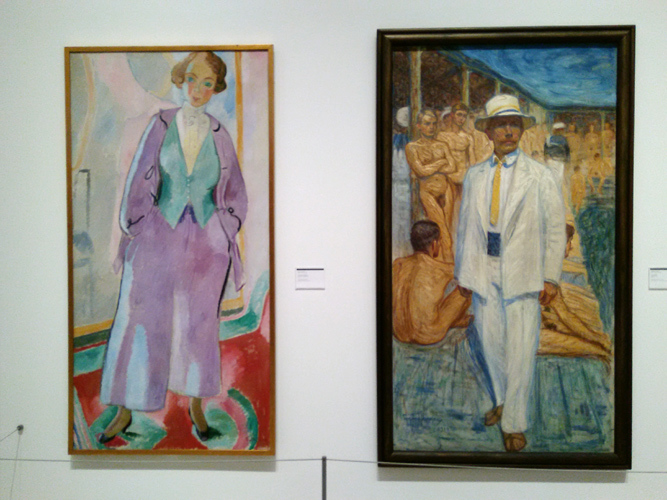
The exhibition “Artist”, which is held at the Moderna Museet branch, at first glance seems very strange. What might be absurd than such a name - probably, only the exhibition "Art". In fact, this is one of the most thoughtful and interesting projects that I have seen in recent years.
The exposition is collected from works included in three collections - Moderna Museet itself, the National Museum and the Royal Academy of Arts. There is Rubens, and Cindy Sherman, and Hilma Aflint, and Vasily Kandinsky, and Swedish artists are more likely known in the local context. Moreover, all exhibits are placed without any pronounced hierarchy: a familiar practice is painful to put a conditional “hit” somewhere “in the center” here in the root is suppressed. The “Bicycle Wheel” (1913) Dyushan is pushed into a corner and closed by other works, and most of the paintings are grouped thematically into small blocks. There are no first and last, everything is on a par. This is very contributed to understanding of art. The only exception was made for Rembrandt, but it was allocated by placing in a special box, only for security reasons.
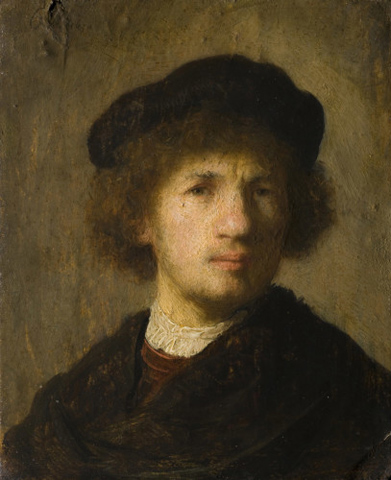 © Nationalmuseum Rembrandt Harmenus van Rhine. Self -portrait. 1630
The team, which was engaged in the exhibition, consisting of six curators, proceeded from a simple idea - to show how artists see themselves and how they look in the eyes of others. It is not surprising that the exhibition has many portraits and self -portraits. The exposition itself is divided into five zones: the first tells about the artist as an entrepreneur, in the second - as an avant -garde, in the third - as a nonsense of social moral standards, in the fourth - as a visitor and, finally, in the fifth - as a traveler. All these are different strategies.
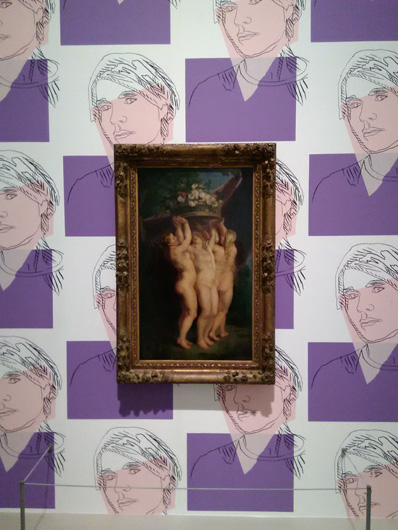 © colta.ru Andy Warhol. Faximile wallpaper "Self -portrait". 1978. Peter Paul Rubens. Three grace. 1620–1625
The entrepreneurial side is understood quite widely: not only the famous lovers of rustling bills Andy Warhol, Jeff Kuns and Salvador Dali are represented in the first zone, but also court artists (this, of course, is more bureaucratic role than business). Dali, nicknamed the “loving dollars” and what only these dollars earned, appears to be a guest of the American television show, and Kuns teaches children (read: other artists) how to achieve success. German artist David Klekker Ehrenstra, who worked at the court of several Swedish monarchs, portrayed himself in the center of the allegory, surrounded by two ladies - fantasy and painting. If you are an entrepreneur, then it is better to forget about modesty.
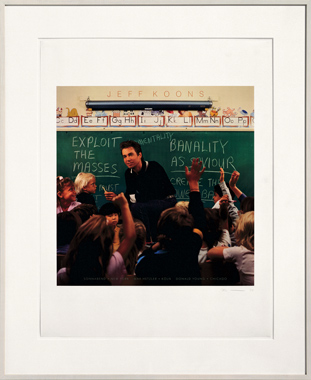 © Jeff Koons Jeff Kuns. Portfolio of art advertising. Fragment. 1988–1989
The curators selected one job for the same zone, which speaks a lot about artistic success. This is a series of 18 portraits of artists, including self -portrait of the author of David Robbins, under the general name “Talent” (1986). The more time passes, the louder the names sound and the less recognizable others become. This is an extremely defiant, shocking job. The context of this series is the race, and some run more slowly than others, the hands themselves reach for someone to remove and remove it. And when you realize this, no matter what democratic views you adhere to, you even experience some inconvenience.
The artist in the role of the avant -garde, the discoverer and genius from the entrepreneur is not so far. The ego is prohibitively inflated, but instead of money, reputation and achievement are more appreciated here. One of the works selected in the same section is the self -portrait of the Swedish artist Tyura Lundgren in 1921. By itself, it is not that special. But it so happened that the catalog designers placed this particular work on the cover, and stylized it under a glossy magazine (inside the catalog is quite ordinary).
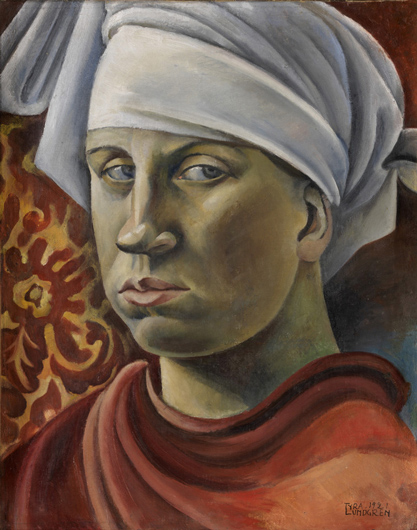 © Moderna Museet Tyura Lundgren. Self -portrait. 1921
The authors themselves begin to imitate the behavior of not only prophets, but also the monarchs with military leaders (the abundance of the militaristic imagery in artistic discourse is confirmation of this). The Swedish artist Karl Gustav Plagemann portrays himself at work in the workshop, a military uniform is worn on him, a gun is leaned against the frames and subframes near the wall. The author portrays himself in color and especially his form. Of course, this situation has a background: the artist came to study in Italy, where he participated in revolutionary events in 1849. But Plagemann clearly indicates the connection between art and the violent reconstruction of the world, whether it was war or revolution.
In the third zone, the viewer sees how art crosses and spends in a new place a line that separates what society is ready to allow him, and what is still forbidden. The Swedish expressionist Isaac Grunewald depicts the writer Ulla Biern dressed “like a man”, as then, in 1916, it was thought. Nearby is a self -portrait of another Swede, Eugene Janson, in 1910 - behind naked people with a clear hint of a same -sex love that was in Sweden at that time prohibited. There are also several portraits of women artists-they were not noticed or forgotten. One of these paintings, written by Richard Berg in 1889, depicts the artist Eve Bonnir. As the exhibition is correctly noticed, practically nothing indicates nothing - except for the name of the picture - the fact that we are an artist, it corresponds to the then “norms of femininity”, which assumed not only certain clothes and hairstyles, but also classes - work in the house, except that the pose in which she sits is not strict enough for those times.
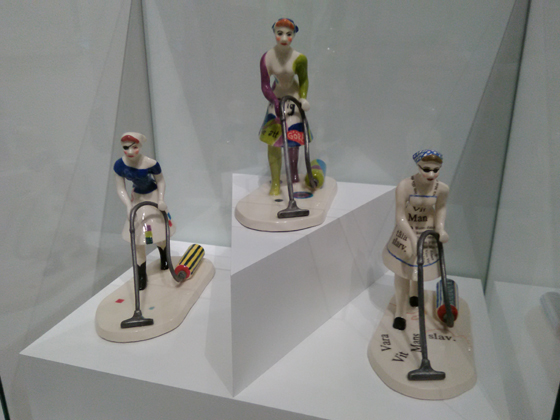 © colta.ru Hittan Jonson. Vacuuming ladies. 2011
Visionnaire artists are generally connected with artists-verification. “Semiotics of the kitchen” by Marta Rosler, which is shown in the fourth zone, could be in the third, as well as the already mentioned Dyushan Redi-Mad, the black and white Suprematic composition of Casimir Malevich or the porcelain figurines “Home slaves” Hittan Yonson.
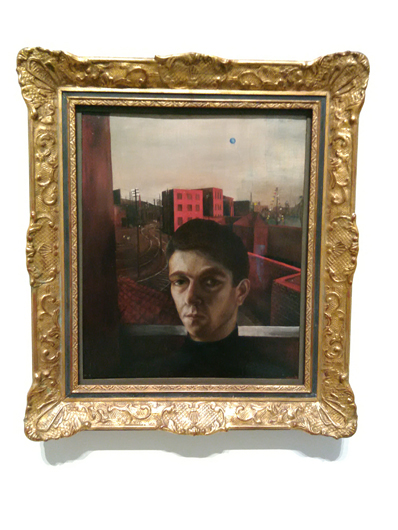 © colta.ru Peter Weiss. Self -portrait. 1938
However, visitor visionals are here: this is primarily Peter Weiss, a German artist who lived in Sweden. His small self-portrait with a blue ball flying in the background, and even in a massive, dazzling-gold frame, is somewhere on the verge of incredible vulgarity and a penetrating statement. A visionary can usually leave a very unpleasant impression of himself - simply because it happens from reality and often returns to it by a prophet, in this sense, Hilma Af Clint, Malevich and the Orthodox icon with the life of St. Nicholas are adjacent here.
Finally, the final hall is dedicated to the traveler. As specified at the exhibition, this role breaks up - it can be a colonialist, reporter and critic. The viewer sees the absolutely orientalist “hunting for a lion” by Eugene Delacrois and a series of photographs of the Norwegian artist Vibeke Tandberg critical in relation to the paternalistic Western approach: she brings food, medicines, knowledge and kindness to the inhabitants of Africa as an employee of the European Fund. It looks completely obscene - the narcissism of the benefactor against the backdrop of other people's suffering. But often, artists themselves who come to the residence or on the Biennal in some depressive region, where their role is to throw a bridge built from art works between business, authorities, etc. are on the site of criticized in this work, are criticized in this work.
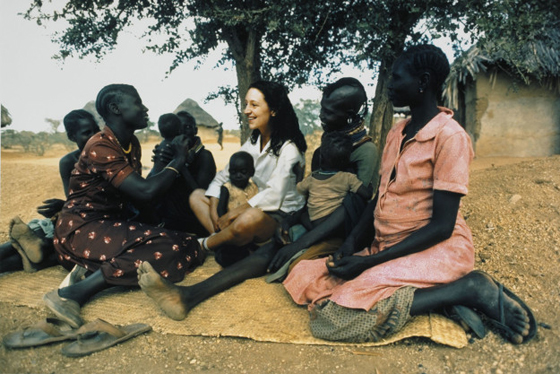 © åSA Lundén / Moderna Museet Vibeke Tandberg. #2. From the series "Consequence". 1994
The exhibition, of course, is representative. But something was still missing. And since on the same day when it opened, a gallery night passed in Malmo, I ended up in a small Artist Run Space - Rostrum gallery . There was an exhibition of graphics of the London team Le Gun . But the most important thing I saw there was not at all on the walls.
At the entrance there was a girl who almost simultaneously counted visitors, made loud ads, handed out the incoming curatorial texts, carefully inserted into transparent files, and took them away from the departing ones. In addition, she tried to find a moment to take a sip from a bottle of beer standing on the windowsill. She was tired and excited, confused in words and constantly blinked.
I went to her and asked what she had to do with the exhibition. It turned out that she is an artist, her name is Helga Stepan. Like several dozens of artists, she is engaged in this space. It was she who proposed to do the exhibition Le Gun , however, Helga does not pretend to be the curatorial status. She has to consider incoming people, because in order to receive state funding (in Sweden, as in Norway, there are programs for supporting such artistic initiatives), you need to reinforce your applications and reports with data. In short: more people began to come to us - give more money. Well, the distribution and collection of texts were associated with savings. Although Rostrum sold food and drinks almost at store prices, unlike museums, there are barn. That is, finances, but ethical coordinates - first of all, democracy - are not forgotten.
Helga briefly told her biography (I would be surprised if she had not done this). She studied at the London Royal College of Art . Lives between the British capital and Malmo. “More, of course, I am in neighboring countries,” the artist admits, “therefore, for example, about the art process in Finland, Norway, Denmark, Germany and England I know more than what is happening in the native Malmo.”
The meeting with Helga was the continuation of the exhibition "Artist" for me. She turned out to be a traveler, an entrepreneur, and a visionary, judging by what I then saw by studying her work. Surely other artistic hypostases in it also somehow get along. True, if at the exhibition in Moderna Museet hints in a romantic man, that these roles were chosen by artists themselves (which, of course, illusion), then Helga, like hundreds of thousands of other contemporary artists, all this is the result of compliance with the art education system, the requirements of institutions, widespread opinions about what and how they should do, how they should live. And she understands it perfectly.
Download the entire issue of the magazine "Disagreements" (No. 8) "What is an artist?": PDF , mobi , epube