
Translated material
Wounded landscapes
Essay Frank-Walter Steinmeier about historical memory and modern conflicts in Eastern Europe
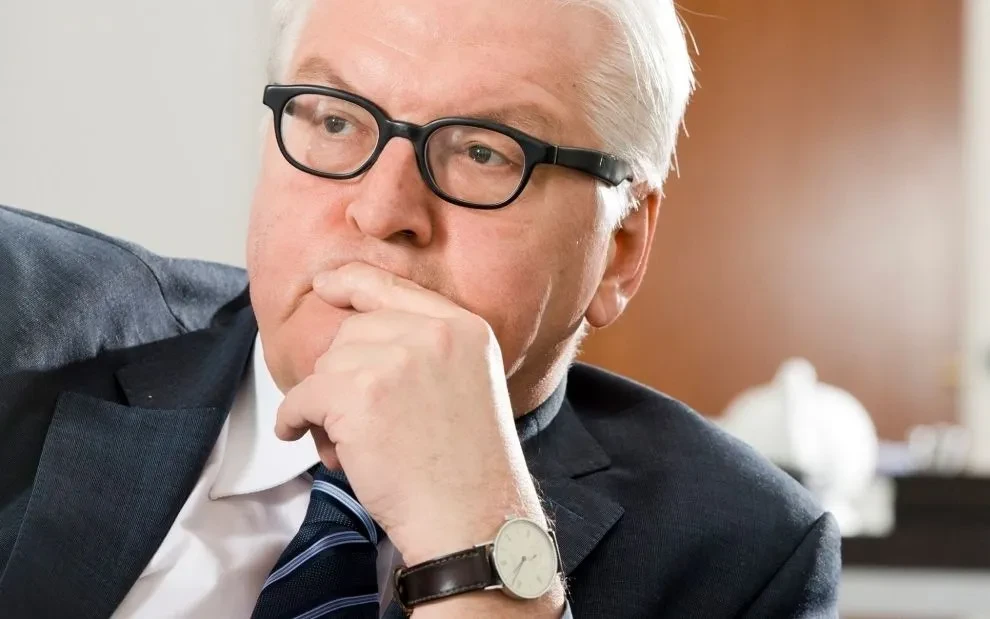
Frank-Walter Steinmeier,
deputy of the German Bundestag,
Federal Minister of Foreign Affairs of Germany
Juicy greens, birches and bushes in the background; A gentle slope, and in front are summer flowers blooming white. I recently saw this photograph of one East European landscape at an exhibition in Berlin. She was shot near Mizoch, a town in Western Ukraine. And this reminds me of many wonderful vast landscapes of a single region, in which in recent years I have traveled so often as in any other corner of the world. Ukraine, Russia, Belarus, Moldova, the Baltic countries - the east of our common continent is the priority of my daily work as the German Foreign Minister.
At that Berlin exhibition, I came across other well -known names for settlements to me: Minsk, Riga, Dnepropetrovsk, Kyiv, Odessa, Chisinau, Dubossars, Pavlograd, Artemovsk. I traveled all these settlements in only one last year. Indeed, in these landscapes today conflicts and tension reign, which are fateful for the safety and future of Europe; Moreover: who returned the issue of war and peace to our continent. We, representatives of German foreign policy and our partners, are performing - to the best of our forces - for peace and mutual understanding in the east of our continent, in particular, in conflict in eastern Ukraine.
But - and this “but” weighs a lot - under these landscapes, under “here” and “today” are the layers that connect us, Germans, much deeper, much more fateful with this region. 75 years ago, with the attack of Nazi Germany on the Soviet Union, a fighter, aggressive war of unusual cruelty began. More than 25 million people in the Soviet Union lost their lives - most of them are civilians. Among them were more than two million Jews. Already in the first days after the attack of Nazi Germany, massacres began, which soon grew into systematic mass executions in all the occupied territories of the former Soviet Union. This is the horror that lies under these landscapes. No matter how beautiful the landscapes that I described: these are wounded landscapes.
Also under the landscapes that I described at the beginning, there is darkness. At the end of June 1941, Mizoch was occupied by the German Wehrmacht. Between the beginning of August and the beginning of November 1941, 25,000 Jews shoot in this area. In the spring of 1942, all the Jews of Volyn must go to the ghetto. At the end of August, the civil administration agrees with the security police commander for five weeks of all Jews, with the exception of 500 qualified specialists. On October 11, the ghetto is surrounded, on October 13, they are blocked. The Jewish residents of Misoch are arson to make the escape possible to some prisoners and prevent their property entering the Germans. The fire is extinguished and Jews are driven to the city square. From there, on October 14, they are allocated outside the city. 1,500 Jews and Jews are taken in groups to one of the hollows, they must undress, then they are killed by one shot in the back of the head - it is in this green meadow from the photograph.
I want to once again name other settlements, Minsk - 55000, Riga - 45000, Dnepropetrovsk - 16000, Kyiv - 35000, Odessa - 20,000, Chisinau - 1500, dubossars - 5000, Pavlograd - 1500, Artemovsk - 1,500. This is the number of Jewish women, men and children who were shot in the indicated cities. For the first time, the exhibition in the Berlin Fund pays the attention of the topography of the horrors of these mass executions. At the entrance to the exhibition premises there is a map. It shows the territory from the Baltic to the Black Sea. A lot of black dots are applied on the map. Each point on the map means a place where more than 500 people were shot. The places that I spoke about is only 10 of them. There are 722 points on the map. 722!
For me, first glance at the card was a shock. And I think, for many Germans, the card is also a shock! But - for most people in the relevant regions, she is not shock! Much worse: this is a manifestation of a very modern memory. Many people are there, it is the older people who know these black dots and their history. They know about silent, terrible places near them; Mass graves overgrown with green grass. Jewish communities and members of the gypsy minority at one time were part of everyday life in cities and villages. Today they have disappeared from most settlements, and people there still live in dark memories. They live with the realization that their parents, grandfathers and grandmothers during executions helped to dig or fall asleep graves, sort the clothes of victims or had to cook food for killers. These landscapes, if you like, are topography of terror.
The Berlin exhibition removes landscapes and sheds light on the details of the past, which is not only the East European, but also our past. Therefore, I see the liability of the Federal Ministry of Foreign Affairs in withdrawing those layers. The Federal Ministry of Foreign Affairs supports the Protecting Memory project (“Save memory”), within the framework of which places of mass executions are preserved. Five such places in Ukraine have been equipped in recent years as memorials. In the spring of this year, seven subsequent places should be added to them. Also, the organization of Yahad in Unum, which is supported by the Federal Ministry of Foreign Affairs, takes care of selflessness, worthy of admiration, about the localization of mass executions in Eastern Europe.
An example of this little lit “Holocaust by Bullets” (“Holocaust - Murder by bullets”) shows that we, Germans, know much worse the stories and scars of those multi -layer territories of Eastern Europe than we would like to think about ourselves. And one more thing: yes, also in the understanding of our own role there we have not advanced as far as we like to think about ourselves. That is why I consider it so important that we, at a time when the new tension reigns in the east of our continent, the more actively engaged in this region. Right now, we must know more about each other - and not less! The Berlin exhibition will contribute that the names of cities such as Riga, Kyiv, Odessa or Chisinau do not sound in the Germans’s ears as a reminder only about today's events. On the contrary: they will remind us of the Holocaust of mass executions and remove numerous layers and stories, as well as ethnic changes and aberrations that lie between “then” and today's surface.
As the German Foreign Minister, I am convinced that without awareness of these layers under the landscapes, we Germans - with all honest efforts by mutual understanding, will never be able to fully and fairly evaluate this region and the role that we play there!
We, today's Germany, cannot change what happened. But we must learn from history. We must take the responsibility that our history has on us. More piercing than this can be expressed by the language of foreign policy, a call to justice in one poem - “Babi Yar” Evgeny Yevtushenko is expressed. This week, for the 75th time, we honor the memory of the victims of those cruel two days when 33,771 Jews in Babi Yar under Kiev were shot. Also, this verse tells about the layers of the landscape, which descendants - also today - must shoot.
“Over Babim Yar the rustle of wild herbs.
Trees look menacingly
in a blessed one.
Everything is silent here silently,
And, having removed the hat,
I feel,
How slowly gray.
And I myself
like a continuous soundless scream,
Above thousands of thousands of buried.
Nothing in me
It won't forget about it! "
(Evgeny Yevtushenko, Babi Yar, 1961)