
Translated material
Self -government instead of arbitrariness
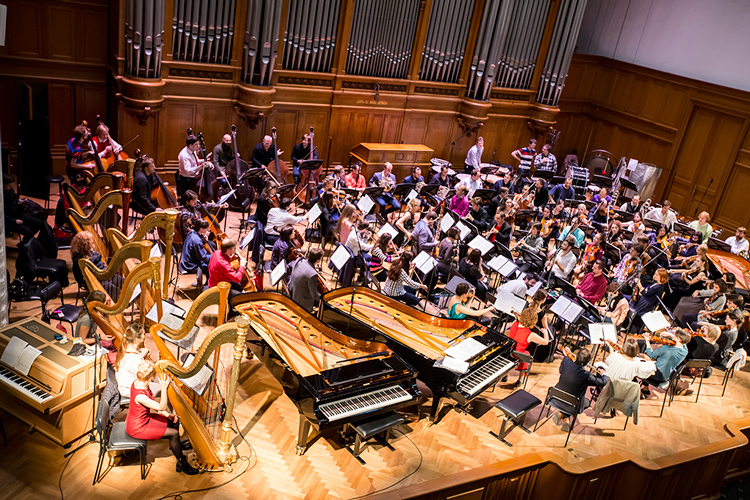
The first symphony ensemble (abbreviated-Persimphans) is an important phenomenon of the 20s of the last century, which broadcast the ideas of conscious equality and collective labor. His main feature was the lack of a conductor. Of course, someone had to ensure the necessary consistency of the large number of musicians, the role of the accompanist increased (the key figure was violinist Lev Zeitlin). But still, playing the music was without hanging over the orchestra mass of the sovereign leader with a conductor wand, who was decisively leading behind him. Instead - the responsibility of everyone, collegiality and principles not of an orchestra, but a chamber ensemble, only overgrown with almost 100 people.
The team, consisting of high -class musicians (for example, included the Bolshoi Theater orchestra, rehearsing in his free time from the main work), existed from 1922 to 1932, and performed in the large hall of the conservatory, as well as in factories and factories. In 1927, during his visit to the country of Soviets, Sergei Prokofiev performed with him, playing his third piano concert, and remained in great delight. Nevertheless, the twentieth century turned towards conductors and dictators, Persimfans and the orchestras created in his likeness in other cities and countries did not survive.
In 2009, this idea was revived by a group of young Moscow musicians under the guidance of a tireless multi -instrumentalist Peter Aid . But this was already a phenomenon of underground order, pretty, but not status, something from the category of the children's creative zone. And for the first time, the utopia reconstructors were allowed to the sacred scene of the large hall of the conservatory, which had long forgotten about the social experiments of the 20s. And it turned out that Persimfans-2 is a serious musical power, with the help of its alternative organization, revealing new creative reserves and simply-a new fascinating life of old forms.
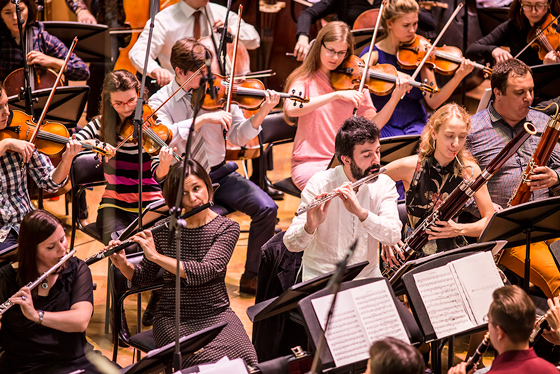 © Irina Polar / Apriori Arts Agency
Musicians, dressed someone in what is it, are sitting facing each other, and even to the public - as it turns out. Strunniki stands on the stage around, inside of which are wooden winds, from the outside in the depths of the stage - copper. The picture is complemented by a line of eight harp and four piano, they are needed for the final salvo - the Prokofievskaya Oda at the end of the war, where, in addition, the scores have still wind, drums and smuggles, and high string are missing. The atmosphere on the stage reigns relaxed, up to the point that the late Mikhail Dubov - one of the four pianists - goes to the stage already during the sound of music.
The impressive blockbuster of Prokofiev was guaranteed success. Like the “factory” of the constructivist of the 20s Alexander Mosolov-in order to deal with his effectively spinning gears, it seems, the conductor really does not need too much. The brutal opuses of Mosolov and Prokofiev performed in the second department were diluted with two mysterious works, where Peter Aid, who was soloed by the piano of the “dreams” and the slow part of the piano concert, took over the unknown Simferopol composer Alexander Lebedev.
Another thing is the first compartment: the overture for the Parsifal of Wagner, the “magic lake” of Lyadov, “Romeo and Juliet” by Tchaikovsky, that is, the most conductor's kingdom. The execution of these works by a self-governing orchestral mechanism (as a seed, while the audience was still settled, the inventor Alexander Zenin reproduced Rakhmaninov’s salt-minor prelude on the mechanical pianol). It would seem that the notes are the same, but it is worth getting rid of the hypnotizing back of the central character and ritual orchestral dressing code with white shockers and butterflies-almost other music is obtained.
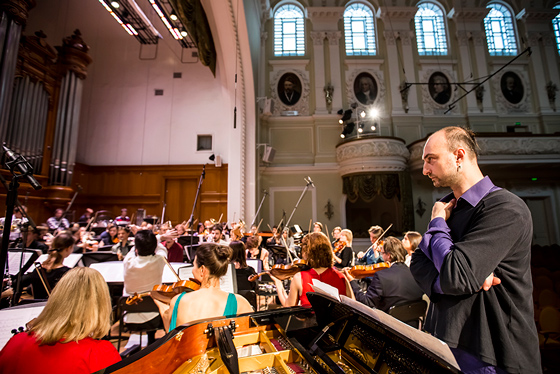 © Irina Polar / Apriori Arts Agency
Not subordinate to someone else's will, the music periodically thinks a little in one place and does not go anywhere. But the sound is beautiful, voluminous and trembling. It seems to be first formed by a cloud above the stage, and does not fly directly into the hall. Emotionally what is very capturing. It turns out that the combination of heterogeneous individual energies acts no worse than a high -tech and a fragmented orchestral conveyor. It is quite obvious that all the musicians listen carefully to each other, everyone is equally included in the process, although some are delegated by the powers of coordinators-concertmasters. It is difficult not to notice the impulses that emanate from the violinist of Marina Katarzhnova or the flutist Ivan Bushuyev from the violinist sitting to the public, although their functions are not advertised.
However, not everyone is recognized, next to the already famous musicians - beginners, students. The call to gather in the orchestra was posted on the Internet. In total, 112 people were gained in this very crowded in this very crowded Persimphans in the latest history of Persimphans. There were four rehearsals - as it is now accepted in ordinary orchestras. Thus, orchestral self -government successfully contrasted itself with conducting arbitrariness.
This action, which can serve as an ideal illustration of various types of social structure, is worthy to go into history. But, unfortunately, it was not quite successful to complete the practical task posed to it. A charity concert called “Stand and Go” annually organize the Apriori Art Agency and the “Addresses of Mercy” fund, its goal is to raise funds for the rehabilitation of children with cerebral palsy. And here it is clear that the more the public, the better. But the audience nevertheless prefers not collective equality, but just the idol star-for example, conductors. So conscious musicians came to listen to a very small number of conscious listeners.