
Translated material
The effect of the butterfly. Insect pheromones will kill them themselves and save the grain

("Wikipedia")
Every year, the same problem arises at the bakery and confectionery factories of the Leningrad Region - the damage to grain. The reason is the mill firing. This butterfly is the pest of the stall for literally all products. Special conditions in the warehouses help to preserve not only the food, but also the insects. Recent studies of St. Petersburg scientists from IEFB RAS under the leadership of Oksana Selitskaya proved the effectiveness of the mass capture of winged overlaps using synthetic sexual pheromones.
Acquaintance with a trap
The pheromone trap is nothing more than a small triangular tent with an adhesive surface inside. However, only inattentive will be in such an ambush. So do not protect the provisions. Flies Feromon butterflies into it. They are impregnated with traps.
Pheromones are special substances distinguished by the female. They inform the males about her readiness to multiply. Thus, only male individuals fall into the trap. And without the “strong half” of the population, the continuation of the genus becomes impossible.
Unlike such methods of combating insects such as fumigans, crayons or tablets, sexual pheromones are almost safe. A person only needs to wash his hands with soap after working with them. The action of substances is aimed only at certain types. A warm -blooded animal and a useful insect also threatens nothing. Pheromones, or rather their chemical analogue, do not cause any harm to the environment. They decompose under the influence of sunlight, temperature and moisture both in the fresh air and in rooms.
How do the experiments begin
There are only two places for “testing” pests: laboratory conditions (in vessels with a volume of about 3 liters, as well as in an olphometrometer with moving air) and directly at the enterprises themselves. To understand how to get rid of the winged eater, to start them had to be bred.
In the grown generation of mill firewalls are the descendants of the real inhabitants of the bakery of St. Petersburg. Explust butterflies pass the hard "casting". All of them are of the same age and are able to mate. Not only their marriage behavior is investigated, but also the reaction of males to a synthetic analogue of pheromone.
For the catch of mill firing, mainly triangular traps are used, described at the beginning. Their adhesive surface is slightly larger than the area of the A4 sheet. To find out, which designs are most effective, two more are tested: a trap of a tone (as for ordinary flies) and a trap-living room. In addition, researchers need to answer one more important question: what is the distance between traps optimal for destroying pests? It can be determined only in production conditions. It was decided to release, and then back to catch the remaining marked males. All this will happen with a gradual distance of chemical traps from each other.
How effective are traps in warehouses, they will be checked according to two criteria: the number of men's caught males and the number of fertilized females. Absolutely all butterflies will be calculated both on the walls of the room and on the equipment.
Servation medium

You can effectively fight the winged enemy only knowing him in the face. Researchers calculated the most popular pests, the place and time of their raid. On the bakeries of the most numerous was a millstone. Others - dried fruit and southern barn - actively help her eat up reserves. Confectionery factories are attacked by a mill -fire and cocoa that is familiar to us. However, butterflies are not the only raiders. In their company and small flour Khrushchak. Although this beetle does not flutter from place to place (its wings are underdeveloped), it does no less harm. His lunch becomes flour, cereal, bran. Less commonly - affected cereals, nuts or dried fruits. He does not recognize only legumes, rice, barley and oats. It is with these types of insects that you have to fight intensely. The rest of the pests are few. For example, a horned Khrushchak, a Surinam mukoed (also a small beetle) or a firing firing arrive at factories only with parties of infected raw materials.

( http://lepidoptera.crimea.ua )
According to the observations of scientists, the movement of the army of butterflies is associated with the movement of flour in enterprises. The fire occupies all storage facilities, bunkers for the accumulation of flour (in the production case) and a doughwing.
The number of mill firing directly depends on the temperature, humidity and quality of the products. The mating season in butterflies lasts all year, but in summer and summer insects breed especially actively. It is at this time that the room temperature reaches 26 ° C, which is ideal for pests. In such conditions, 6-7 generations of raiders are born. They replace each other after a half to two months.
Biologists have found that at different enterprises, the number of insects increases at about the same time. This is due to similar conditions in confectionery factories and bakeries. There is a demographic explosion at the end of February - beginning of March, although in St. Petersburg behind the windows even below zero.

The influence of other organisms with which pests interact is small. Consider this on the example of the Venturia wasp. This insect parasitizes on the caterpillars of the mill firing and on the parasite of the small flour Khrushchak - Bethylidae (one of the families of primitive OS). However, the rider did not cause any mass death or a surge in the birth rate of butterflies or beetles.
Slaughter elixir
The most effective traps for catching pests contain a special component. This is a sexual pheromone, on which males fly in search of a female. This substance not only lures male individuals, but also determines their behavior exactly. Each representative of the mill firing performs a marriage ritual. There are five main stages: the movement of antennae, running and taking off, flight to the “source” of pheromone, landing on it and an attempt to mate. An effective synthetic analogue should awaken the same reaction in insects.
From the "original" hormone, scientists identified two substances. One of them is the main one and is part of the sexual pheromones of each mill fire. The resulting element attracts absolutely all males. Insects repeat their wedding ceremonies, not suspecting insidious deception. It is this substance that is used for traps. Other is not studied. Its functions are unknown.
Testing of synthetic pheromone in the olphometrometer complement other observations. The butterfly reaction is studied directly on the created triangular traps. Those males who are half a meter from the trap begin their marriage ritual. When the distance is reduced to 30–40 cm, only 6% of male individuals avoids the trap. In most cases, the butterflies land next to the trap and no longer move. Perhaps because of their addiction to synthetic pheromone. No more than 4% of pests are selected alive from the "networks". Although insects do not die, the search for a female becomes difficult for them.
Mass capture of males using pheromones sharply violates the ratio between the sexes. It becomes difficult for male individuals to navigate in space and look for a couple. However, a mating delay increases the life of females and the time of their readiness to multiply. This negative consequence is compensated by a decrease in the fertility of butterflies and the viability of eggs.
Production practice

After laboratory experiments, pheromone traps begin to be checked "in the fields." The tests showed that one trap is enough 1-1.5 mg of artificial hormone. But the exact numbers are necessary not only in the dosage of the substance. The distance between the traps and the level of their placement are important factors of effective capture. For example, in rooms with high ceilings and low pests, the trap can be arranged one and a half meters from the floor. If insects densely settled the enterprise, then the height decreases to half a meter.
Often in factories you have to put traps in the neighborhood of the equipment or in front of the wall. Biologists have proven that under such conditions adhesive traps properly catch winged overlaps. The optimal distance between pheromone traps is 2.5–5 m. Scientists tried to more clearly define the range. But the difference in the number of caught appears only when the trap from the butterfly is 7.5–10 m.
There is an opinion that insects that have entwent in a trap reduce its effectiveness. The results of the experience of St. Petersburg researchers refuted this. According to statistics, the injured pests do not affect the effectiveness of the trap, do not “clog” it and do not frighten their relatives.
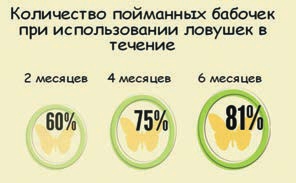 From all kinds of pheromonic traps trap and triangular traps are best neutralized by the mill. Zhivolovka with butterflies copes much worse, which is most likely associated with the shortcomings of its design.
The use of pheromone traps in enterprises reduces the size of the pest and does not allow it to increase sharply. This is environmentally friendly. The toxic load in the factories is reduced, the workflow is not violated. The minus of this method is one - all this does not work instantly. The effect has to wait for at least three months.
The highest efficiency is achieved when using traps with simultaneous processing of the premises. In this case, about 93-95% of the milling fire is dying, which allows you to maintain the food practically untouched.