
Translated material
Malinikha. The pride of the courtyard
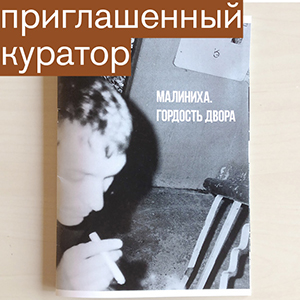
This year, Colta.ru decided to go to the experiment and invited to temporary curators over the section “Photo projects” of young and talented representatives of leading Russian photocurium. We divided the calendar year between six curators and asked them to select the most interesting samples of modern Russian photography for publication.
Invited curators
Katerina Zueva , center of photography named after Brothers Lumier
Nadezhda Sheremetova , "Femicip"
Sergey Lostev , "House of Metenkov"
Daria Tuminas , Freelance Curator, Amsterdam
Anastasia Bogomolova , The Blog This a Photobook
Svetlana Taylor , British Higher School of Design

Fifth resident: Anastasia Bogomolova. An artist working with photography, installations and performance. The circle of close interests includes topics of the mobile nature of memory and oblivion, the boundaries of the existence of the archive and document, as well as issues of mythology and self -identity. Curator and lecturer; researcher, collector and author of the photo book; Flog editor This is a Photobook. Graduate of educational programs "Photode Department". Participant of Savignano Immagini Festival and Bitume Photofest (Italy), Pingyao International Photography Festival (China), OBSCURA Festival (Malaysia), “Fashion and Style in Photography” (Moscow), “Month of photography in Minsk” (Belarusian). The works were also presented as part of group projects in St. Petersburg, Moscow, Kaliningrad, Rostov-on-Don, Norilsk, Perm, Yekaterinburg, Kazan and other cities. Personal exhibitions were held in Moscow, Yekaterinburg, Nizhny Tagil and Chelyabinsk. Lives and works in the Urals.
Anastasia Bogomolova about the "useful properties" of the photozins and about the photojin Evgeny Petrachkov
The critic, curator and editor of the advanced online magazine Conscientious PhotoGraphy Magazine Yorg Kolberg complains about how often he can hear the question: “Do all photographers should release photo books?” The answer seems quite obvious: no, of course. “I personally don’t think that someone should feel any obligations about whether many others should do what he is doing,” Kolberg explains. - The first reason for the existence of the photo book: it should make sense for its creator. So, if the publication does not matter to you, just do not do it - and the task is solved. ” I would add to the Council of Criticism more: if the author doubts whether he needs to release a book (or is he enough material for a full -fledged big job), let him try to begin with Zina's format.
It is only at first glance that such low -trip editions of a magazine type appear to be simple and optional gizmos. In fact, Zina - satellites of a photo book culture - are a progressive and even provocative part of photographic practices. Of course, they are able to be just a tool for creating a certain visual product that does not seek to get the status of an ambitious project. But in addition to this, Zina can act as an experimental platform for the rapid development of the artist’s ideas or perform the function of a sketch, a prototype for something that will acquire a large finished form in the future. But no matter what task the photographer in the end, Zin, is in any case a good (and often less expensive) option to declare your work.
The “Malinikha” of the Izhevsk documentary photographer Evgeny Petrachkov is one of the latest examples of such a modestly executed, but smart and successfully folded zina, which has the potential for an expanded publication. Its name is the toponym refers to the old sleeping area on the outskirts of the capital of Udmurtia, behind which the reputation of the local ghetto was reached, in the 1990s filled with gangs.
Built mainly by serial Khrushchevs, this territory incorporated the equally similar fate of several generations of residents. “I think my childhood and youth story will be just as slightly different from the stories of friends, neighbors, like the interiors of our apartments. We went through about the same thing: beating windows, the theft of linen, climbing garages, parties at the entrances and in the porches, the delivery of scrap metal, the manufacture of mini-bombs, ”says Petrachkov about the project.
The photographer represents a set of such plots on 17 leaflets of A5 format, supplementing them with the content at the very end of the photozin, where the keywords listed by the column are more likely on tags than on the names of the chapters. Loneliness, poverty, past, friendship, courtyard, leisure, porch, creativity, behind the house, relations, trap, future, salute - the author does not give any indications of the pages, and therefore the viewing of the publication turns into a swim in the free style, the intermediate marks in which the viewer himself determines.
The boundaries of the headings are mobile and sometimes superimposed on each other, making some frames by the focus of several meanings. So, an awkwardly stuck in a fence grid from the penultimate U -turn Zina seems to have frozen at the borders of the sections “Relations”, “Western” and “Future”. On the one hand, it indicates the nature of the interaction of residents with the environment surrounding them (“connections that are so important inside the region lose their significance beyond its borders, and therefore people seek to stay in a familiar and familiar world”). On the other hand, it captures the laconic, but a bright image of the closeness of the territory (“Residents reluctantly leave Malinikh”), but at the same time hints to escape from this mothballed place in time.
In addition to the title on the cover and indefinite content in the publication of Petrachkov, there is no more text, and this makes it sketching not only the Izhevsk district, but generously scattered throughout the country of the same raspberries and even more rages within many of us.