
Translated material
Euro. Not long
From October 14 to 16, the CDC will host the Festival “The Highway of a Short Meter 2MorROW”. In addition to the competitive program of 16 films/m of films, as well as the short -term directors of the “large” directors - Jia Zhanke, Abbas Kiarostami, Denis Kote, Bertrand Bonello and Lava Diaz (yes, he can shoot films in short three hours) here will show the selection of the best works of the main European film schools: La Fémis, DFFB, Vienna Cinema Academy and Kinokol In Lodzi. Maxim Semenov carefully watched the work of European excellent students and found certain national trends in them. About them - below.
An endless stream of people and events. Some young fathers, unsuccessful mothers, indecisive brides, young actors, circus shirts, teenagers with guns and children, a lot of children. All these characters are busy with important and often mysterious affairs. They fight with hellish pigeons, try to go to the world of the dead, confront mysterious doubles, steal babies, do not go to the wedding or just kill time in very boring work.
It seems that there is nothing in common between them. Unless all of them are characters of short films shot by students of European film schools: Vienna Film Academy, Film Schools in Lodz, Berlin Academy of Cinema and Television and Parisian film school La F é Mis . As part of the weekend of a short 2morrow meter, they will be represented by the Russian viewer, and he will already draw conclusions about the “main aesthetic and thematic landmarks of each of the film schools”, as usually states the language of press releases.
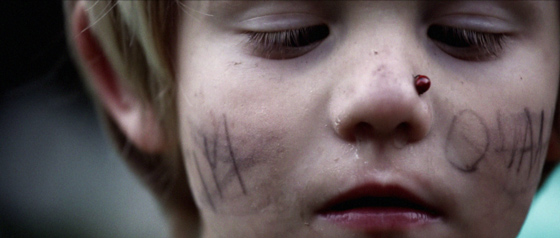 Frame from the movie "Milk Teeth", dir. Peter Brunner, Vienna Film Academy
To draw conclusions is not so easy. Already the films of the Vienna movie academy are completely different in handwriting and intonation. Okay, the “nonsense” Yasmin Bahartener, the lyrical “weightlessness” of Yannis Lenz or the touching “our song” of the Catalina of Molina ... But it is worth taking a closer look at how general features are found by themselves. Almost all the films of the crowns somehow turn out to be views on the youth, attempts to comprehend youth as a phenomenon. In the “Nelyud”, whose main character, the young actor and the wit-self-taught Yasper, tries to find the necessary acting intonation and plays the performance to the homeless, the message is rather critical. Bahartener draws attention to the ostentatious cynicism, indifference and, in general, the emptyness of their characters, who seek to turn into a joke. However, critical intonation is softened here by the author’s irony. The hero of “Our Song”, on the contrary, is a rather responsible person, and quite pretty. Koni is a young father, who is responsible for raising a three -year -old daughter. In the afternoon, he works in the post office, and in the evenings, when his daughter falls asleep, he goes to perform reggae in local clubs. Almost a child himself, Koni tries to brave to fight the blows of fate. And he does it quite charming. As for the “zero gravity”, it generally turns out to be a whole poem about young townspeople, born among SO SUY and street noise. Lenz mounts documentary surveys of Viennese tracers with poetic fragments performed by Fatima Mumuni, creating a magnificent and very lyrical narrative.
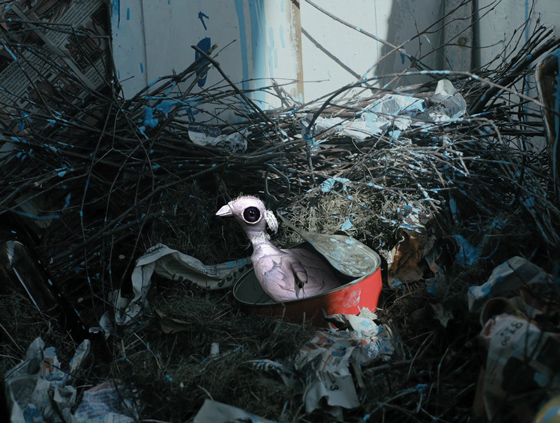 Frame from the film "Apocalypse" Justine Mytnik, film school in Lodz
Students of the famous film school in Lodz are quite thoughtful and gloomy researchers of human nature. This is especially felt in the “Apocalypse” by Justine the Mynik - a chronicle of the collapse of two young people, Maurice and Suzi. The heroes of the Mynik live on one of the upper floors of the panel house. In their fairly cramped balcony, infernal pigeons live, who report that Maurice and Suzi are sick and, in order to recover, must learn to look into each other's eyes. But is it possible to overcome disunity at all? Even sex does not give unity, and genuine intimacy is sometimes possible only before the very end. In the “science” of Amy Bughkhvald, schoolchildren should learn the classic poem by Julian Tuvim, in which Tuvim writes about the inability of school knowledge to give ideas about a real, rather frightening life. Poetic lines cause questions in children (sometimes quite serious), which parents cannot always answer. An equally impressive study of the human is the “guard tower” of the documentaryist Magda Yaroshevich. Here, it seems, nothing decisively happens. The heroine is alone on the tower. Time stretches slowly. Somewhere below the crowns of trees sway, clouds flow quietly upstairs. And the appearance of a random passerby suddenly turns out to be a real event.
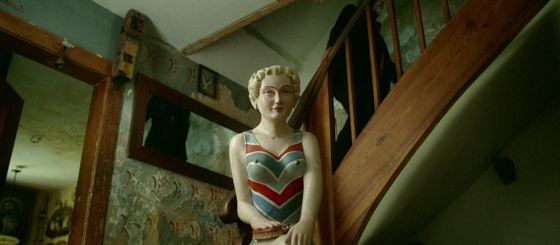 Shot from the film "Circus", dir. Emilia Shnnyoskaya, Cinemle Lodzi
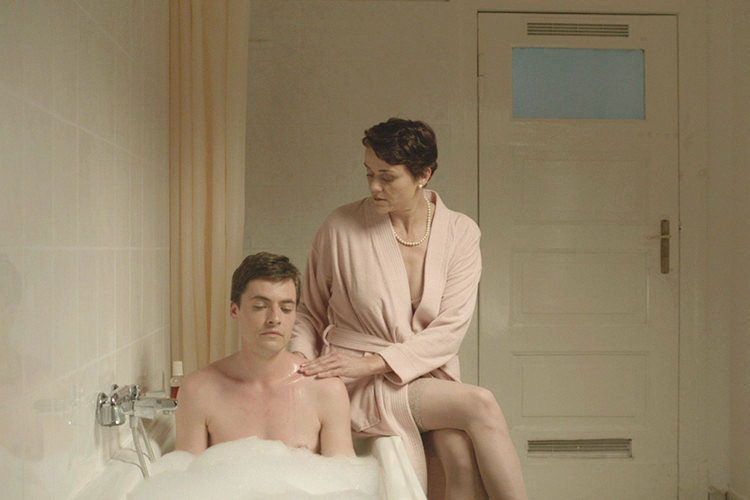
The Germans are actively interested in bodily and passionate about experiments with form and genre. Among the films selected for showing: Eliza horror, grotesque anti -utopia “umbilical cord”, Kafkian drama “Wedding preparations in the village” and the avant -garde documentary “Tomorrow”. In Eliza, Christina Stubert, a little girl is opposed by a loving, but too strict mother and a sinister double in dreams. In “Tomorrow” Cecil Tolla-Polonovsky, free fantasy on the theme of Hugo’s poem “Tomorrow at dawn”, a lively voice is opposed to the computer, and countless roads and airports appear in the frame. It turns out lyrical. It is striking that young German directors are actively interested in absurdity. In a rather ironic, even sarcastic “umbilical cord” (Eliza Petkova), whose grotesque is akin to the grotesque “Lobster” of Lantimos, verified to the smallest detail and the sterile world of the protagonist (work, gym, watching the TV along with the mother, on whom he is extremely dependent) is destroyed after a corporate party, which ended in sudden bisexual experience. The main character of “Wedding Preparations in the village” Judid Kaveochi is late for her own wedding, but cannot decide to cross the threshold.
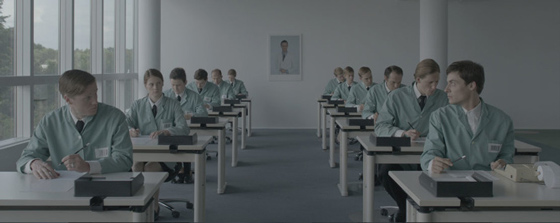 Frame from the film "Navel", dir. Eliza Petkova, DFFB film school
Graduates La F é Mis , like their Viennese colleagues, are interested in youth. But if the Austrians create a rather fragile world subject to invasion from the outside (whether it be the homeless of the “non -human” or mother from “our song”), then the French, rather, occupy actions and their consequences. Acts can be insignificant, at least at first glance. So, in the "purchases" of Vladilena the faithful boy tries to steal hair dye for his mother from the store. It would seem an empty story. Not enough money in the store. He put a box with paint under the jacket. Then he collided with the guard. However, a lot is happening during these few minutes. In the "Tag visit" Iris Caltenbek is a young mother, whose child died during childbirth, steals a living baby from the hospital. Her husband just returned from the army and knows nothing about the death of their child. Both heroes, both she and her husband, - in the recent past, children themselves. Theft of the baby will not bring happiness. In “pretend to be the dead” of William Laburi, a teenager Tom, who is attacked by older guys experimenting with home -made weapons, ceases to be a victim, showing generosity to his offenders. In the surreal fantasy, Caroline Zear and Jonathan Winl, “There is still rifles”, a teenager Joshua cannot go into the world of the dead after his friend who have committed suicide until he finds a new family for his older brother. Around the French province. Empty houses, deserted forests and fields. Young people from the Iceberg gang drive around the fields. All this is wonderful, strange and a little reminiscent of Alena Girodi.
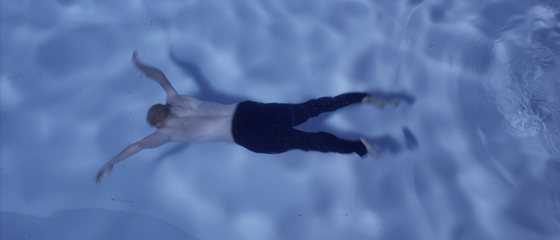 The frame from the movie "There is still rifles." Dir. Karolin and Jonathan Winel. Film School La Femis
Youth, absurdity of human existence, observation of human nature, the consequences of act-all these leitmotifs are, but still they are quite ghostly. In each picture there is too much distinctive, and in each collection there is a film breaking out of it; The handwriting of interesting authors is always stronger and brighter than the handwriting of the institutions that gave rise to them. Obviously, many of the directors shown at the festival will determine the face of European cinema tomorrow. Someone is doing this now-for example, the full-length film “Srileyka” by Eliza Petkova has already won his first awards at international festivals.