
Translated material
Time of destruction
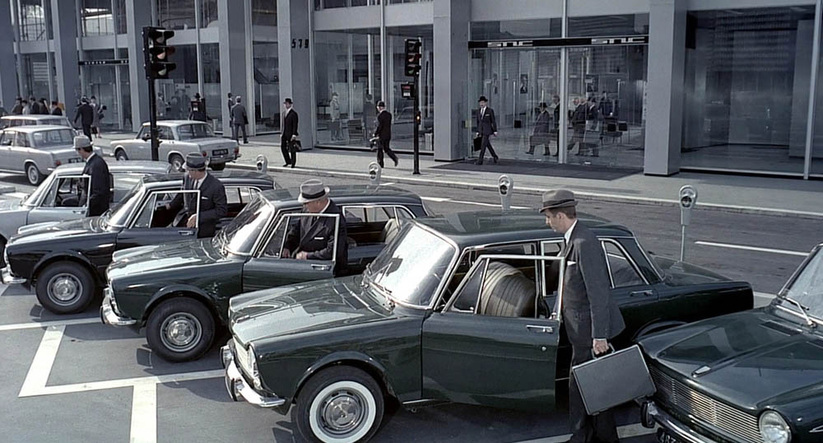
On October 15 and 16 , two shows of “Reflections” series will be held in the St. Petersburg “Motherland” (it is supervised by our colleagues from the magazine “Session”). This time the theme of paired sessions will be the architectural utopia-the totalitarian eclecticism in the “New Moscow” of Medvedkin and the monotonous modernism of Tati's “Entertainment Time” (with different attitude of the authors to the NTR, both films actively used its achievements: Medvedkin used innovative combined shootings, Tati-70 mm film and six-channel sound). Kiril Ass tells about the mutations of architectural styles (as well as about their temporality) by Medvedkin and Tati.
In 1938, the film by Alexander Medvedkin "New Moscow" was laid on the shelf. In the newspapers, he is defeated - but Soviet newspapers, as a rule, write not about what caused the ban on a movie or book. However, their resentment can be understood: the new Moscow turns out to be a secondary character - although it is declared the main character.
The film finds the capital of Soviet Russia at the time of its transformation into another city. This city, as the character of the film says, is “a monument of our era”. This era is busy with a hasty erasure of all sorts of traces of the past, permutation, shuffling its remnants, which ideally, as we will see at the end of the film, should not be visible at all. A new time comes, it is the last, completion of history. Monuments of this time could become possible if they were an excellent environment. But the environment, as Medvedkin shows at the demonstration of the “living model” of the new Moscow, is one with monuments, it is a monument and thus does not have items for comparison, a monument is generally all that the Bolsheviks build. The future shot on film is almost the present and finished. The comic hero artist Fedya is the only one who reacts to the current of time, to the expiration and completion of time - after which he will have nothing to write.
The architecture of New Moscow is unexpectedly close to the metaphysical landscapes of de Kiriko - and not only with its conditional classicism, but also in desertiness. Mechanically moving transport and the same mechanical movement of demonstrations do not violate this desert. Thirty years later, Mikhail Roginsky perfectly showed equality between the void and crowds of Soviet everyday life - they are equally inhuman in their non -leadership. The heroes of Medvedkin only slip out from the viscous crowd to which they belong, and the carnival masks only emphasize their affiliation. Even small companies that find themselves in the frame immediately turn into a single organism, breathing, speaking, singing and moving. In the crowd, individuals are ridiculous. Their fear of the new, before the end of the story is ridiculous. The thought of turning the story back causes laughter - incredible such a turn. Destruction is caused by an explosion of joy, as V. Paperny showed well. The crowd laughs. A crowd of spectators also laughs.
The architecture of New Moscow Medvedkin is abstract, ideal and unattainable far away. It can only be seen on the general plan, contact with it is exclusively visual. It is not surprising that professionally heroes are dealing with visual representations: with painting and diorama. Near the new world there is nothing new for the characters. Touching it is a rarity, but when it occurs, it is quite imperceptible. Both the heroes and the crowd feel in the new architecture as natural as in the hut, in the car, in the field or in the park. Even technical innovations such as the metro and escalator become a natural habitat of characters in a matter of minutes. These people are ready for a new life. And when the protagonist returns to his construction, then this is no longer a swamp, but the projection of a new one in the taiga. The same projection is the hero’s love on an airplane.
The classicizing language of New Moscow is turned into eternity. Formalism, this last stage of architectural history, has already been overcome, the choice of ideal architecture has taken place, there will be no other. Under the laughter of the crowd, which may not be, the old time ends, and the immobility of eternity begins.
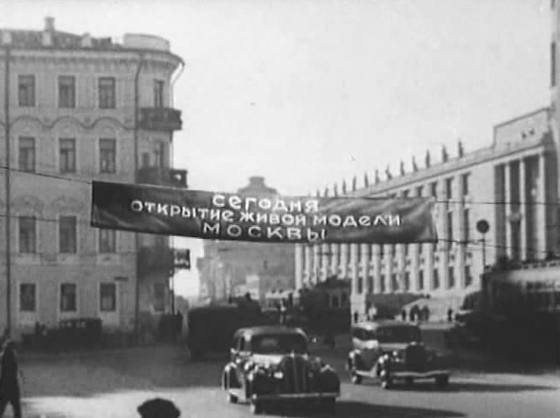 Frame from the movie "New Moscow"
Tati is exactly the opposite. Monsieur Yulo is completely individual in the new city. In general, each hero here moves along his own trajectory and with his own sound - and are ridiculous, on the contrary, those who perform synchronous movements, the crowd, are ridiculous, funny groups. Barbara, constantly falling out of the herd of tourists, ceases to be ridiculous: she may be awkward, but strives for the self.
Tati’s characters are constantly in contact with architecture and design: the chairs are sipped, the glass is beaten on the nose, linoleum sticks to the legs, the bulbs blink, the dishes do not crawl into the openings. International modernism has been brought to comic extreme, it is Hilberzamer, multiplied by Misa Van der Roe, it is repeated around the world presented on posters in the turburo.
But the new world of Tati is not adapted to constancy: the devices do not work as it should, the light goes out without waiting for the guest’s departure, the mirror doors turn to a dead end. In the Royal G Arden restaurant, this reaches the point of absurdity: the just built interior rebels against its existence and crumbles before our eyes. The reliability of the new world is all the time to question - and the characters who continuously make children's mistakes in this novelty, with all their organic fragility, look much more true.
This new world is also devoid of memory, like Moscow Medvedkin, but not because the time has ended, but because it is not able to remember, unlike people. Almost all voices in the “Entertainment Time” recall and remind you of a folded suitcase, about past trips, about military service, previous meetings, and even backs remember the drawing of the backs of chairs. And as a gift to Barbar Monsieur, Julo presents Souvenir , a reminder.
But the chairs, returning to the original form, forget about the presence of people. Rooms, floors, at home are indistinguishable. All indistinguishable is ridiculous, because unification, brought to its logical limit, is comic, as everything is excessive. The same things are the key to confusion. This is a comedy of errors where things are confused instead of people - the handrail on the bus turns out to be a floor lamp, the international exhibition replaces the office, and each waiter seasoned with fish on the dish. The same furniture is everywhere.
Nevertheless, the laughter of Tati is not derogatory, it does not come from the screen, but from the viewer, it is ironic - because the strange time has not won, it does not have rights to memory, in the end, its generation is devoid of individuality, so it cannot be dangerous, it is not total, but locally, as the reflections of the old Paris in the glass of doors. The new architecture is not able to take away the memory and become a monument, because it does not have tools for this, especially suppression tools. Memory and constancy belong to people, the army friend Julo remained a bouncer, and the Yollo himself is at ease confronts the new world, only a little surprised and remaining himself.
The architectural languages in the worlds of Tati and Medvedkin exchanged their inherent political order. The totality of modernism has turned into a lifestyle for bourgeois, only slightly correcting the everyday life of people who maintain individuality as much as they want to afford it. In Medvedkin, the inhabitants of the metaphysical urban landscapes, composed of deceptively diverse buildings of totalitarian eclecticism, have become a single mass acting according to unified rules. His heroes are just exemplary masks living without memory in the world after the end of time.