
Translated material
Get to the bottom of the truth
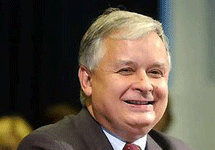
The remains of Polish President Lech Kachinsky, who died in a plane crash near Smolensk in 2010, will be exhumed. His twin brother Yaroslav Kachinsky agreed to carry out this procedure, reports Onet Internet portal.
Yaroslav Kachinsky noted that this will be one of the first exhumations of the victims of the Tu-154 disaster. "I agree with the decision about the exhumation. In the case of my brother, we are already talking about dates," he said.
According to Kacinsky, the investigation of the crash of the aircraft, which was conducted by the previous government, was "scandalous" and "many people should sit on the bench of the defendants."
On February 2, it became known that Poland would resume the work of the commission to investigate the reasons for the collapse of the Tu-154M presidential board. According to the press secretary of the Ministry of Defense Bartlomei Misevich, the new group of specialists who have entered the commission will begin their work "from the moment of the Tu-154 repair."
In March, the Minister of Defense of Poland Anthony Maderevich said that the crash of the aircraft near Smolensk should be regarded as a terrorist act . “After the Smolensk catastrophe, we can say that Poland became the first victim of terrorism in the framework of a modern conflict that is played out before our eyes,” the minister added.
On May 12, Maderevich said that the previous authorities of Poland misinformed the company, hiding the key documents regarding the disaster of the presidential Tu-154. According to the minister, the military intelligence and counterintelligence service did not conduct any analysis of the available disaster information. "They gave the prosecutor to verify the data, but so that it was impossible to understand their true meaning and real content. They concealed key documents, including the Tu -154 trajectory in the last phase of the flight," Maderevich said.
On September 12, the head of the Disaster Investigation Commission, Vaclav Berchinsky, said that the dispatchers at the Smolensk airport were misleading the crew of the aircraft, giving him incorrect information about the distance before the start of the runway. According to Berchinsky, the commission received records of negotiations between Russian dispatchers, and they "differ from what we had previously had." “They also differ from the notes from the tower and the plane that we have. There is a clear contradiction,” Berchinsky noted. The head of the commission emphasized that the distance that the dispatchers were given to the crew was "significant and could affect the landing and disaster."
On September 13, it became known that the Prosecutor General’s Office of Poland decided to exhumer the bodies of the dead in the plane crash, explaining this to the “investigation with the needs of the investigation”. "Comprehensive pathological studies using computed tomography in the field of toxicology and DNA will be important for determining the nature of the wounds and the causes of their death, as well as restoring the course of disaster and its causes," the prosecutor’s office noted earlier. It was emphasized that this will also help to check the main versions of the investigation, "despite the fact that several years have passed since the tragedy."
On September 15, Berchinsky stated that the commission found a certificate of fraud in the case file . “We can say that a significant part of the facts in previous reports was a fake,” he said. “We found evidence that some data were subjected to manipulations.” According to Berchinsky, in the last seconds of the flight, “strange things began to happen that tried to hide by cutting out sound fragments” from the notes of black boxes.
Member of the subcommission, Professor Casimir Novachik, announced the discovery of unaccounted for eight seconds of records from the on -board registrars of the liner. In the “black box” studied by the Polish side, three seconds were cut out, in the second - five. "We are now deciphering the Russian five seconds, it is not easy, but we have already heard the signal of the malfunction of the first engine, generator and both meters of height," Novachik said. He also claims that the head of the Air Force of General Andrzej Blazik was not in the cockpit. Earlier it was assumed that he was in the cab and could put pressure on the crew.