
Translated material
How a rocket works and why it flies
Fragment of the book of American physicist Luis Bloomfield "How everything works"
At the end of October, Corpus, with the support of the Polytechnic Museum and “Book Projects of Dmitry Zimin”, will publish the book Physicist Luis Bloomfield “How everything works. The laws of physics in our lives. " Professor of the University of Virgin simply and clearly explains why light bulbs burn and a bicycle rolls on how to water the garden correctly and how kitchen slabs work. In early December, Luis Bloomfield will arrive in Moscow at the Non/Fiction Book Fair to present his book. With the permission of the Medusa publishing house, a fragment of the publication explains why the rocket flies.
Despite the whole complexity of the design of modern spaceships, the rocket is one of the simplest aircraft. Its device is based on the principle according to which any action gives rise to opposition. The rocket flies, throwing a certain substance from its tail. Despite all this simplicity, the missiles were developed and improved for more than seven hundred years. Rockets are used in space research, in weapons, in rescue operations and entertainment.
Jet engine
Among the most impressive properties of the rocket are its ability to provide its own movement even in the complete void of space space, as well as to achieve amazingly high speeds due to this reactive force. Somehow, the rocket pushes itself without the help of external forces, and it seems that this impetus can tell it an arbitrarily great acceleration.
Of course, in fact, the rocket cannot move itself, just like you cannot lift yourself over the ground behind the laces of your own boots, and its acceleration has the limit. In fact, the rocket receives a driving reactive force, starting from its own fuel, and when the supply of fuel runs out, it ceases to gain speed. To understand how the rocket extracts reactive power from the fuel supply, let's see how Newton's third law works (the same that describes action and opposition) in relation to rockets.
Imagine that you are sitting on the ice in the middle of a frozen pond and your speed and impulse are zero. The sun warms, and wet ice is very slippery. It seems, no matter how you try, you will not be able to budge. How do you get to the shore?
Since you have inertia, the only hope to move is to get some kind of impetus from the outside. Of course, you can order pizza by phone, and when it is delivered, pushing away from the peddler. And you can recall the physical principles that we discussed at p. 68: Remove the sneaker and throw it with all your might towards the eastern shore of the pond. Throwing a sneaker, you put power to it with your hand. The sneaker receives acceleration and flies in ice.
What happens to you? You move to the western shore! You are moving because when you pushed the sneaker east, she pushed you to the west with the same force. At the same time, you handed over the impulse to the sneakers - and she also handed you an impulse, but directed in the opposite direction. The impulse cannot arise from nowhere and disappear to nowhere, it can only be redistributed. Even after you abandoned the sneaker, your total impulse is zero. The size of the sneakers pulse is equal to the magnitude of your opposite impulse.
Naturally, your mass is much larger than the mass of sneakers, so you move much slower than it. The impulse is equal to the work of the mass to speed, and the larger the body weight, the less speed it needs to obtain the same impulse. One way or another, you achieved what you wanted - you slowly slide to the west bank.
Your final speed has the limit, because you managed to tell the sneaker only a small impulse, and you also received a small impulse from it directed in the other direction. If you managed to throw it at a higher speed or run a whole box of shoes into the air, your impulse would be much larger and you would start sliding faster.
However, throwing sneakers is not too effective. It would be much more effective to release a quick stream of gas towards the eastern shore. Even at room temperature, the speed of molecules in the air is approximately 1800 km/h. If the gas is heated to 2800 ̊s - this is the temperature of the gas in the liquid rocket engine - its molecules will move three times faster. Throwing something at such a speed, you will get a pulse of a fair in size, directed in the opposite throw.
This process is implemented in a classic missile engine (see Fig.). As a result of a chemical reaction, the fuel turns into a heated gas of the reactive jet. The energy, which at first existed in the form of potential energy of chemical fuel, turns into the thermal in the preheated and ignited gas (this is mainly the kinetic energy of the chaotic movement of tiny molecules). The nozzle of the rocket engine directs the disordered movements of the molecules in one direction, and the engine is reported by a reactive force directed in the opposite direction.
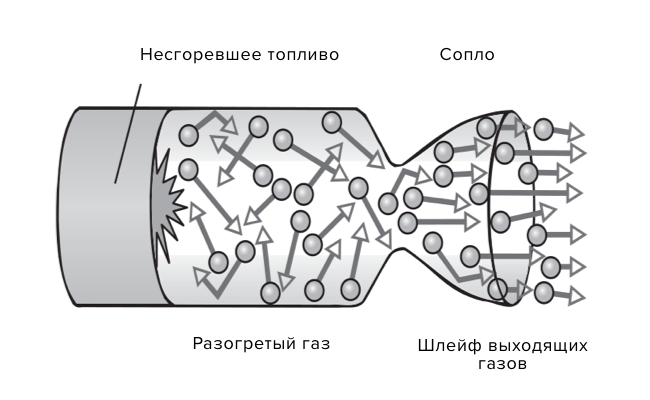
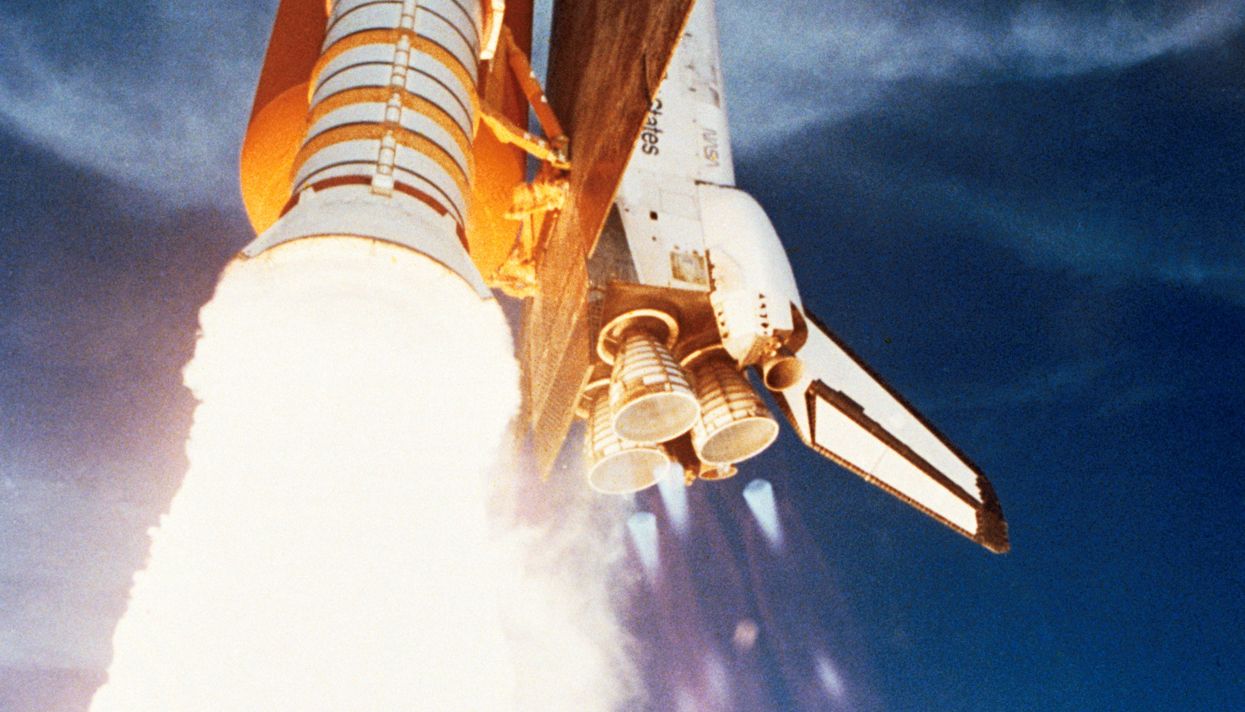
If you ever had to observe the start of a large rocket, you probably noticed bell-shaped nozzles through which gases are thrown away. Each nozzle directs the reactive gas stream back and, as a result, allows the rocket to extract the maximum possible forward pulse and dial the maximum possible speed. As we will see in chapter 6, the nozzle allows the gases to convert various types of internal energy into kinetic energy; The nozzle is ideal for directing the flow and disperse molecules. The optimal shape of the nozzle of the rocket engine is the shape of the hourglass. Such a nozzle is called Laval's nozzle in honor of its inventor - the Swede of Karl Gustav de Laval.
For a more complete understanding of why such a complex shape is required for the nozzle of the rocket engine, it is necessary to study the physics of gas flows, the speed of which is close to the sound speed or exceeds it. Later we will talk about this in more detail, but for now it will be enough for us to briefly touch on this topic.
Inside the rocket, at the entrance to the nozzle of Laval, the hot gas is squeezed and is under huge pressure. Like gas from an aerosol spray, hot gas with acceleration flies out of the nozzle in the direction of the lower pressure. The narrowing of the nozzle contributes to the growth of acceleration to a certain limit. The narrowest part of the nozzle gas passes at the speed of sound, and its properties begin to radically change. Then the nozzle expands to disperse the supersonic reactive gas stream even stronger. Here, in the expanding part of the bell, the initial small volume of a strongly compressed gas increases, and the hot gas has already been prepared in order to get out of the nozzle into the surrounding space.
The optimal (that is, providing maximum reactive force) the diameter of the outer half of the lval nozzle depends on the external conditions. At a low altitude above sea level, a gas stream enters the air under normal atmospheric pressure, and in this case a relatively narrow nozzle is best suited. In the stratosphere and in space, gases go into a sparse environment or vacuum, so a wider nozzle is required. As a rule, designers find a certain compromise solution so that the nozzle is suitable for both conditions.
By the time the nozzle exit from the nozzle, the initial gas energy is almost completely transferred to the kinetic, and the gas flow rate is directed away from the nozzle. However, since the gas continues to burn even after the outlet from the nozzle, its kinetic energy and speed increase to fantastic quantities. Thanks to the design of the Laval nozzle, the rate of expiration of the reactive gas stream - that is, the speed of the gas stream directed back from the rocket engine - reaches values from 10,000 to 16,000 km/h.
The rocket throws the reactive stream back and tells it the impulse directed back. The reactive gas stream sends the rocket forward and thereby closes the process of transmitting an impulse. Everything that is required to obtain a reactive driving force is the actual emission of gases; The rocket does not need to push off from any other body, and it flies perfectly even in complete void. Having “pushed away” with sufficient force from its own ejection, the rocket not only compensates for its own weight, but also rises with acceleration. At the time of the start, the space shuttle, along with the fuel tank, weighs about 20,000,000 N, and the reactive force is approximately 30,000,000. As the ship burns its fuel and its weight and mass decrease, it rushes upward faster.
Common misconception: action and counteraction in rockets
Misconception: To start movement, the rocket must relate to a certain outside body.
In fact: since the movement of the rocket involves the action of two equal and opposite forces - action and opposition, the rocket pushes back the reactive gas stream (action), and the reactive stream pushes the rocket (opposition). If a stream of gases and hit something after leaving the nozzle, this is not related to the reactive movement of the rocket.

Rocket stabilization
While the rocket cuts out layers of the atmosphere, it is best to fly forward. Even a bird, which suddenly flies forward, will look rather stupid, but the rocket that has lost stabilization is also extremely dangerous. To maintain the correct orientation, the rocket must have dynamic rotational stability. A lot of missiles were remotely destroyed shortly after the launch, as they lost dynamic stability and began to randomly tumble in the air.
The rocket is dynamically stable if the total moment of the forces attached to it relative to its center of mass is zero when it orientation with the nose forward. In case of any deviation from this position, she must return to him. Any moments of strength should either again and again unfold the rocket with the nose forward, or they must be negligible.
The missile designer is obliged to take into account the two reasons for the occurrence of the moments of forces. Firstly, the strength of the engine traction. The engine located in the rear of the rocket pushes the rocket forward, and potentially it can have unpleasant consequences. In the end, even an ordinary cart is easier to direct in the right direction, if you pull it in front, and not push from behind. In order for the rocket to be constantly oriented by the nose forward, the engine must create a traction force directed exactly to the center of the masses, then the moment of power does not apply to the rocket. If one of the engines is not quite accurately oriented, its traction can create a moment of power that will begin to tighten the take -off rocket. The moments of forces arising due to the displacement of the engine are one of the most common causes of the crash of modern missiles. The failure in the operation of the engine itself or its control system can lead to the fact that the missile will get out of control.
Secondly, on the rocket, while it is in the atmosphere, the moments of aerodynamic forces may act. We will study aerodynamics in chapter 6, but for now it’s enough to say that the air flow streamlining the rocket helps the rocket with the nose forward, provided that the air resistance in its tail part is greater than the front. In this case, the aerodynamic forces are attached to the tail of the rocket behind the center of the mass and direct it with his nose forward.
The stability of the simplest rocket is provided exclusively by aerodynamics. The tail of the rocket contributes to the formation of aerodynamic forces that hold its tail behind. The nozzles of the engines are also carefully aligned so that the reactive gas stream does not create a moment of power regarding the center of the missile masses. Such a rocket flies in a straight line, but it is difficult to control it.
Modern high -tech tail rockets do not have, they are stabilized due to reactive forces. Such missiles are able to control their own orientation and turn the nozzles of the engines in such a way as to adjust the trajectory. In addition, on the housing of such missiles there are additional small steering engines that create moments of forces and support the correct orientation of the rocket. Most modern launch vehicles have no stabilizers at all. Their stability and maneuverability are fully provided by the engines under constant control.
The fact that the correction of the flight path is carried out exclusively with the help of a reactive gas stream becomes fundamentally important when the spacecraft leaves the Earth's atmosphere. In the airless space, where the moments of aerodynamic forces do not arise, the flight of the ship is directed only by special steering engines, which turn the ship in the right direction with short emissions of reactive gas streams. Wings and tail plumage are needed by cosmic shuttle only when returning to the ground, when he begins to plan in the atmosphere. In orbit, neither wings nor tail work, because there is no air from which they could push away.
However, any self -respecting space crew commander wants his ship to look as elegant as possible - no worse than starships that are shown to us in blockbusters. Space aircraft in the cinema are almost always decorated with completely useless tail plumage and wings in outer space. And when you once again see an intergalactic cruiser with elegant wings and tail on the screen, do not forget that a starship, say, like a giant and awkward school bus, will be no less effective.
Translation from English by E. Valkina and Yu. Plisina