
Translated material
Hear the other
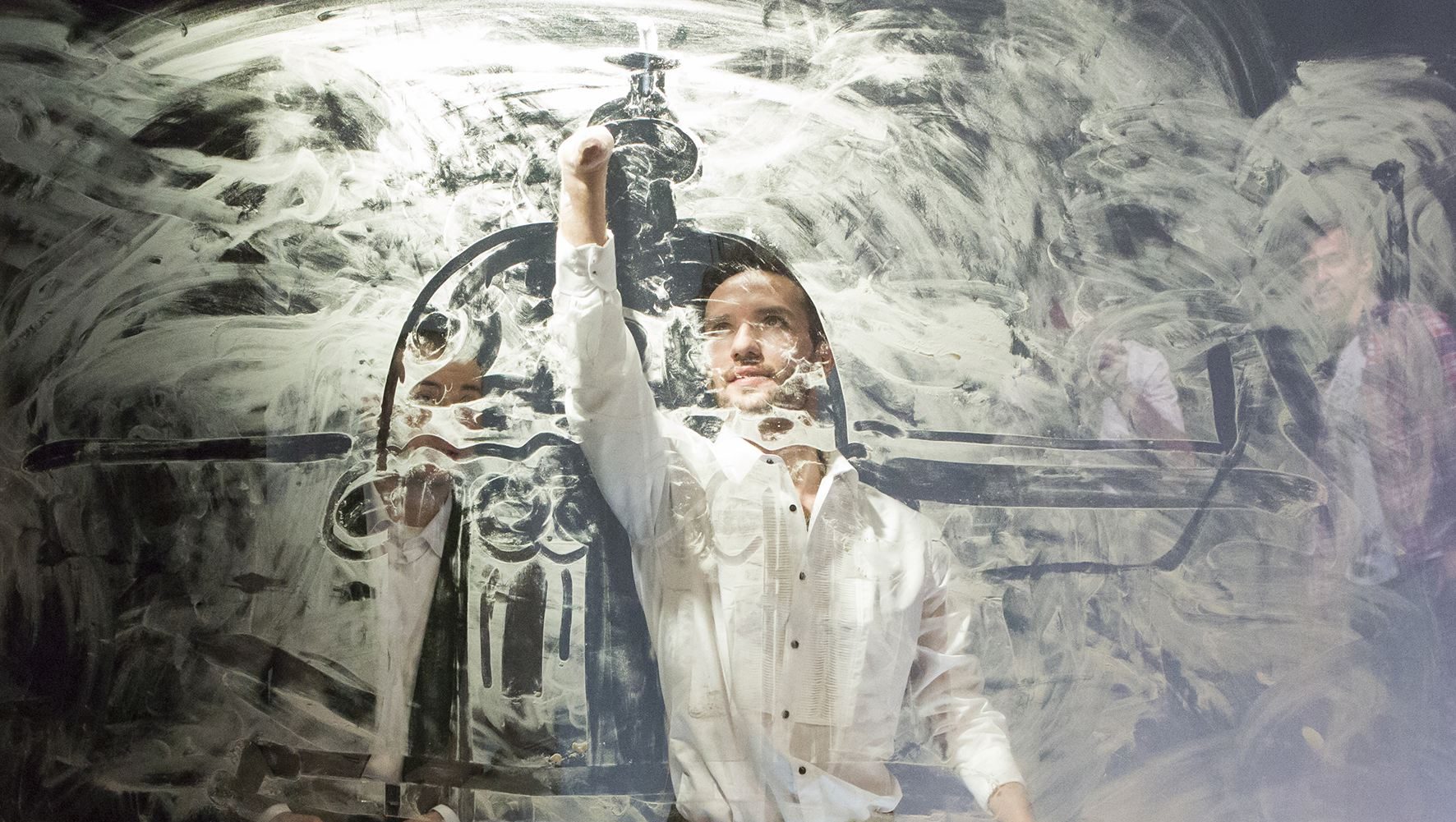
On the International Day of the Deaf in Moscow, several events were held dedicated to inaudible people whose experience is difficult to imagine if you hear. Film order, performance, exhibition. For art, it is natural to make a hidden visible and try to establish a dialogue with those with whom they usually do not even try to speak.
Help your interlocutor help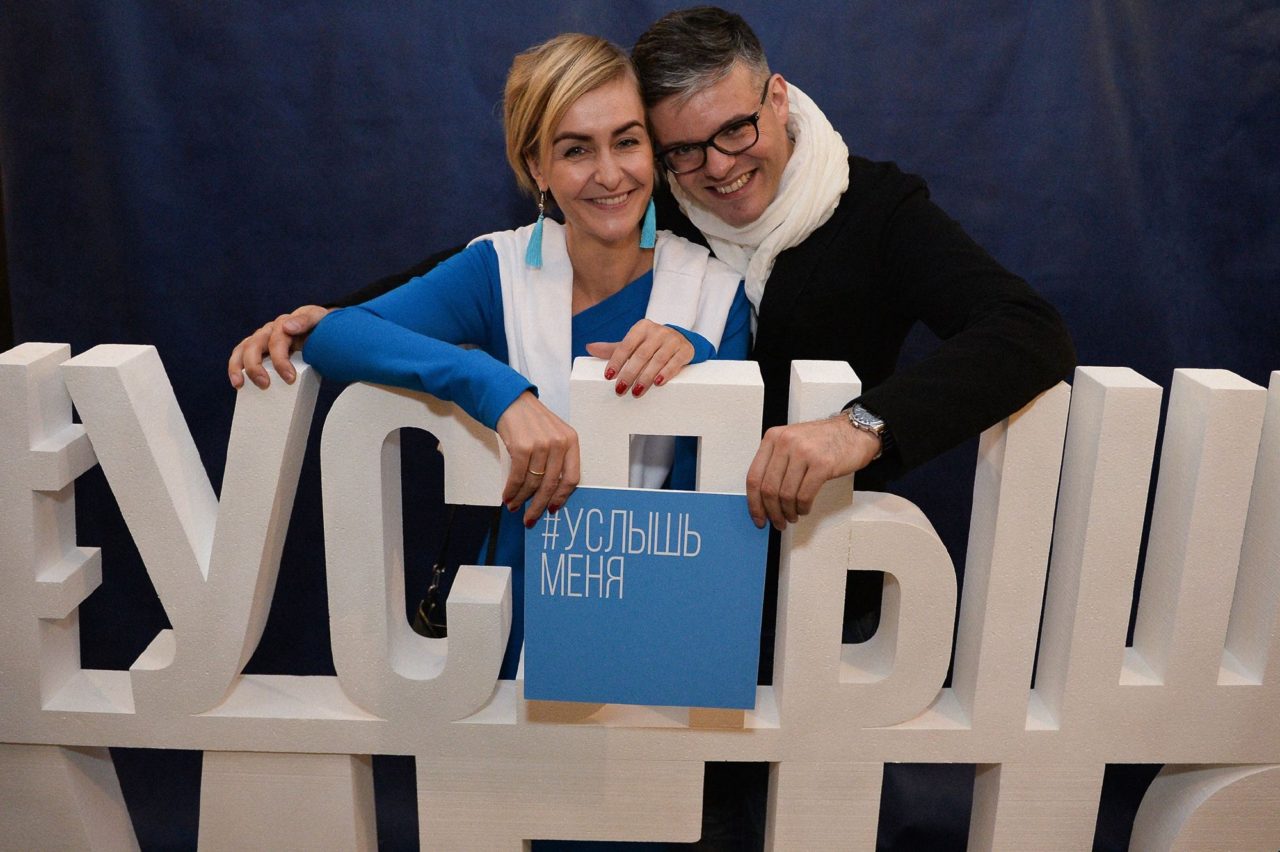 Olga Arlauskas and Nikita Tikhonov-Rau Photo: Ramil Sitdikov/Laboratory of Social Cinema "Third Sector"
Hear the other
The only event, directly dedicated to the Day of the Deaf, is the premiere of the film "#Hearing". The creators (producer Nikita Tikhonov-Rau, the grandson of the founder of the Russian Surdopedagogiki, directors Olga Arlauskas and Svetlana Gorlo) position the result of their work as a documentary movie about "those who do not hear, but want to be heard."
This is really documentary - the film is built on the facts and numbers related to the life of people with various hearing impairments in Russia. Illustrations for the information part and comments of specialists - doctors, representatives of organizations engaged in the help of inaudible, translators from the brutal language - are real stories of deaf and hard of hearing. At the same time, the “#heard” is more likely a guide for the most unusual world without sound than a document that fully describes the experience of another. For the latter, the film is too vigorous and tuned to be attractive. Its audience is the “majority”, which in an hour and a half of the session can recognize the main and, of course, very significant things about the world of people with hearing impairments.
First of all, “#Povingmen” talks in detail about how to start communication, claims that this does not require overwhelming work. At the same time, this is a manual on how not to offend, not to become a victim of stereotypes. Several “social experiments” were carried out and filmed for the film, the heroes of which were the townspeople who were put to the need to urgently start communication with those who communicate not through sounding. Spectators see the same as themselves, an inexperienced person who finds out that he came on a date with a very beautiful inaudible girl. This story can be called one of the most traumatic. Despite the fact that the film is “assembled” rather as an optimistic picture, in some important points the creators do not spare those who consider themselves “normal healthy people”.
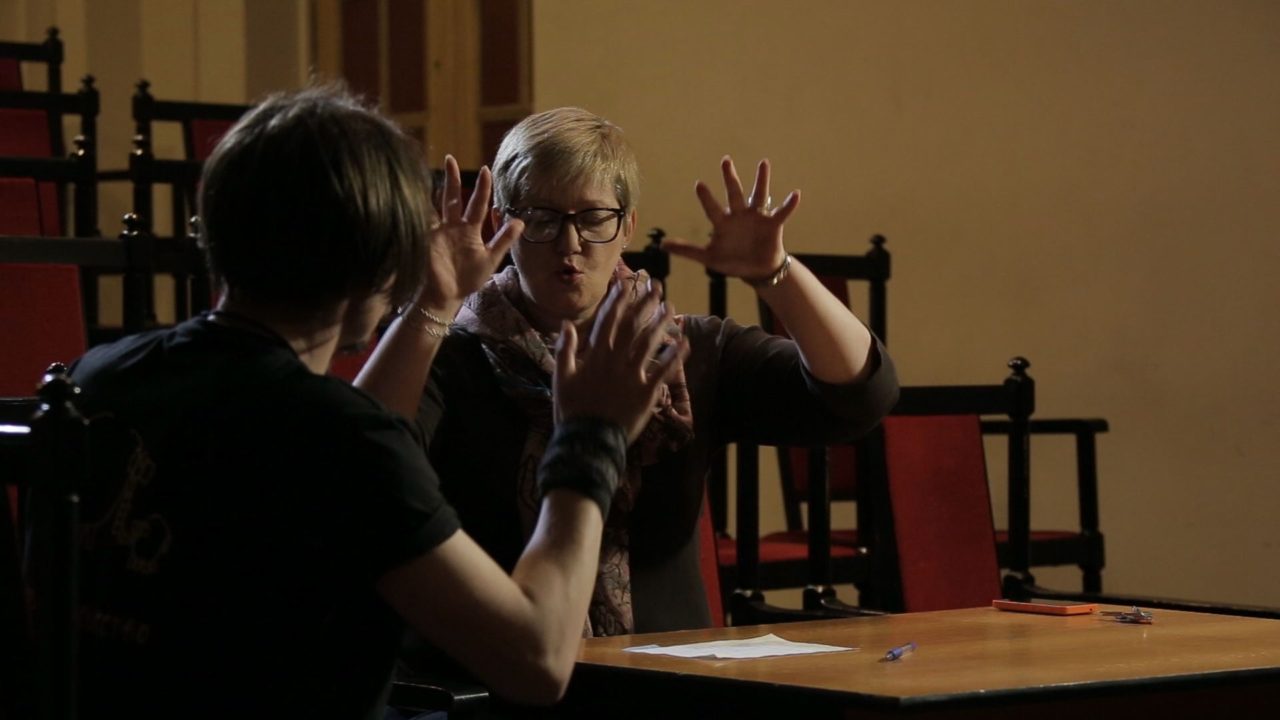 Frame from the movie "#Hearing" Photo: Arseny Kalashnikov/Laboratory of Social Cinema "Third Sector"
On the screen are not only awkward from embarrassment and unexpectedness of attempts to find out the interlocutor, but also frankly boorish reaction to her peculiarity, complete unwillingness to come into contact. You can consider some distortion that the heroine of the experiment became a girl intentionally “glossy” appearance. But due to this, the situation of categorical refusal to continue communication with it is also exacerbated. Looking at frightened men is a shame.
Other episodes are also designed. We see people talking about their daily problems - they do not hire, you cannot get a “ordinary” education, it is difficult to perform a small everyday action, for example, to go to the doctor. But one way or another, the heroes managed to overcome restrictions. The film collected those who can be called examples. If this is an actor of the theater of facial expressions and gestures, then participating in a well-known dance project on television, if an inaudible stylist, then part of the top 100 Moscow hairdressers, if the mother of a deaf boy, then the president of a charitable foundation for children after colear implantation. The creators of “#Povingmen” say that they wanted to inspire less successful people with hearing impairments, show them that access to the “big world” is possible, although complicated.
One of the important features of the film is that in a short period of time the “navigation card” was fit on the mutual communication, and the story about the medical side of the problem and ways to return the hearing, and the social aspect, and even an attempt to simulate the sensations of people who are bad or not hearing at all. And that is why “#Hearing Me”, which is planned for two or three years to show for free in cinemas, can be called an excellent minimum program to eliminate ignorance of a soundless friend.
Look at the other
“Absolutely incredible event. Marriage ”appeared as a result of a competition of inclusive performances, in which three Moscow theater universities took part-the Moscow Art Theater School, the Schukin Theater School and GITIS. “Marriage” was recognized as the winner of this “competition”, having received the right to play the prime minister in the theater of nations, and later entered the program of the festival of special theaters “Protein”.
Director Mikhail Feigin says that the decision to put Gogol with a heterogeneous inclusive ensemble is due to the fact that “ordinary” artists, finding himself in an exaggerated, grotesque space of his dramaturgy, begin to “grimace” intentionally. The director’s task was to fit the special artists into the world of awkward and sad-laughing Gogol people, so that they simply “start living” in it, remaining almost themselves.
"Marriage" simultaneously openly uses "disturbed" bodies and leveles their dissimilarity“Marriage” turned out to be a performance, which simultaneously openly using the “disturbed” bodies and the “sealing” and dissimilarity to their “seizure”. Several artists have hearing impairments-and mediators-translators appear in the play, or visions, or silent characters “speaking” exclusively in a sulfur language. The endless stream of manual “replicas” is unobtrusively inscribed in a common plastic pattern.
On the small scene, the Piglet is almost always there is a tightly knocked out group of characters moving so actively that the brutal language does not look as a foreign, forcibly introduced element, but as part of the everyday movement. For inaudible actors themselves, the lack of speech becomes an additional characteristic of the image.
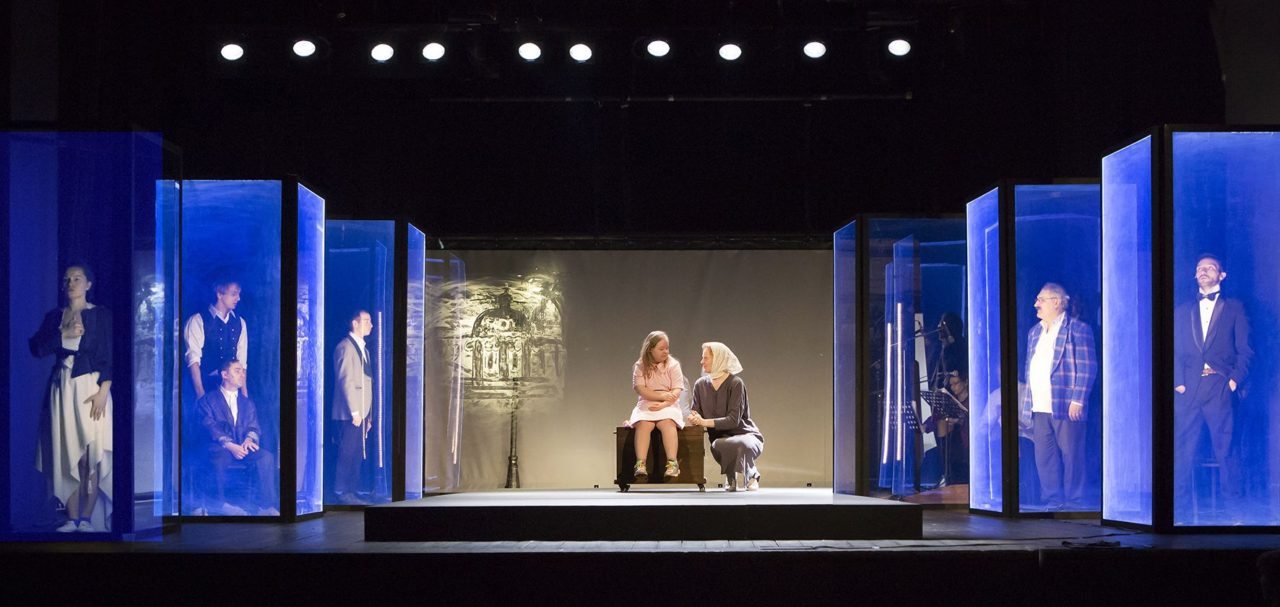 The scene from the play “Absolutely incredible event. Marriage » Photo: Nikolai Germanov
For Fekla performed by hope, a sharp, high voice becomes a sharp, high voice, making it like a restless small bird, and “screaming” something hands-as if the matchmaker is in a hurry to finish the businessman that the words do not sleep behind the body, get stuck-explain both more intelligible and emotional. And the deafness of Alexander Monich, who played two small roles, the father of Agafya Tikhonovna and the scrambled eggs, made his characters with sedate, important, leisurely. It is a lot to talk to such men either by the status, like an egg, or temperament does not allow.
The characteristics of other characters were also “fed”. The role of Agafya Tikhonovna can be called the most interesting in this sense. The image of the “female girl” was born from the physical characteristics of Svetlana Asanova, actresses with Down syndrome, which is part of the Moscow theater of the Odro-Moving. Her Agafya is at the same time and infantile in appearance with her delicate curls of the princess, a pink dress, ruffles, and an internally adult, thoughtful, reasonable young lady. Features of the actress’s speech also become the colors of the image: Agaphia- “Girl” a little burnt, expresses thoughts colorlessly and sparingly, as if he understands everything, but cannot force himself to pronounce so many complex things at once. For her, a lot is agreed by the “adult alter ego”, following the heels of the nephew Aunt Arina.
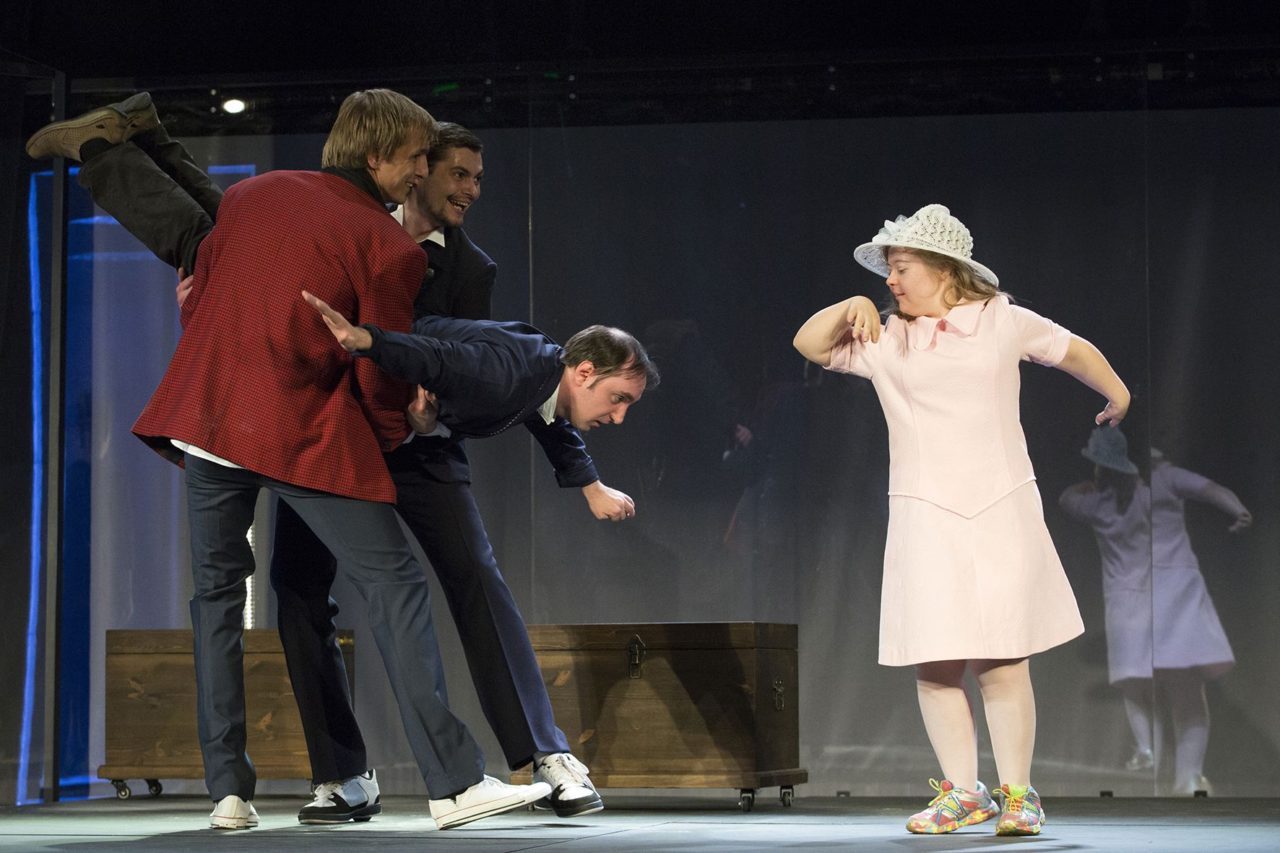 The performance “Absolutely incredible event. Marriage". Right - Svetlana Asanova photo: Nikolai Germanov
Several funds involved in special people participated in the creation of a “absolutely incredible event”-“I am” (support for children with developmental features), “life in movement” (assistance to children with diseases of the musculoskeletal system) and “supporting” (supporting deaf ground). Victoria Avdeeva, the producer of the inclusive theater school of the Co-Union Foundation, speaking before showing at the “Protein”, said that one of the tasks was not just a performance in which people with various violations participate, but to make it at a level that allows “marriage” to be considered an independent fact of cultural life.
And the “Events” team reaches this: the method of working with special artists, chosen by Mikhail Feigin, removes ethical ambiguity that is inevitable in a situation where “conditionally healthy look at the game of others”. Despite the fact that the features of the artists work, including on the comic side of the production, the audience is not in a privileged position. It is a strange world that works according to slightly different laws, inside of which characters simply cannot exist differently.
Master the experience of another
Performance "Tactile dialogue. Collective action ”is more likely to refers to the method that the world is mastered by an invisible person, but it can be called an important act of trying on the optics of another. The artist Fayen d'Awy and the dull actress and the artist Irina Volotskaya gave the opportunity to volunteers from among the viewers of the performance and just visitors to the museum to get acquainted with part of the exposition tactilely.
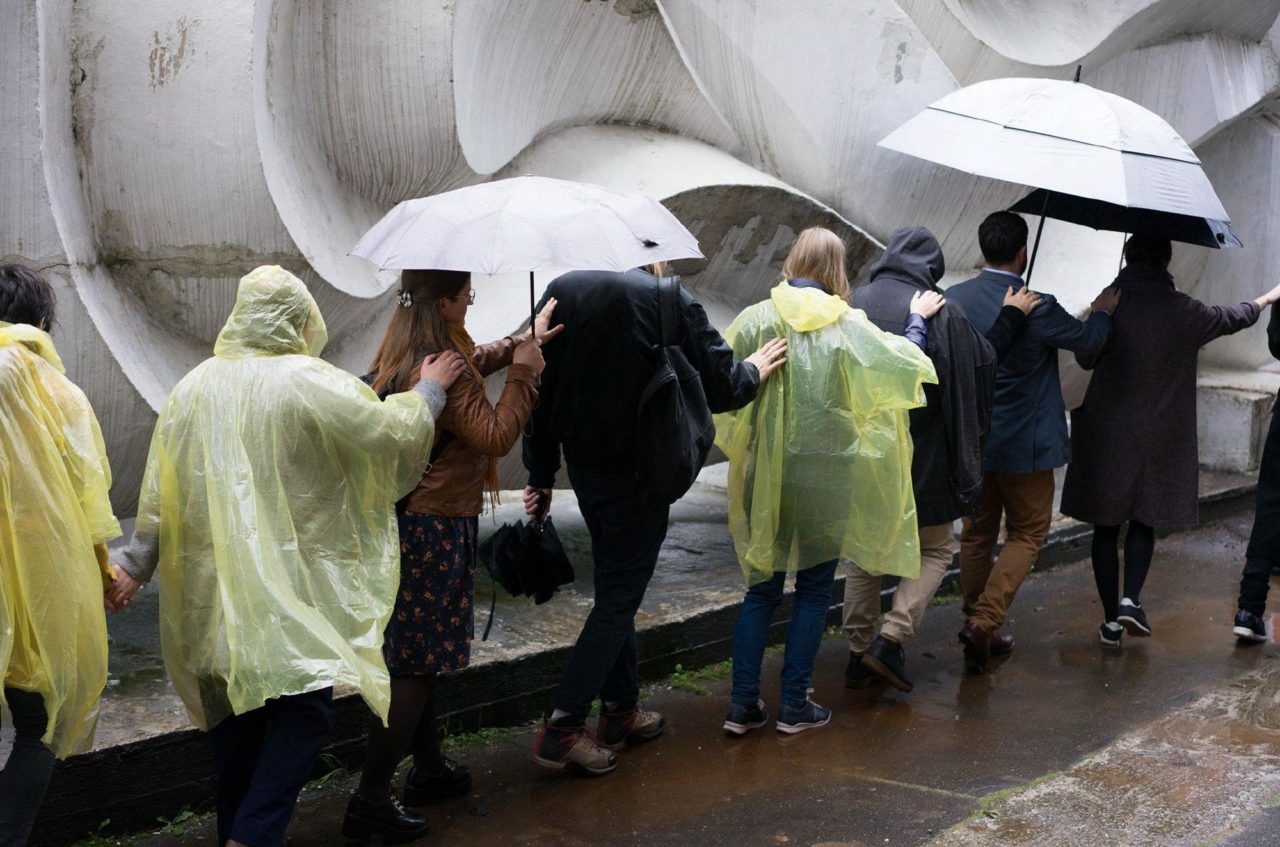 Performance "Tactile dialogue. Collective action » Photo: Evgenia Chapaykina
This happened in the space of the exhibition "General whole", among the sculptures of Vadim Sidur. Entering a small bright hall, everyone could examine them on their own. Although more precisely the word "feel." Objects “tell” the fingers much more than open eyes. Small intricate curls made of grayish metal turn out to be unexpectedly inhospitable, cold and slightly frightening - every now and then the hand slides, stumbles on especially rough and unpleasant parts. It is difficult for those who see with vision, to trust only touches.
Part of the exposition directly refers to the problem of the connection in one space of blind people and contemporary art. Next to Sidur's objects, accessible to both sighted and invisible, there is a series of paintings by Yuri Albert. White squares, on which the descriptions of well -known works are typed by a dactile, are just as opaque for the seer, as well as ordinary paintings for people with visual impairments.
Objects are much more “tell” to the fingers than open eyesThe performance itself is about the experience of communication of the blind with the outside world. Is it possible to "see" an object if it is impossible physically? Does tactile perception replaces vision? An unambiguous answer is impossible, but the “common whole” and “tactile dialogue” are trying to offer one of the options for a positive solution. For about an hour, two artists chose their partners from the public, bypassing the sculptures with them, trying to “teach” to study them without the help of vision. The art objects themselves were “equal in rights” with the surrounding space - along with Fayen and Irina, one could “examine” both the simple table and the wall of the museum. It is important not the status of an object, but an attempt to literally with the skin to feel the world around him.
Artists offered two varieties of knowledge. Fayen was more responsible for the rational, urging those who decided to go with her, to explore, monitor their movements, how they complement the exhibits and thus become in some way the new objects of the exhibition.
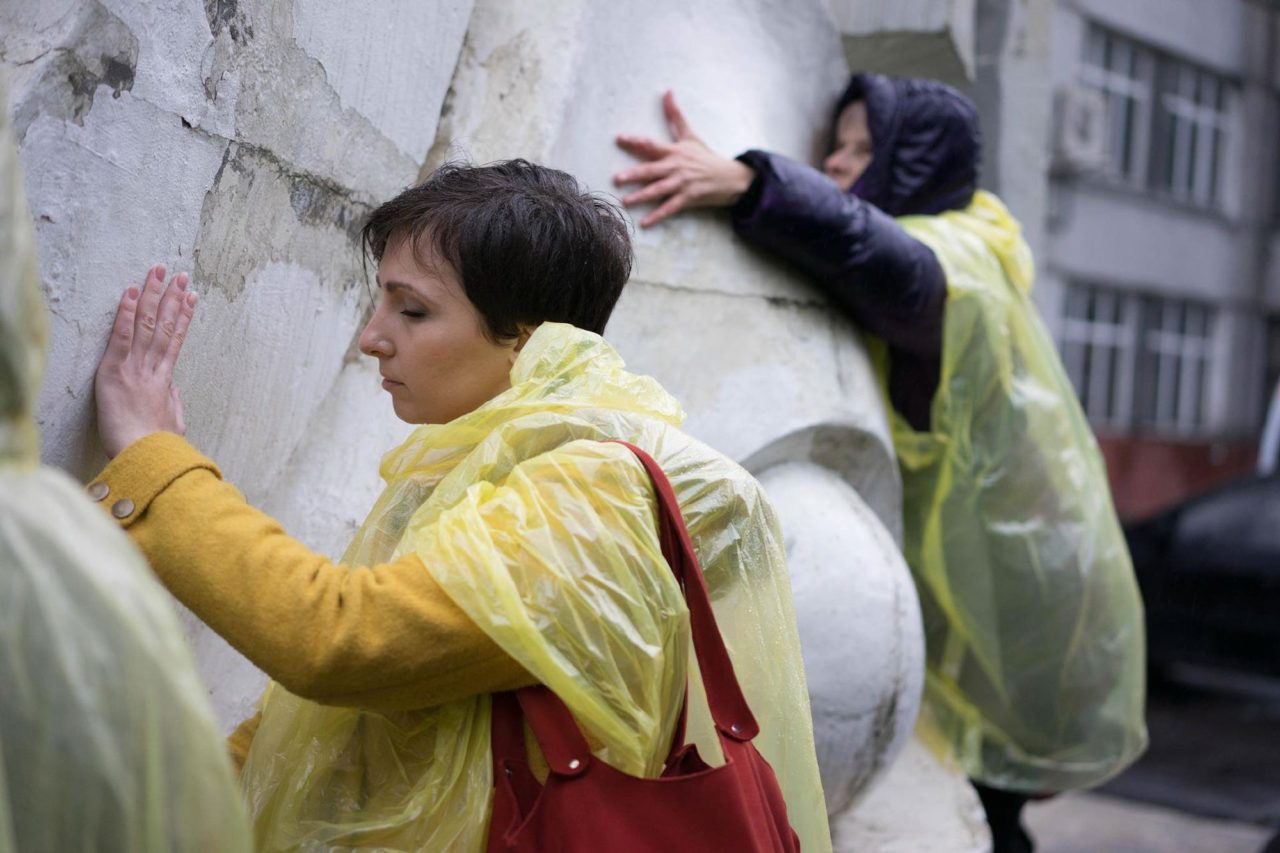 Performance "Tactile dialogue. Collective action » Photo: Evgenia Chapaykina
Sittens of Volotskaya more performed the second task of the performance, learning after instant improvisation to adapt to the movements of another person. Sidur’s sculptures were no longer subject to objects of study and observation, but by the reason for the tactile “conversation”. If Fayen used slow, deliberately non -blessed gestures designed to fill the space and want to become an independent part of it, then Irina played rather, danced with her partners. In her actions there was more intention to get closer, convey through gestures a momentary emotional state - interest, joy, interest in a new “acquaintance”.
Read also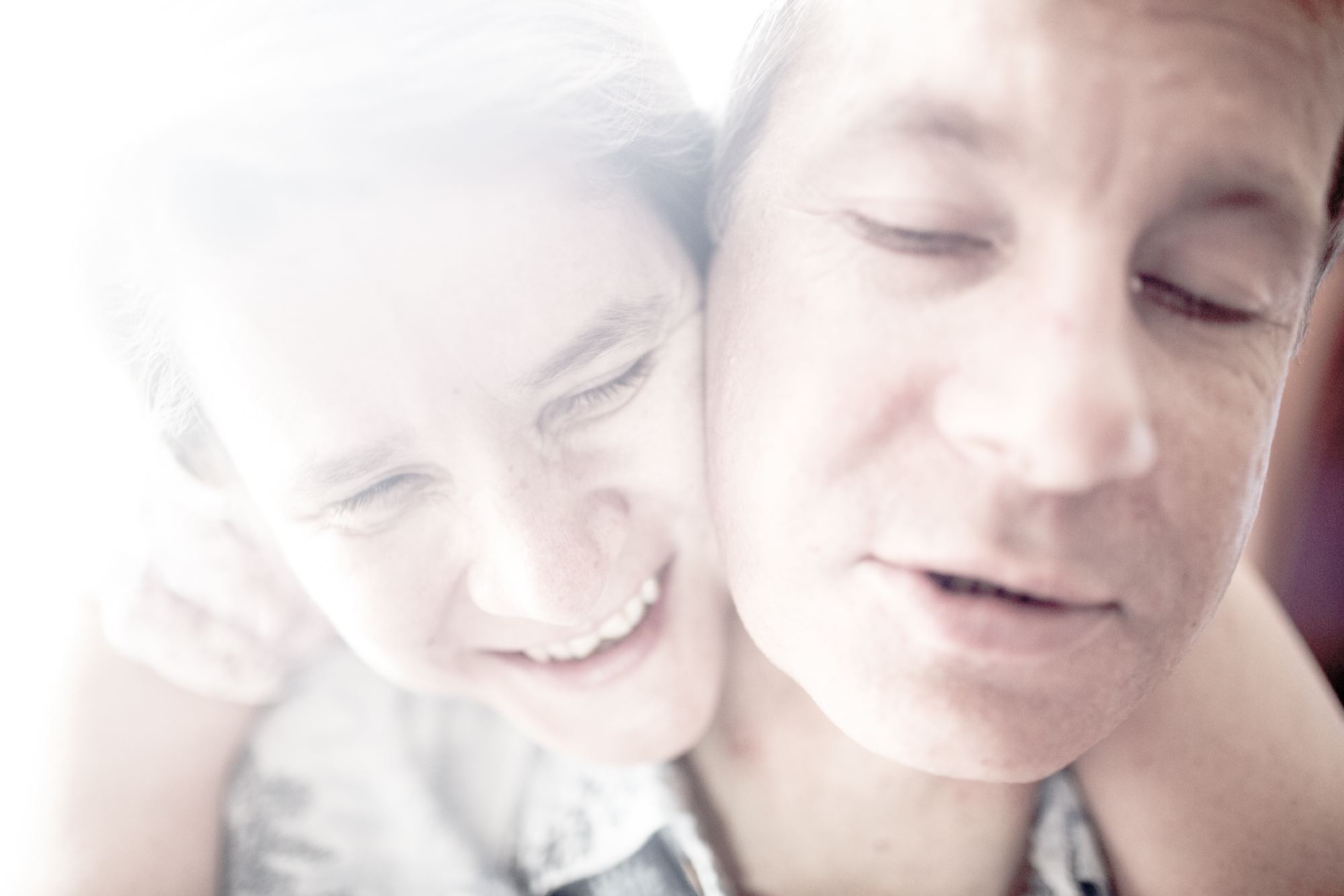 Blind love Sergei and Galina Lelikov have been together for 15 years, but have never seen each other. They told “such matters” about the first date, walks in Moscow and love for cooking
Of course, attribute "tactile dialogue. Collective actions ”to inclusive art can only be with a stretch. This performance can hypothetically include any “curators” and their “led ones”, none of them have to have any health disorders. But, participating or even observing such an action, you can try to try on an unusual way of existence.
“#Hearing” and “Absolutely incredible event. Marriage ”can be designated as the stages of acquaintance with another - the first, involving the recognition of the main information and the relief removal, and the second, more detailed, erasing the label from another, teaching without anxiety to approach his world. And the “tactile dialogue” is already the experience of full communication. There are no more others in his system - there are simply people with a distinguishing experience that can be tried and analyzed.
The Help Foundation collects funds for the magazine "Your Interlocutor", the only magazine for blind men in the territory of the entire former USSR. The publication publishes important information for deaf -blind information: about rehabilitation and social adaptation, about how the life of disabled people in Russia and abroad, as well as on inclusive art. Another magazine is a platform where blind men can communicate with each other. It is a pity that it does not come out very often and its circulation is not enough for all those in need. Your donation can help.