
Translated material
Syria recognized Crimea part of Russia
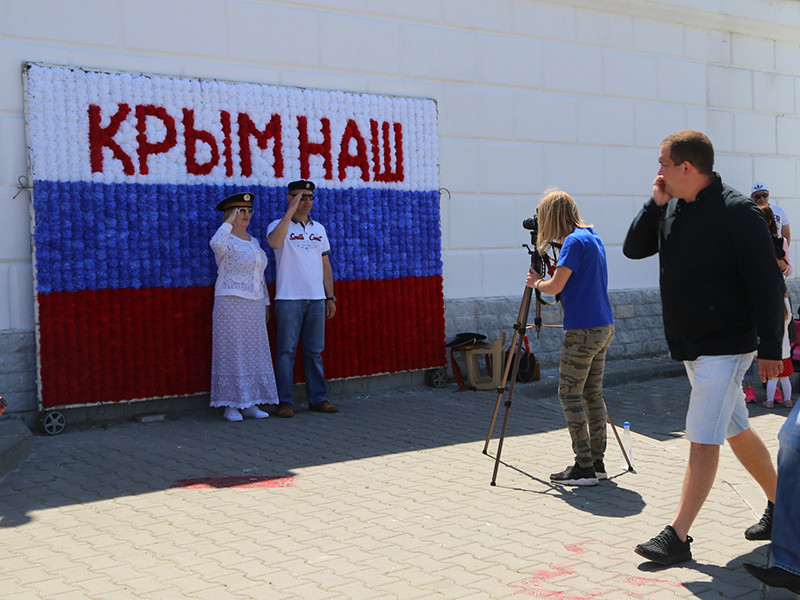
Syria authorities consider Crimea part of the territory of Russia. This was stated by the chairman of the Syrian parliament Hadia Abbas. The current leadership of Crimea was greeted by the statement of the head of the People’s Council of Syria, noting that this is only the beginning of the process of legalizing the Crimean referendum.
Abbas reported that Damascus recognizes Crimea as part of Russia, in an interview with Sputnik , a member of the propaganda international news agency Russia Today. "In connection with the events that unfolded after the collapse of the Soviet Union and to date, this subject returned to its roots by expressing the free will of people in the Crimean referendum ... We admit that Crimea is an integral part of Russia," the head of the Syrian parliament said.
In turn, the chairman of the State Council of Crimea, Vladimir Konstantinov, said that he was welcoming the statement of the leadership of Syria about the recognition of the peninsula to part of Russia, TASS reports. “We are ready for contacts and are now in contact with all sane people around the world and are trying to convey our position. And the fact that the Syrian parliament heard us is only the beginning of the process of legalizing our referendum,” Konstantinov is convinced.
In his opinion, in the world they gradually begin to understand what exactly was caused by the Crimean referendum and what happened in February 2014 in Ukraine. “The world will have to recognize the anti -constitutional coup in Ukraine, otherwise trouble will be going on with the country,” said the head of the State Council of Crimea.
How Crimea became part of the Russian Federation
In November 2013, President of Ukraine Viktor Yanukovych announced that he was suspended the process of signing an association agreement with the EU. This led to mass protests, which in the press designated as Euromaidan. In Kyiv, rallies of supporters of European integration on Independence Square (Square Square) were held. After the police dispersed the opposition’s tent town on the night of November 29-30, the protest campaign took a sharply anti -presidential and anti -governmental character. The acceleration of the protesters served as the reason for the formation of the "self -defense detachments" of the Maidan and began the capture of government buildings.
President Yanukovych left Ukraine on February 22 after the aggravation of the situation in Kiev and the "Maidanovites" attempts to storm his residence. The former president of Ukraine is currently in Russia. According to the media, the politician fled the country by sea through the Crimea. On October 13, 2016, the Main Directorate for Migration of the Ministry of Internal Affairs of Russia officially confirmed that Yanukovych is located on the territory of the Russian Federation on the basis of the temporary asylum provided to him.
Soon after this, a referendum on independence and accession to the Russian Federation took place in the Crimea. According to its results, the peninsula was part of Russia - in March 2014, the Russian president signed laws on the adoption of Crimea and Sevastopol in the Russian Federation. The annexation of Crimea to Russia took less than a week if the countdown from March 17, when, following the results of the referendum held on the referendum peninsula, Putin signed a decree "On the recognition of the Republic of Crimea".
In April 2014, the Minister of Defense of the Russian Federation Sergey Shoigu made an ambiguous statement about the participation of Russian special forces in the events in Ukraine. At first he said that such reasoning “look like paranoia”, and then added, paraphrasing Confucius: “I will say only one thing: it is difficult to look for a black cat in a dark room, especially if it is not there. All the more stupid if this cat is smart, bold and polite.” Later, Russian President Vladimir Putin confirmed that there were military personnel of the Russian Federation in Crimea.