
Translated material
Sentsov was put in a schizo
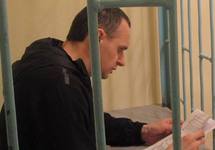
The Crimean prisoner Oleg Sentsov, who is serving a 20-year term in IK-1 of a maximum security in Yakutsk, are placed in a schizo. This was announced on her FB page by the cousin of Politzeck Natalya Kochneva (Kaplan).
“There is an opinion that now the colony has a green light for torture,” added a relative of Politzeck.
The Center for Journalistic Investigations refers to another entry on Facebook Kochneva. In particular, it is said that Sentsov was sent to a schizo for 15 days and that he had previously served a three -day period in the isolation ward. “Slowly but surely, we are moving to tightening conditions,” the edition quoted the recording of a relative of Sentsov.
However, as of 15 hours Moscow time, such a recording - at least in the public domain - was not on the FB page of a nomadic.
"Mediazone" - also with reference to Kochnev - reports that there is no information about the reasons for sending Sentsov to the schizo. From what day the political zytk is placed in the insulator is also not known. It is suggested that he was sent there from October 22. From whom this assumption comes - the most nomadic or "mediazone" - from the text of the note is incomprehensible. One way or another, it seems unlikely, since disciplinary commissions, which impose on convicts, do not hold meetings on weekends.
Sentsov has been in IK-1 since the end of March . Information about the living conditions of Sentsov is scarce. In mid -April, the head of the Yakut PMC Valentina Kirillina told Ukrainian journalists that “everything is fine there” , “Sentsov has no complaints, including health,” and asked not to bother her so often.
On October 21, it became known that the Russian Ministry of Justice refused Ukraine to issue Sentsov, as well as a convicted with him in the same case of Alexander Kolchenko. Officials referred to the fact that both political prisoners after the annexation of Crimea became citizens of Russia, and therefore, according to Russian laws, even if they have citizenships of other states, they are not subject to time to retire to these countries.
In fact, however, neither Sentsov nor Kolchenko became citizens of Russia. Both political prisoners have repeatedly emphasized that only Ukrainian citizenship have.
Thus, the legal procedure for the transfer of political prisoners to their homeland is failed. However, the ability to use political mechanisms remains. It was their involvement that allowed another Crimean prisoner to return to their homeland - Gennady Afanasyev, as well as the prisoner of war, Nadezhda Savchenko and the defendant of the “spy” case Yuri Soloshenko.
At the end of August, Kochneva published a letter from Sentsov from IK-1. Having affected the problem of the liberation of Ukrainian prisoners and political prisoners from Russia, the Crimean prisoner remarked: “To become more famous prisoners so that you are exchanged faster than others is not the path that I would like to go along. I don’t want to pull the blanket on myself. I want to remain just a surname in the general list. It is unlikely that I will be offered to leave the latter, but it would be a good choice.”
“We don’t have to pull us out at any cost - the victory will not come from this,” Sentsov concluded. “To use us as a weapon against the enemy - yes. Know that we are not a weak place. If we are destined to become nails in the tilan’s coffin, then I would like to be such a nail. Just know that this nail will not bend.”