
Translated material
Alien against predators
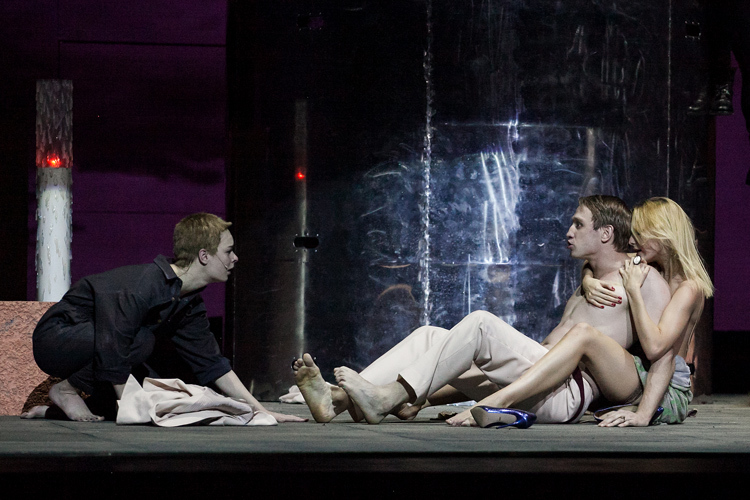
On the poster is an African face by which to identify the floor is as difficult as age. One of those "wild" persons that were destroyed throughout European history. Vitold Gombrovich, who grew up in the rich Polish estate of the 19th century, was sensitive to social inequality, to those who did not enter the canon of beautiful gentry Poland. Therefore, his play “Ivonna, Princess Burgundy,” written in 1938, a year before the World War, turned out to be prophetic - it investigates the mechanism of destruction of another. First - in itself, then - beside yourself. At first - like endless self -censorship, then - like total censorship in relation to any other .
“Ivonna” is a philosophical parable, despite the high level of allegory, it is quite clear, however, related to the cruel political context of its time. Grzegozh Yazhina, this context is not so ignorant, but abruptly draws into the present. He needs the tension of those meanings that attracts Gombrovich’s play at the beginning of the 21st century - although Ivonna, which wears on his head, the sensors that scan her brain and resembles the victim of the experiments of Dr. Mengele.
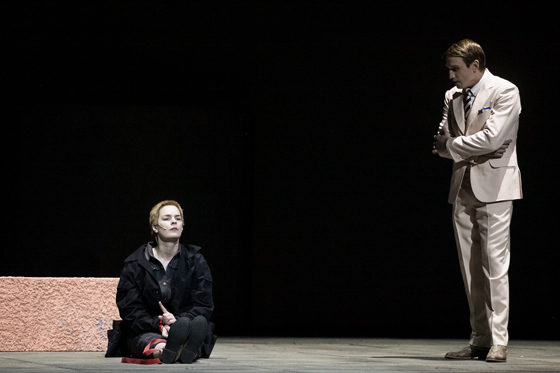
The stunning, pulsing the most difficult video and acoustic vibrations space enters into consciousness as a living organism, as an Ivonna itself, fearlessly and accurately played by Daria Ursulyak. Actually, Yazhina, along with Peter Lakoma (scenography), Yatsek Grudzen (music), Felis Ross (Light), Martha Navet (Video), Andrei Borisov (sound) and Anna Vysikovskaya (costumes) literally pumped up the whole stage “body” with the attraction of Ivonna, was that its silence that constituted the main secret of the play. It includes the public on the principle of the same mechanism that is described by the Prince Philip: “If she loves me, then I ... then I, therefore, love it ... I exist in it. She enclosed me in herself ... Ah, because, in fact, I always believed that I exist only here, by myself, in myself - and then right away - bam! She caught me - and I ended up in her trap! "
 © Maria Horeood / Theater of Nations
The performance was invented so that we all find ourselves in it as in a trap. Yazhina invented a technology that coincides mainly and the motive of Gombrovich’s play: invisible sensors along the curtains make the entire stage field vibrate, which becomes like an electromagnetic literally - every movement of actors makes sounds, extracts sounds from the space. It is difficult to guess about this, but the magic of either growing, then weakened sound, flooding the screen of the color pulsation of color, implicitly depending on the movement of bodies on the stage, affect the subconscious of the audience, who find themselves in the same confusion in relation to the radical silence of Ivonna, as well as Prince Philip (Mikhail Troynik). Ivonna, by the way, appears on the scumbags, dressed in something like a protrusion or a scene of a loop of a loop, is one of those who, always invisible, allows the festival of the performance.
Only in the second act, when the silent Ivonna begins to talk about himself with the help of the Termen - a power tool created in 1920 by Leo Termen, reacting to the slightest fluctuations and extracting music literally from the air - we begin to guess that the whole stage box was such a terminovis. The zone in which silence sounds, or the subconscious itself, replaced, right along the lacan, a repressive machine of the tongue. Before that, the mechanism hidden in the wings is localized on the stage as an instrument from which Ivonna extracts music, as total as all her androgynous creature with huge eyes and a hat of cut white hair.
The performance was invented so that we all find ourselves in it as in a trap.
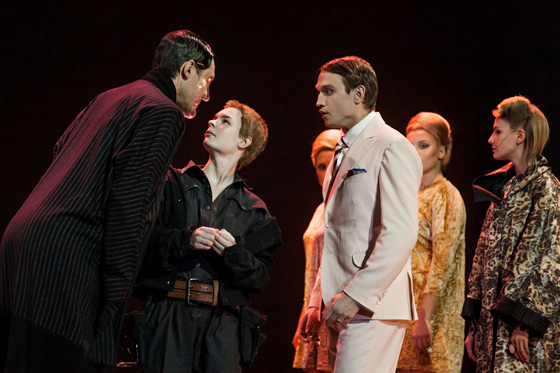
The total presence of its presence in the middle of the cyber desk is the theme of the performance, the society of which is made up of the symulycra shells. Here, court ladies wear hats, grown up with their heads, at the chamberlain (Sergey Epishev), the face was completely overgrown with a transparent mask, a silicone layer between man and the world, and Queen Margarita (Agrippina Steklova) in a night hysteroid gust of revelation is exposed to silicone nudity, discovering the Hahangen. The body is mask, the shell of the same silicone soul. The king (Alexandra Feklists) does not need a mask at all - there, together with the crown, panties and Mike have grown to the body: not the ruler, but the dedicated layman, most afraid of himself.
Reading the Yvonna Yazhina clearly resonates with the concept of Lacan about a language structured as an unconscious, where contact with himself becomes as a cultural formation of the subject is more and more difficult. The directing exacerbates this topic, bringing it to almost a parody. The textual space of the performance was expanded due to the interludes read by the announcer in the pure English language (co -author of the stage version of the yazhina - the chipan of Oryol) and dedicated to how the system - language, politics, cybernetics, censorship - turns individual into mass. This voice in the language, which is the same part of the global world as cyberspace, describes the experiment: subjects, obeying the majority, are called white. The inability to independently judge seems to be a harmless property until such as Ivonna becomes its mass victims.
 © Maria Horeood / Theater of Nations
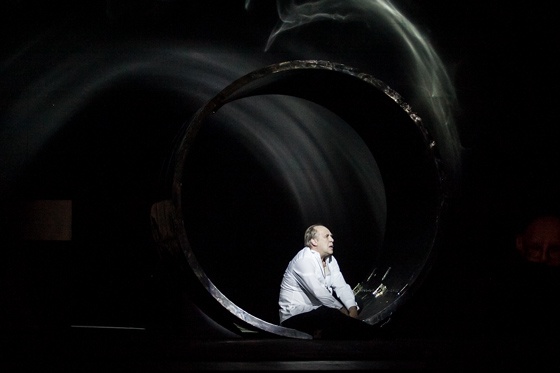
“Control is not carried out from the outside, it is built into the infrastructure,” the Englishwoman tells us, while we are sliding around the cylindrical, cubic and human figures, on which the silence of Ivonna produces an implicit, but powerful influence, forcing, like ultrasound, to perform the most eccentric and cruel actions. “Julian Assange, founder WikiLeaks , a journalistic non-profit organization, describes a self-censorship built on fear, like a pyramid ... Remember, when the last time you wanted to say something and changed your mind due to possible consequences? Self -censorship leads each of our actions, but we do not notice. The truth is that we live in lies. ”
This jazzian manifesto, which in itself, would have caused anything but boredom, if it was not built into the text of Gombrovich, in whom the political parody borders on psychoanalysis, drawing all our mental and rational nature into the process of self -reflection.
Twenty years ago, Yazhina had already put the Ivonna, and then in the play by Gombrovich he was interested in an intimate, deep side of human relations. Today, the director’s interest has moved to where there is no longer a relationship, but there are communications. Where the inexpressiveness of internal experience has long been caught in the trap of the system.
 © Maria Horeood / Theater of Nations
Having received an invitation from the Theater of Nations, the director and artistic director Tr Warszawa , it seems, was happy to include in the context of the play the bourgeois respectability of the most brilliant theatrical platform of the Russian capital, the premiere of which is always marked with a special atmosphere of Shika. In the pre -premiere interview with COLTA.RU, the director directly noticed that he hopes for the effect of recognition: “What are they [spectators] They will think during and after the performance, it is very important for me. The play by Gombrovich-including about the court life, so here we build something like a mirror. "
The mirror is the most important motive of the Ivonna, directly borrowed from Hamlet, with an eye on which the philosophical parable of Gombrovich was written. The bile attacks against bourgeois democracy with silicone masks of equality, tolerance and social responsibility, where the intention of Prince Philipus marries a commoner, marked by obvious signs of autism, is perceived first as a strange joke, then as a populist game and, finally, as a catastrophe for the regime, all this was addressed to us no less than in those days of 1938, when it was written when it was written when it was written Play.
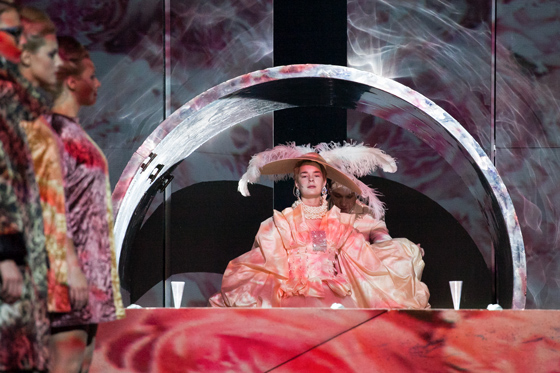
But is it only before the public, which has financial influence and the authorities, is the yazin mirror establishes this mirror? "Ivonna" plays with much more complex reflections, drawing our whole being into its "political body". Baroque chords of the wedding ceremony, a huge table, a scene flooded with pink flowers and the scene space, white feathers and crinoline silk of the bride, making it completely similar to a sacrificial lamb ... The fear of another, nesting in the depths of any violence, kills Ivonna with a quiet - fine crucifix. She falls on the table, turning from a living person, which she has never been to them, into a pile of white skirts, flooded with a pinkish color of her anemic blood ...
 © Maria Horeood / Theater of Nations
PS since the large -scale touring projects of the Polish theater in Moscow ceased several years ago, and some major directors, led by Christian Lupa, refused to come to Russia with their performances for political reasons, the mutual isolation of the two theatrical worlds seemed inevitable. The change of government in Poland also did not seem to contribute to active contacts in the field of the theater. But here the long -term mechanisms of mutual attraction were embarked: a cycle of lectures, exhibitions and video shows began, and then - the productions of Polish authors, we have few well -known or not at all staged. Instead of loud tour, Russian and Polish theaters begin to cooperate at the level of deeper creative exchanges. And the fact that after the Ivonna Tr Warszawa created in co -products with TR Warszawa , several performances from Vitold Gombrovich’s plays will appear in Russia one after another - in the St. Petersburg Theater named after The young director Beniamin Kots puts the “wedding”, the same play rehearses the same play in the Moscow School of Dramatic Art, Elena Nevazhina, - perhaps it will allow you to deeperly understand the author, so consonant with our time.