
Translated material
Battle for Moscow
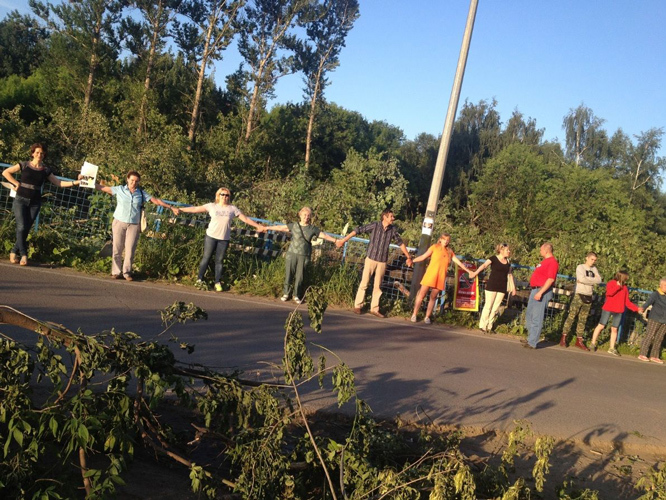
The city in Russia has become a topic for a wide public discussion relatively recently. This happened in the early 2010s, when key manufacturers of urban discourse-“Strelka”, The Village , Ilya Varlamov and Maxim Katz with their “city projects”, the Higher School of Urbanism, the Moscow Urban Forum, the Festival “Do itself”, Partizaning , and after them and others began to appear rapidly and manifesting themselves. Media and institutions that are still translating the words “urbanist”, “urbanist”, “urban environment” that are still unknown to the reader who are still unknown to the reader. An important impulse to the focus of public attention on the city was the movement “For honest elections” 2011-2012, one of the slogans of which was “this is our city!”, And one of the leaders - Alexei Navalny - urged the protesters to run for municipal deputies.
This protest wave catalyzed the appearance of independent municipal deputies in many areas of Moscow and caused a new form of civilian activists - urban activists. A bouquet of phenomena began to form violently, still qualitatively unreasonable, which was called the hipster zombie, which largely closed the moves to understanding. In public speakers on the pages of newspapers and in descriptions of lectures, the title of Urbanist began to appear. Everyone in a single impulse began to discuss the quality of the urban environment, their aspirations, requirements and expert opinions on how to properly lay bicycle paths, how much we need to put shops and how to make us “like in Europe”. The key manufacturers of the discourse, to which the Moscow government was more closely observed, ensured the filling of the discursive field with new concepts and foreign experts - Yan Gale, Enrique Penyalosoy, Vukan Vuchik and invisibly present Richard Florida.
The crisis sets a strict condition for the public approval of any decisions of the party and government.
Few people saw the work of ideologies in the unfolding pursuit of a favorable urban environment - the conversation about them practically did not go. Separate attempts by some players to raise the questions of ideology were disclosed as not related to the new reality of real, specific cases aimed at a decisive high -quality leap in a bright future. It seemed that the resulting expert and activist forces endowed with faith and knowledge in the dialogue with the concerned public good authorities would discard all ideological disagreements and together would build new principles of urban life. What, of course, did not happen.
In parallel with the enthusiasm of the Gorky Park, neighboring dinners and the appearance of pedestrian zones in the center of Moscow, such concepts as “urban planning conflict”, “expansion of the craftsmen”, “Peter Pavlovich Biryukov” began to enter into everyday life. It turned out that in addition to the smiling Sergei Kapkov in an electric car in the city administration, there is still a strong business executive of Biryukov, practicing carpet improvement, and the ominous Marat Khusnullin, whose construction ambitions do not know the word “urban”. These people, in fact, responsible for the physical production of the city’s space, were in no hurry to adjust their practice for the sake of talking about the urban environment.
Healthcare was optimized and reduced, schools were merged, and the Housing State Budgetary Institution was enthusiastically engaged in the desertification of the regions.
Separate exemplary reserves of the “new Russian urbanism”, of course, appeared in the Central Administrative District, and some of them were really pretty. But even then one could see how the ideology of neoliberalism begins to manifest itself behind the declared value of the city on a person’s scale, if we call a spade a spade. Gorky Park, which all city publications sang unanimously, turned out to be too noisy and rich activities for elderly visitors and, in addition, reoriented to more solvent groups of the population - primarily to a creative class. The pedestrian zones also turned out to be an ambiguous phenomenon, since the result of how the city authorities understood the concept of pedestrian infrastructure: total, insensitive to details, not caring about existing and future meanings.
Sir Terens David John Pratchett in the Fantasy-Roman cycle about the flat world has such a character-death. Death lives in his own world, but looks at the living world with interest and even sometimes tries to copy it so that Susan’s granddaughter feels at home. So, for example, death has a bathroom where there are beautiful, but hard towels, and the pipes are made of a whole piece of metal, without a cavity inside, along which water could flow. This bathroom is the exact metaphor of the city that the Moscow government built for Muscovites. Indeed, those qualities and elements of the urban environment that we are observing in the admiring reports of Ilya Varlamov about the cities of Europe and America are not only and not so much a design product as a product of a democratic process, a system of retirement and counterweights, scientific analysis, public discussion and long -term planning. The democratic process, of course, does not protect against urban planning errors, but it allows them to be recognized. In Moscow, even the minimum democratic process that existed, in recent years, was rapidly folded and replaced by the technologies of pseudo -workers.
Before our eyes, municipalities were abolished and the Institute of Public Hear was dismantled. Instead, the sites of the “active citizen” and “youth parliament” were created, which allowed to participate in decision -making and other aspects of the city’s life, but in fact replacing the involvement and will of the townspeople with gamies in the interclamation. The elections of the Moscow Mayor and the elections to the Moscow City Duma (and later on the State Duma), despite the fact that at the first, Alexei Navalny received second place, demoralized the opposition, the volume of efforts and expectations did not correspond to the result. Social security institutions, administrative resources and advisers of managers in each entrance were able to digest almost all protest efforts.
The electoral base of protests 2011-2012 It was largely cornered in front of the life of the life -up fairy tale of Hipster urbanism, giving the feeling “like in Europe” here and now. Against this background, healthcare was optimized and reduced, schools were merged, and the Housing State Humanitarian University, created on the sample of the Soviet Pzhro, enthusiastically engaged in the desertification of the regions, ignoring DPIOOS instructions to limit the mowing of green spaces. The neoliberal policy of reducing costs and transfiguring expenses for residents unfolded more and more.
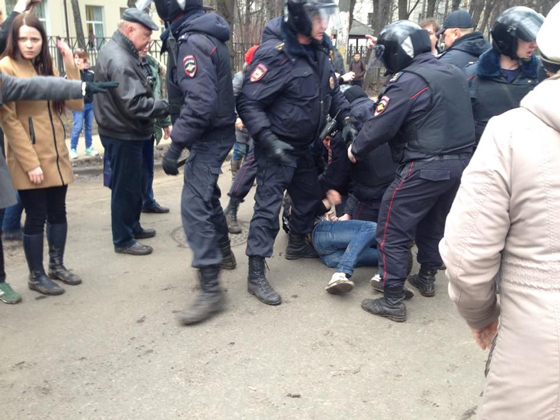 Destruction of the defenders of the Park "Oak"
And in 2016, urban space in Moscow finally showed itself in a new way-no longer as a kingdom of a benevolent or indifferent consensus, but as a battlefield. Urban planning conflicts came to almost every district. Dubki Park , Park “Koropyanka” , road in Ramenki, Kuskovo Park, Friendship Park, Square at the satellite Hotel, Fields of the Timiryazev Academy, Apartments in a Warm Stan, Point Building in Troparev-Nikulin, Demolition of the Taganskaya ATS and dozens and hundreds of urban planning conflicts, around each of which the residents of the districts were united, went out to rallies formed inter -district coalitions. At the district rallies, calls were increasingly ranging to the municipal deputies in the next election so that there were more than one real deputy in the areas, but if possible everything.
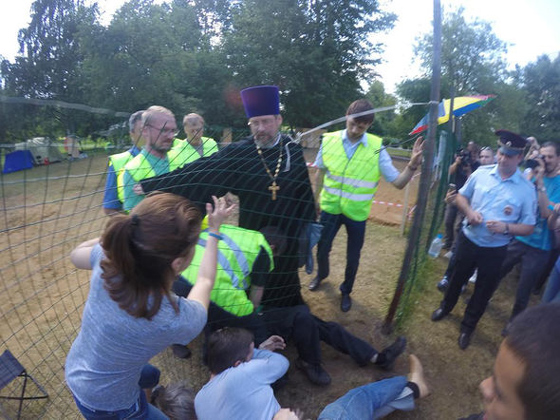 The use of force in the Park "Peat"
Also, at these rallies, the most important thesis sounded that the urban planning problems of the districts are not individual cases, each of which must be carefully disassembled, but the result of the systemic dysfunction of urban planning law in Moscow. Systemic dysfunction, which essentially endowed unlimited power by the Urban Planning and Earth Commission of Marat Khusnullin.
Finally, the theme of the environment sounded more and more-with links to the 42nd article of the Constitution of the Russian Federation, ensuring the right to a favorable environment. And if at the dawn of Moscow Urbanism eco-activists called skepticism among city activists, now it became clear that the city and nature are not only non-mutually exclusive, but organically interwoven things.
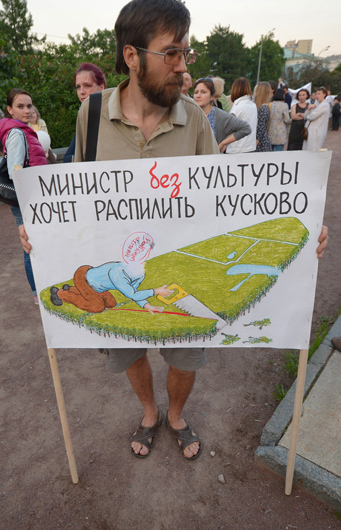 © Gennady Gulyaev / Kommersant
In the meantime, the regions blazed in urban planning conflicts, while their inhabitants fought off the construction equipment and militants from the “officers of Russia” who attacked the protesters in front of the inactive police, the well -fed art critic Grigory Revzin painted as Muscovites, like sheeps, themselves will stretch on freshly blessed streets in the Central Administrative District. After all, he explained, these streets are now executed according to all the laws of urbanism by leading specialists - that is, according to the standard developed on the Strelka a little later than the end of the improvement work and in accordance with the wishes of the residents who were interrogated during the work ... Meanwhile, the municipal deputy of the Khamovinniki district, who tried to pass the issue of cutting up Kuskova and Luzhnikov was kicked out of the Moscow urban forum by guards Marat Khusnullin , letting everyone understand that the forum is not a place for discussions.
At the same time, the townspeople are almost accustomed to constantly ironically amazed to festivals, which continuously walking throughout the CAO and filling the streets and squares more and more unthinkable small architectural forms. However, the "townspeople" is not a completely accurate generalization. Rather, we are talking about those who joined the urban process in the early 2010s. For most Muscovites in the sculptures of Urbantino there was nothing reprehensible. These festivals, passing at the pedestrian zones created for the creative class, were by no means aimed at hipsters, but at those who were still deprived of the attention of the Moscow authorities - poor residents of sleeping areas, which are chosen into the city center infrequently and, in general, do not mind seeing any “movement” there. For the creative class, the Moscow government, meanwhile, came up with a much more sophisticated trick.
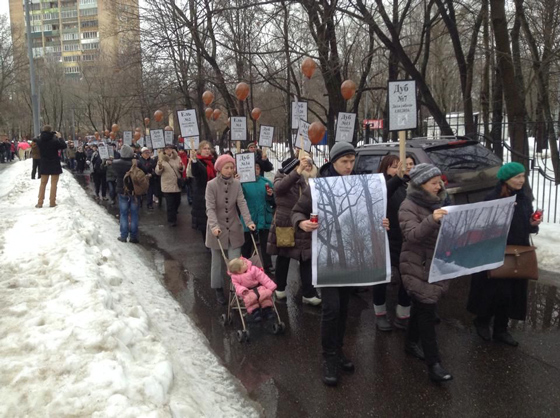 Rally in defense of the Park "Oak"
The fact is that the creative class feels well in stable, growing economies. The product of his labor is by no means referring to essential goods. Thus, the creative class is in a vulnerable position when it comes to an economic crisis. Demand for creative class services falls, fees for projects are reduced, demand for low -qualified creative specialists is expanding, who agree to work on even more poor conditions. However, this applies to the commercial sector. The Russian economy is arranged so that the state is the most stable customer in the crisis. But the state understands the complex position of the creative class and offers it a contract that implies not so much the purchase from the creative class of his services, but to the purchase of its loyalty. If in the pre -crisis years it was possible to serve a state order and at the same time criticize the existing state of affairs, then the crisis sets a strict condition for the public approval of any decisions of the party and government.
Alexander Parushin was kicked out of the Moscow urban forum, letting everyone understand that the forum is not a place for discussions.
And exactly here the idea that urbanism is for all the good against everything bad is scattered. And the genuine ideological and political nature of city processes opens. Can an urbanist, observing hundreds of urban planning conflicts in Moscow, say that in Moscow, with Sobyanin’s advent is finished with point development? Can the urbanist visit the Moscow Urbanist Forum on which nothing sounds except Mosenna Sobyanin? However, during this summer the very word "urbanist" has become abusive, associated with unprofessionalism, bad taste and complete insensitivity to reality. Only the civil liability of the professional community can wash this word from abusive connotations. But the professional community has not yet managed to form, and civil liability threatens the temptation of loyalty.
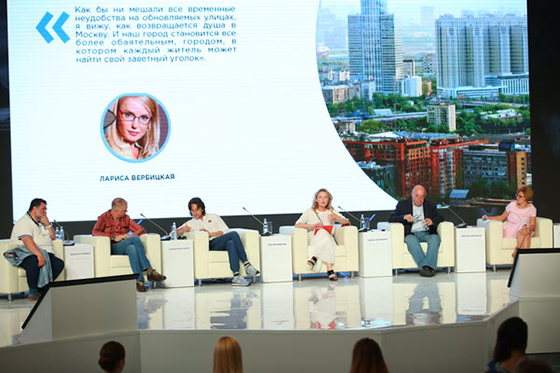 © Mikhail Tereshchenko / TASS / Moscow Urbanist Forum Moscow Urbanist Forum 2016. Discussions "This is my district. Renaissance of the identity of the place "
These two trends - on the one hand, the requirement of the democratic urban planning process by residents of the districts and the need for civil liability of professionals, on the other hand, the impenetrable decisiveness of the neoliberal alliance of the authorities, business and loyal creative class - set the political field in which the new discourse of urban development will be formed. It is difficult to imagine exactly how this process will occur. But I see here a large resource for self -organization: to attract professionals in activist projects to develop insurgent plans for the development of districts and create unions of urbanists (or, if you like, urban engineers); for the unification of various district initiative groups into the All -Mom -School Coalition, the creation of the platform of activist and professional mutual assistance and the exchange of competencies; For public education in the field of urban planning, territorial and municipal administration, urban ecology. Ahead of the election of municipal deputies, and the coalition has a chance to hold a huge corps of independent deputies to the district municipal meetings. And start building democracy, in fact, from the very bottom. And along with democracy - and the demand for real professionals.
Many of these processes are already going on, albeit not fully manifested formats or only at the level of discussions, intentions, wishes. But the main thing is to understand that the era of hipster urbanism, apolitical happiness from what you first heard about the concept of Henri Lefera “right to the city”, irrevocably passed. It is time to defend this right in the ideological and political struggle, and not to think that it is only one of the objects of consumption. It's time to regain this city for yourself.
Download the entire issue of the magazine "Disagreements" (No. 9) "Go out on the street. Back to yourself the city ": PDF , Mobi , Epub