
Translated material
After the ball, or all ahead
Modern Russian art at the exhibition in Dusseldorf
Three pink toy hares tirelessly pedal the pedals of exercise bikes. On a large film screen, there is another pink hare in front of them, he looks at the pedaling pedal and at the other hares, planted by other hares. They are also pink and plush, while fear and thrill causes a movie screen, and interest is those who do it, that is, pedaling pedals.
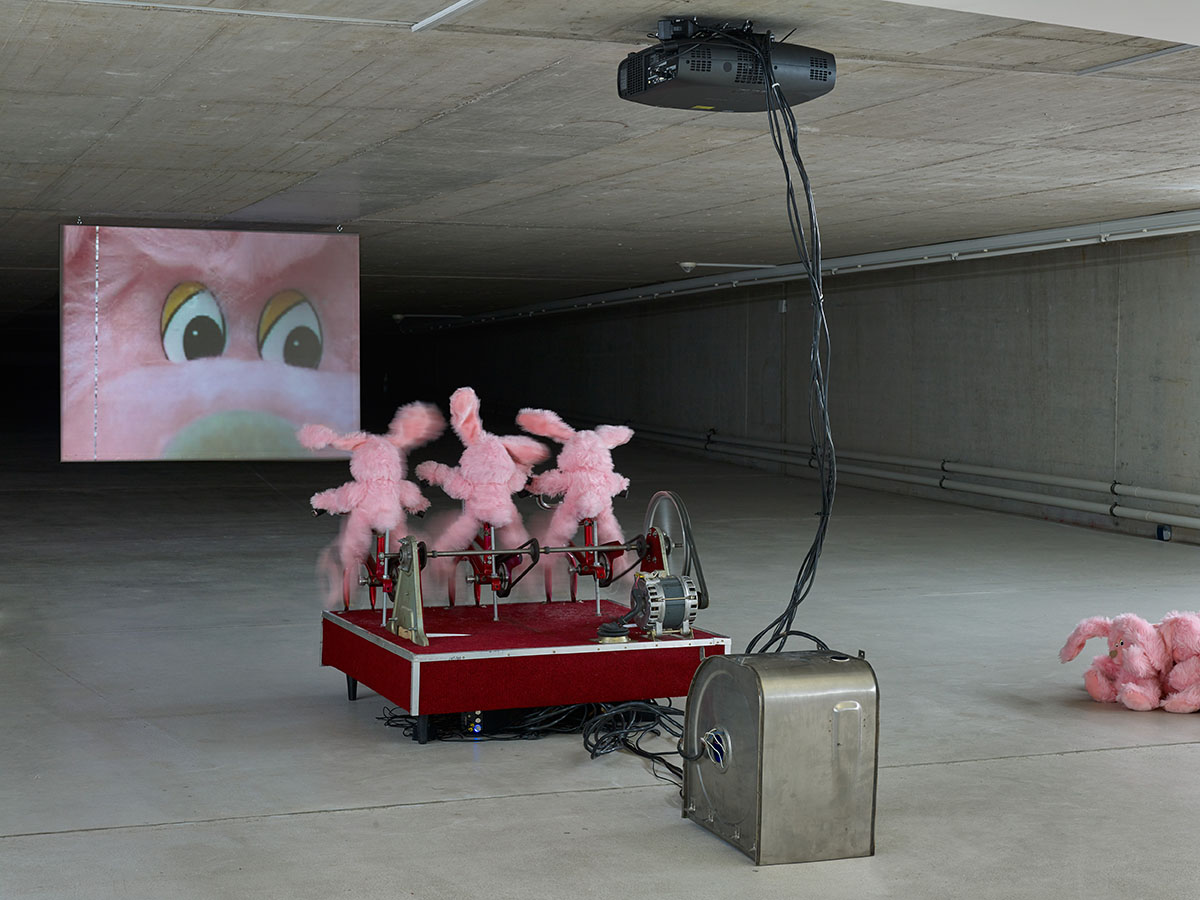
One installation of Rostan Tavasiev “Kino” reminds of the cult French cartoon “Trio from Belville”, telling about the mafia in cycling, the other about the mass media component of the modern world. It is hardly possible to find a more accurate metaphor for the relationship between the narcissistic power, which is on the screen, submissive media (preferring to portray themselves with cyclists), and the public, dumb from delight, is unable to utter or swallow the words of admiration for the authorities.
Art in the dungeon
Hares are the first thing the viewer sees at the exhibition of modern Russian art “... after glamor” opened in Kit halls in German Dusseldorf. This is probably the most unusual exhibition hall not only in the city, but also on the banks of the Rhine in general, and not only because it is equipped in the place of the once burnt parking lot. Formally, the hall is part of the Dusseldorf Kunsthalla, but with its independent curator. To get into it, you need to enter a glass cafe on the embankment in the city center, and then go down a few meters - there you find a huge, 900 m2 hall, neatly dug between the beams of a long car tunnel going near the embankment. Hence the full name of the space - Kunst Im Tunnel, "Art in the Tunnel." The hall, elongated like a long cucumber, really resembles a tunnel, it stretches for one and a half hundred meters and is noticeably narrowing in the corner far from the entrance: in the widest place it reaches eight meters, in the narrowest - one meter. This is not the first time this space was given to Russian art, the Moscow House of Photography supports creative ties with the museum. He held his first exhibition here back in 2003, among the latest projects of the museum of Olga Sviblova - “I am when I am. Young Russian artists and leading representatives of modern Russian art. ”
The new society of consumerism makes itself believe that all the main goals in life have been achieved: “Super-elite, exclusive ultraplus-excess”
Open years behind
This time, the work of 11 authors (the oldest of 52 years old, the youngest - 30) is shown here without signatures (however, the hall of the hall with the names of the exhibits can be taken at the entrance). This anonymity at some point makes an exhibition similar to immersion in the world of fantasides, especially when you see the paintings of Konstantin Latyshev with their mocking signatures such as “Petya goes to the rally, and Mitya goes to petition” (a britow-l. Or his coarse -planned portrait in his life understood and now fully consisting of a girl’s high -quality spiritual bond: “She saw Putin.” But the face of another enthusiastic contemporary, looking at the ring with a precious stone: "Her first tiffany." The signature for another female portrait reminds of simple-minded, but effective methods of self-hypnosis, with which the new society of consumerism makes itself believe that all the main goals in life have been achieved: "Super-elite, exclusive ultraplus explorer." Unlike many self-taught political scientists, artists feel the intricacies of neurolinguistic programming well and still leave the viewer a chance not to fully believe in his own madness: the audience comes to the Moscow vernisages, which is painfully similar to the characters of his paintings. It is interesting to what extent they are aware of the new era that has come: the obese years behind, there are less and less crazy money, and the gloss is stubbornly occupied by Instagram and other social networks, where the connections are not as important as in the media, but success is measured by specific figures of likes and subscribers.
Emptiness without censorship
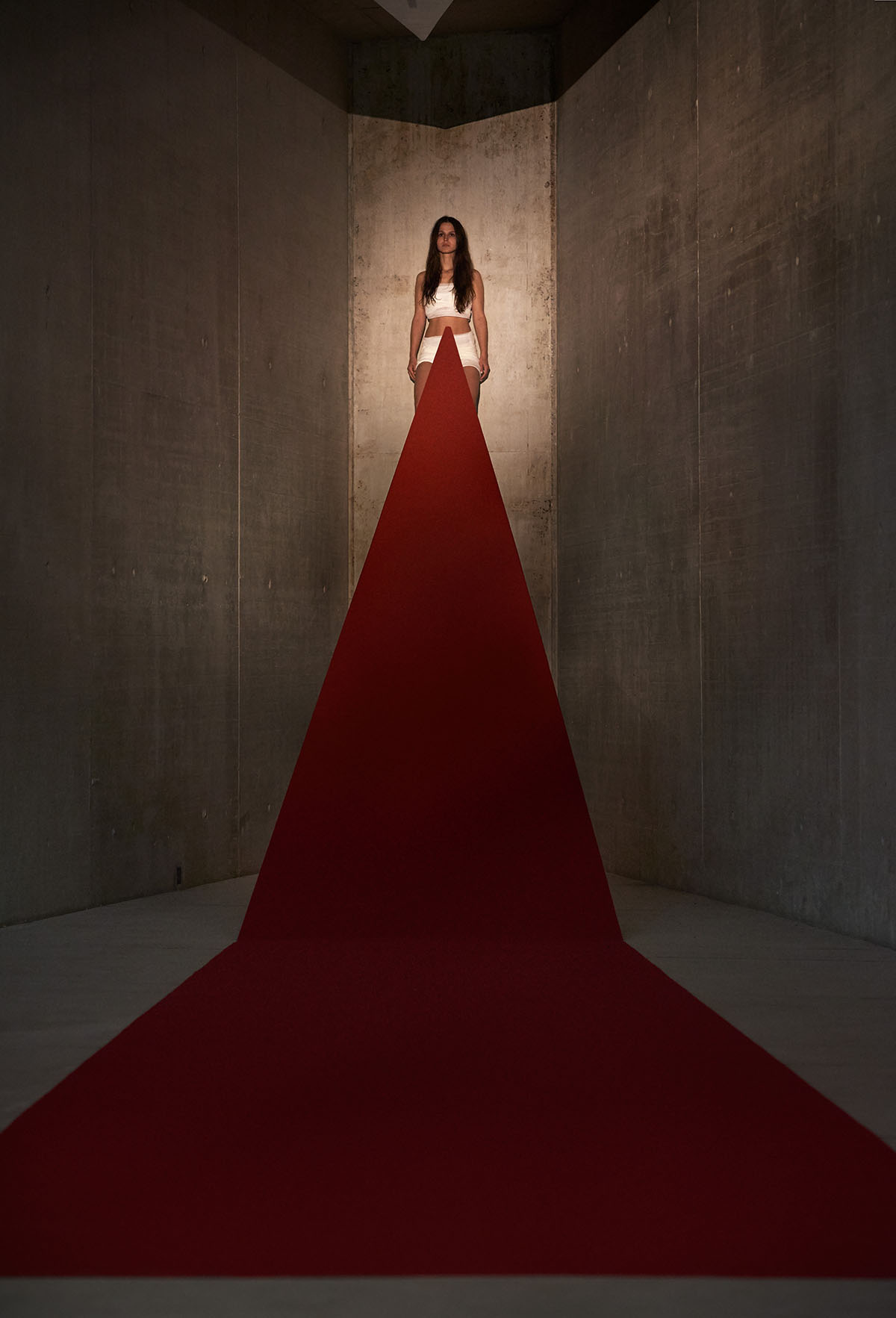
The exhibition is not imprisoned for politically engaged art, many artistic statements relate to socially significant topics indirectly - and perhaps this seem only stronger from this. So, the “iron wedding” of Anna Acorn looks like a set of empty hangers hanging on a long bar - an impressive image of a marked void that came from the past and promising the future zero in the literal sense of the word background. Perhaps, in the current situation of the total romanticization of the 1990s, this is not the most pleasant reminder of the badly understood secularism, which for many years has mastered the capital's homeless bomber, but the legacy of those years includes such a thing. The main thing is to discuss and show without censorship. And then the picture without the name of Viktor Kirillov-Dubinsky from the cycle “Birth of the World” (2015), depicting the widely spread out female bodies, in Germany shows in the option “How it is”, having removed all the extra covers, and on the website of the Moscow Museum of Modern Art, in the cooperation with which the exhibition was made, this picture was given in the “Differently” form-the model reinforced the model. Panties, which, however, looks much more erotic.
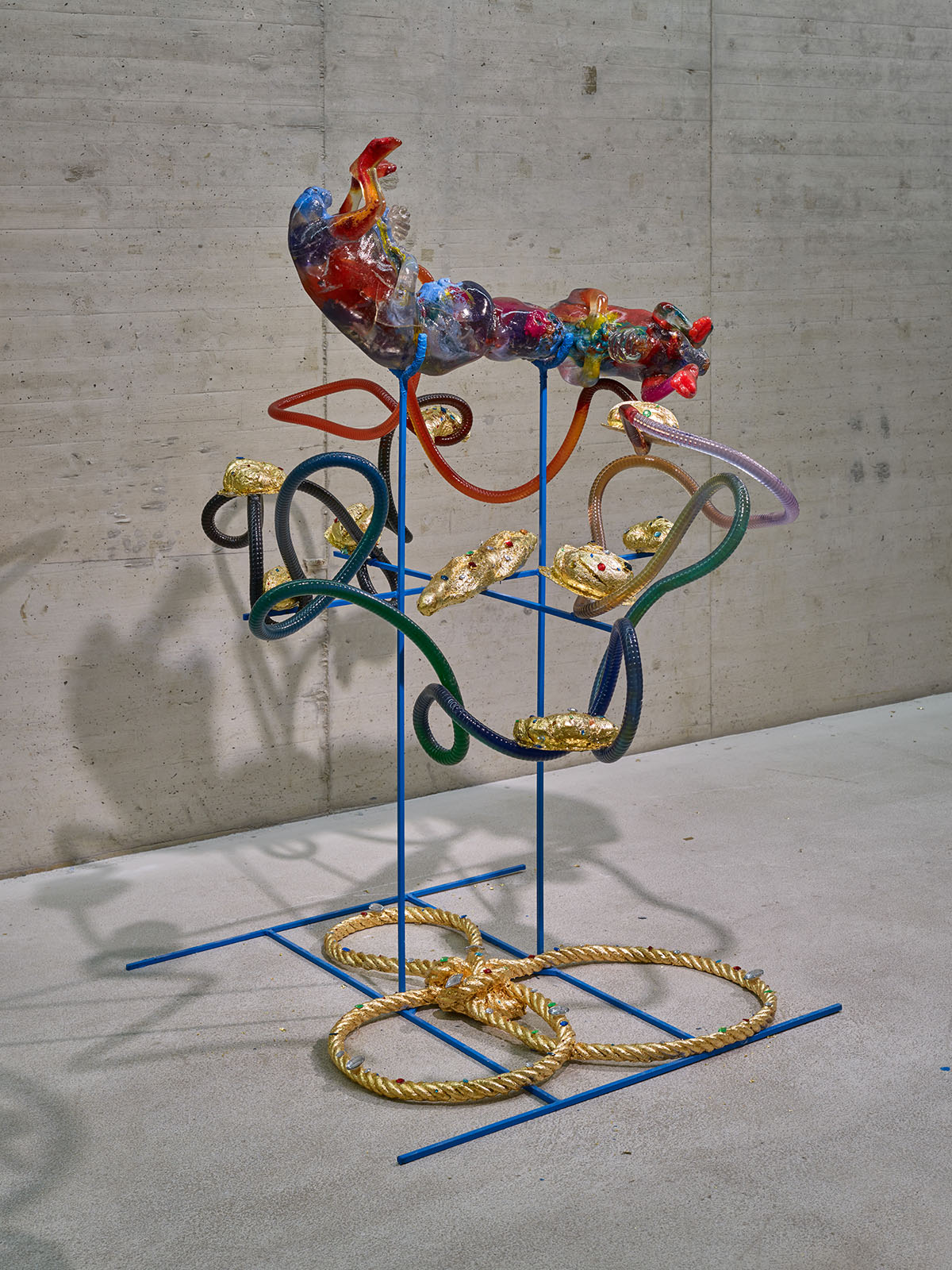
But there is at the exhibition in Dusseldorf and optimistic art, at least promising something in the future, even if not everyone among the audience will be able to make sure that these promises will come true.
All the best for children
Installation of Andrei Kuzkin "Everything is ahead!" It consists of 28 boxes of different sizes installed on each other and forming a small slide. Initially, the boxes were one less, five years ago in Moscow in them in the eyes of numerous witnesses, things from the artist’s workshop were stocked up - works of art, clothes, including the last shirt, dishes and even a working computer with all the work files in it, including the last sketch at that time. During the performance in the capital's open gallery, the artist put the documents remaining with him and even his hair in another box - Kuzkin cut his hair right in front of the public. All this was carefully packed and closed, and it will be possible to open the boxes only in 2040, when the son of Kuzkin will turn as many years as the father of the artist himself in the year of his death. In the meantime, the boxes carry as an illustration of how a separate person is trying on the phenomenon of the Russian psychotype, expressed in the phrase: “To the basis, and then ...” As the artist himself believes, “then,” as a rule, we do the same as “before”, but the experience of “before the foundation” is very important for our culture and history.
Is it important for abroad? Surely, especially today, when Europe once again thought about what Russia is and who Russians are.
The Russians are coming. New series
Of course, “there is no need to talk about any serious reception of Russian contemporary art in the West. As for the availability of interest, yes, of course, he is, ”says Natalia Gerthevskaya. Together with Evgenia Chuykova, she became the curator of the exhibition
"... after glamor." But the fact is obvious - there is a lot of Russian art in the West again: in November, two more exhibitions from Russian meetings, including the museum in Kolomensky, open in the same Dusseldorf in November.
Mutual sanctions and reduction of economic contacts served a good culture service - as during the Cold War, it again came to the fore, but the place of nesting dolls and ensemble "Birch" was occupied by the art of the museum level and theaters far from the aesthetics of socialist realism. Of course, there are also classical music, and there are few new ones: performers from Russia have long set tone on concert venues, whether it is opera theaters around the world, where many singers - graduates of the conservatories of Moscow and St. Petersburg, or the Salzburg festival - will not open the Vienna Philharmonic Orchestra for the first time in history, but the Perm orchestra under the Directorate of Theodore Kurentsis.
But the breakthrough of the Russian theater is an event of a different order. The program prepared by Marina Davydova for the Viennese festival was the discovery for many, the special success fell to the Moscow Ideal Husband in the directing of Konstantin Bogomolov and the “three sisters” of the Novosibirsk Theater “Red Torch” - the Western intensities were immediately reached for the Timofei Kulyabin, and manufacturers have long been following the cultural life of the Russian province and manufacturers have long been monitoring and manufacturers have long been monitored. CDs, and selectors of the largest festivals.
Mutual sanctions and reduction of economic contacts served a good culture service - as during the Cold War, it again came to the fore
Fine art is also in fashion again. After the increased attention of the perestroika years and the loud auctions of the works of unofficial art of the late 1980s, interest in it would seem to have come to naught. But the recent gift of the Paris Center Pompidu Pompidu, a huge, including 250 works, the collections of Russian post-war art and opened in the Bobur in this regard, the exhibition returned their rightful place in the world art-life to Russian artists (although their part is still ignored by art business, but here the reasons are more likely to compete, and not aesthetics). The less understandable codes of communication in the industrial and military spheres become, the more important the language of culture looks - then the little that if it did not unite, then at least the Soviet civilization with the rest of the world was reconciled and what is the main thing in the communication of two political systems today.
Not everyone considers new cultural diplomacy a response to a political crisis that erupted in the relations of Russia and the world. Thus, the Beethoven Festival’s quartermaster in Bonn Nick Wagner (she is the great -granddaughter of Richard Wagner and the great -great -granddaughter of Ferenc Liszt) believes that the constant choice of her festivals from Russia is determined by the quality of these performers, he is invariably high since Soviet times. But at the same time, for many “Russian posters” the festivals entrusted to them, there is a personal answer to the existing confrontation.
Another thing is that the mass thinking of an average European citizen is not much different from the thinking of an average Russian - all are full of stereotypes, and few are ready to part with them. In this regard, “... after glamor” for someone it will seem unbearable intellectual weight. It would be much easier to evaluate the ode of the Russian salon life - even if this life seems to be an imitation, but it is clear to the smallest detail.
Photo: IVO Faber, photo provided by Evgenia Chuikova