
Translated material
I will start the case
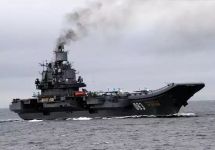
Russia withdrew a request for the entry of the ships of the Northern Fleet Aviation Group to the Spanish port of Seuta for refueling. This was reported by Interfax with reference to the Russian embassy in Madrid.
On Wednesday, the Spanish Foreign Ministry said that they would withdraw the previously issued permission to enter Russian ships in Seutu if they receive confirmation that the ships are heading to the shores of Syria to participate in combat operations.
"The latest requests for a stop are currently considered on the basis of the information that we receive from our allies and the Russian authorities," the ministry said.
The day before, NATO Secretary General Jens Stoltenberg announced the "concern" related to the fact that ships can be used by Russia to "intensify air strikes in civilian in Aleppo." At the same time, he clarified that the alliance countries have the right to independently decide whether to put Russian ships into their ports for refueling and replenishing stocks.
The permission of Spain is the Russian heavy aircraft -caring cruiser Admiral Kuznetsov and the accompanying group of ships to refuel at the port of Seuta condemned European politicians. “Only last week, the Spanish government signed up under a statement by the European Council, accusing Russia of committing war crimes against civilians of Aleppo, and today it helps a fleet, which has only one goal - the destruction of Aleppo and hostile actions against the EU and NATO,” wrote the head of the alliance of liberals and democrats for Europe in the European Parliament, ex -premier of Belgium Gi Verkhofstadt.
Ex-Minister of Defense of Great Britain Gerald Howwart called Spain’s decision "completely inappropriate." Later, the current Minister of Defense of Great Britain, Michael Fallon, said that the country will be "extremely concerned" if any of the NATO allies would assist Russian ships heading to Syria.
On October 15, the Northern Fleet Aviation Group began a campaign in the Mediterranean Sea. It includes the only Russian aircraft carrier Admiral Kuznetsov, the heavy nuclear missile cruiser Peter the Great, large anti -submarine ships Severomorsk and Vice Admiral Kulakov, as well as four support vessels.
Currently, in the Mediterranean Sea, up to ten ships and ships of providing three Russian fleets are serving as part of the constant operational unit of the Russian Navy in the Mediterranean.
On September 21, the Minister of Defense Sergei Shoigu said that Russia "will" send "Admiral Kuznetsov" to the Mediterranean Sea " to increase combat capabilities. “In order to realize national interests and maintaining the world in 2013, we resumed the constant presence of the Navy’s forces in the eastern part of the Mediterranean,” the minister noted, ”the minister said.“ I recall that in 1967 the 5th operational squadron in this area allowed us to prevent the growth of the armed Arab -Israeli conflict and in the future was important restraining a factor for unfriendly actions against the Soviet Union. "