
Translated material
In force and inright
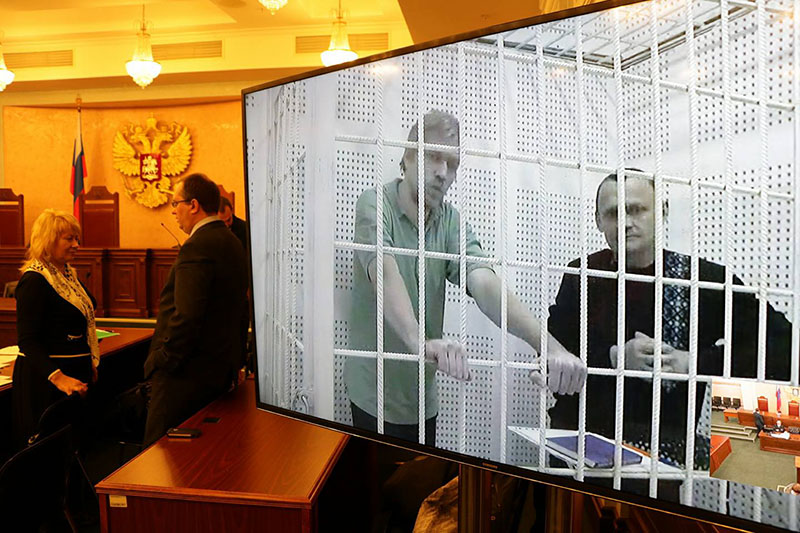
The collegium of the Supreme Court of Russia, as part of Peter Kondratov, Viktor Smirnov and Alexander Botin, upheld the verdict to the defendants of the UNA-UNSO case Nikolai Karpyuku and Stanislav Klykh, convicted of 22 and 20 years of strict regime, respectively, in the fabricated case about their participation in the first and second Chechen wars. This was reported by the correspondent of "faces" from the courtroom.
The reasons for such a decision are unknown, since the judges announced only its introductory and resolutionary parts.
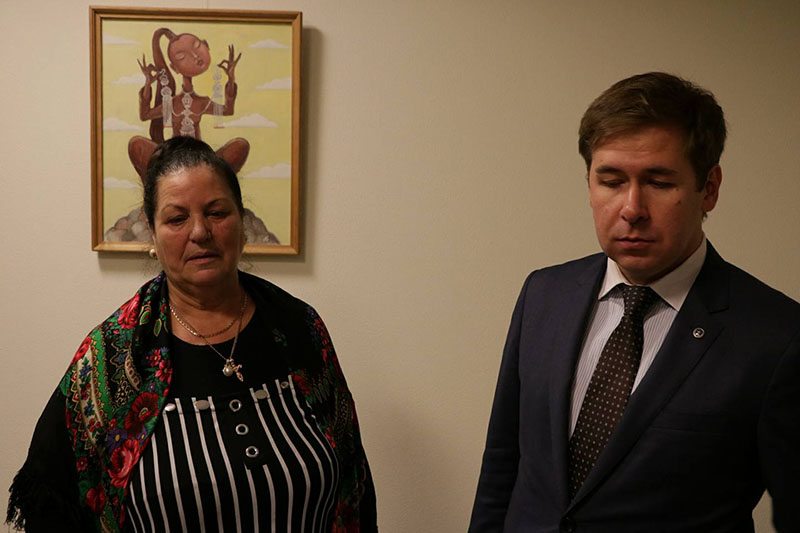
At the same time, however, the college canceled the private rulings of the trial court against the lawyers of Dokka Itslaev and Marina Dubrovina, representing in the process the interests of Karpyuk and Klykh, respectively. The definitions were made to the lawyer colleges in which lawyers were registered. The judge of the Supreme Court of Chechnya Vakhit Ismailov demanded to deprive both defenders of the lawyer status, arguing that during the hearing in the Una-UNSO case they committed actions "defaming the honor and dignity of a lawyer."
The Politzeki themselves participated in the hearings on the video from the pre-trial detention center-1 in Grozny . Klykh, who received a mental disorder as a result of torture, on October 17, during the trial in his second case, refused the services of Dubrovina . However, the next day, the second lawyer Karpyuk, Ilya Novikov, said that Klych’s refusal concerns only a new business, but did not do UNA-UNSO. In addition, both political prisoners during the visit of Itslaev and Novikov to the pre -trial detention center signed a single defense statement. Thus, Itslaev, Novikov and Dubrovin began to represent the interests of both convicts together.
Shooting Dmitry Borco:
The appeal of Karpyuk and Klykh. Savchenko in Moscow
The prosecutor Guliyev, speaking at the hearing on Wednesday, called the verdict in the Una -UNSO case "clear and consistent", and the terms issued by the Political Zygs - "deserved and fair."
Meanwhile, Karpyuk in his speech stated that the trial court, when pronouncing the sentence, "as it were, declared legal extraterritoriality to Russian legislation and Russian law." "Here is the concept of" law "in general ... This is how the FSB officer tells, so he is interpreted. And as for the jury, they were immediately asked: for whom - for Ukraine or Russia? They were not asked: are you for the truth or for lies?" - noted Politzek.
The lawyer of Dubrovin, in turn, said that Klyha was tortured after detention, and also exposed to psychotropic drugs. Klykh could not sign the protocols during the investigation, since his hands were "completely turned off", the lawyer continued. However, the confessions obtained under torture were not recognized as unacceptable evidence, and they were read out by the jury. Based on these confessions, the assessors in Grozny carried out a verdict.
In the plot of the Grozny GTRK, Dubrovin, Karpyuk and Klykh continued, even before the verdict, peremptorly called the gang participants and the killers of the soldiers. The program claimed that the participation of two Ukrainians in the battles in Chechnya is a "proven fact", the undoubtedness of which is convinced of the "whole public."
The judges satisfied the defense of the defense of introducing the case of all evidence of the innocence of Karpyuk and Klykh. At the hearing in the Armed Forces of Chechnya, Ismailov refused to introduce all these documents. However, the attached evidence did not affect the decision of the board.
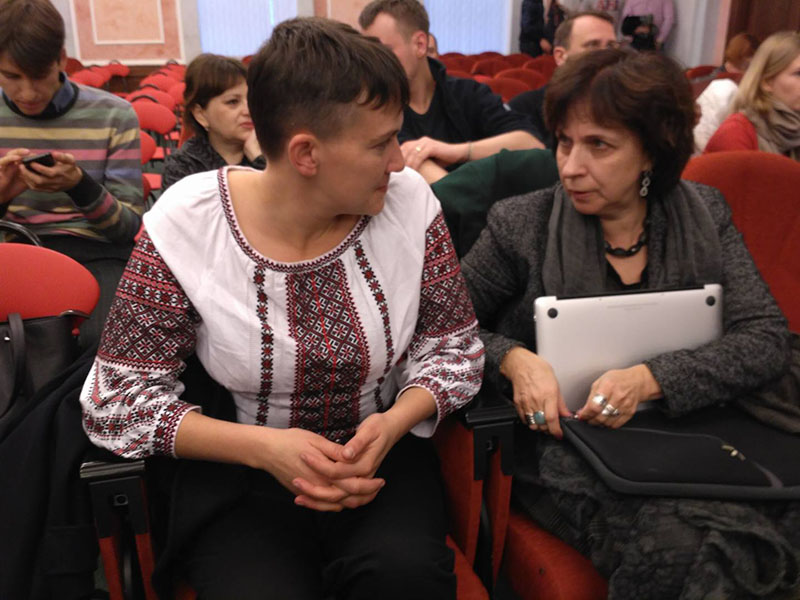
The deputy of the Verkhovna Rada of Ukraine, the former prisoner of war, Nadezhda Savchenko, came to the complaint from Kyiv. During the break of the meeting, the employees of the pro -Kremlin media asked Savchenko provocative questions, but the former prisoner answered them in silence.
Photo by Dmitry Borco:
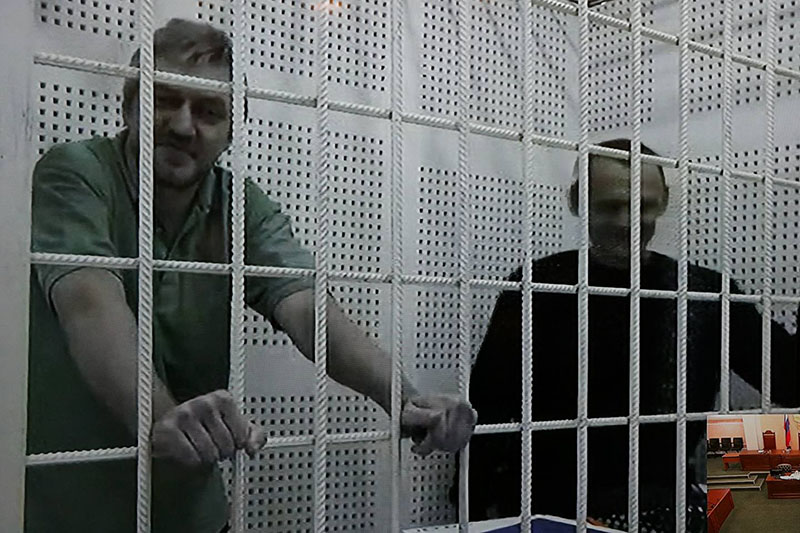
The jury verdict in the UNA-UNSO case was issued on May 19. A week later, on the 26th, Ismailov announced the verdict . Karpyuk was declared guilty under part 1 of Article 209 of the Criminal Code of the Russian Federation (gang organization), and Klyu - in part 2 of the same article (participation in the gang). In addition, both were found guilty by paragraphs “B”, “Z”, “H” of Article 102 of the Criminal Code of the RSFSR (intentional killing of two or more persons in connection with the fulfillment of official debt, committed by preliminary conspiracy by a group of persons) and part 2 of Article 15 - points “B”, “Z”, “H” of Article 102 of the Criminal Code of the RSFSR (attempt on the same crime).
Karpyuk was recognized as the commander, and Klykh, the fighter of the Viking detachment, who, in December 1994 - January 1995, allegedly fought with the Russian military in Grozny in the territory of the presidential palace, as well as on the square and the railway station. During the fighting, according to the Fabul of the case, Karpyuk and Klykh "deprived the lives of at least 30 military personnel and at least 13 military personnel were injured in varying severity." Another episode was the participation in the Second Chechen War imputed by the defendant.
At the trial, neither Karpyuk nor Klyat was guilty, saying that the testimony was given under torture. The entire accusation was actually built on the testimonies of the recidivist Alexander Malofeev, sentenced to more than 20-year for double murder during a robbery and a number of deadly diseases. During the trial, the defense showed that the course of the events of the First Chechen War, set forth in the case, contradicts the facts.
In fact, neither Karpyuk, nor Klykh before arrest were in Chechnya. Witnesses of defense, questioned in the court of first instance, argued that Malofeev did not take part in the Chechen wars.
On June 16, it became known that the Ministry of Justice of Ukraine sends a request for the issuance of Karpyuk to Russia, and on June 23 - that the same request was sent against Klykh . Lawyer Itslaev noted that Karpyuk, if necessary, was ready to send a petition for pardon to Vladimir Putin.
Later in the summer, Klykhi filed a letter to the Prime Minister of Ukraine Vladimir Groysman. He asked to speed up negotiations on the exchange of citizens of the country convicted in Russia in fabricated political affairs.
Later, in August, the Zavodskoy District Court of Grozny began a trial in the second case of Klych. It was fabricated in the spring under part 1 of Article 297 of the Russian Criminal Code (disrespect for the court, expressed in insulting the participants in the trial), which provides for four months of arrest. The “victim” in the case is the prosecutor of the criminal subordinate department of the prosecutor's office of Chechnya Salambek Yunusov, who supported the charge in the UNA-UNSO process.
The reason for the new persecution of Politsek was the incident that occurred on February 20 during the hearing about the extension of his arrest. When Yunusov began to prove the need to further maintain the political prisoners in the pre -trial detention center, Klykh began to interrupt the official with curses addressed to him.
The behavior of Stanislav Klykh in court. Video "Mediazons":
Initially, the trial was led by judge Ahmed Imayev, but then the consideration of the casewas entrusted to another judge - Aslambek Shaipov . Since the lawyer Viskhan Basayev, who protects the Klykh by proxy after the refusal of Politzkek from Dubrovina, did not, unlike her, achieve a call to hear all witnesses, Shaipov completed the judicial investigation at the second meeting in the case. The debate of the parties was scheduled for October 31. Then the performance of the fang is planned with the last word.