
Translated material
Jan Fabr - Botox injection
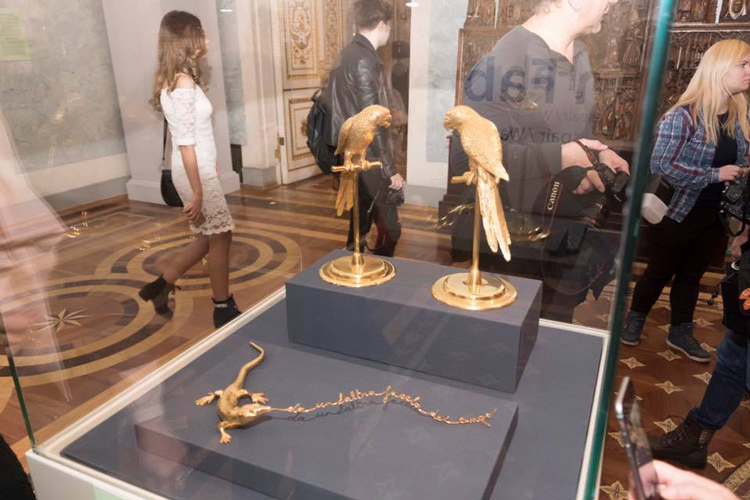
Jan Fabr is a sleek gray -haired Belgian with a noble oval face and a thoroughbred nose. The older generation of the shocking European aristocracy, tanned white people standing on the author’s cinema, on the one hand, and the deep enlightenment and talisman tradition-on the other. It took almost two years to think about how to pack the Fabra in the Hermitage , which is only pretending to be the Louvre, but in fact remains the Byzantine palace. During this time, the Fabr managed to do cases in the world of performance and shocking, domestic cultural processes changed the vector, and budgets - scope. It is precisely because of the contrast with the trends and due to the reputation of the Hermitage Fabr that looks juicy and fresh. The country's main museum, because of its vastness and imperial ambitions, is in many ways old-fashioned, but it is he who may afford to not reckon with the bred censors and “activists”. Finally, the Fabr is the Belgian, and the good half of the Hermitage second floor is occupied by its eminent fellow countrymen. Here, the spirit of Netherlands, adored by the art critics Van Dyck and Rubens, has the best positions in terms of light and geometry of the halls, monumental still lifes with a carpet are reigns here.
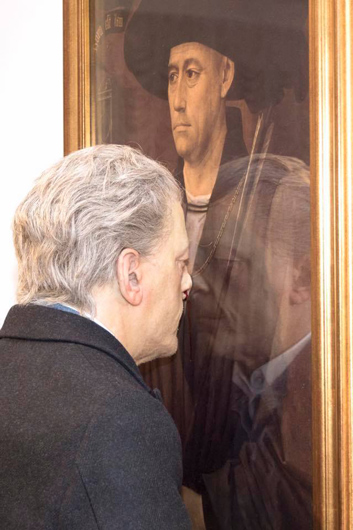
However, it is better to start watching the Fabra in the main headquarters. Already rising from the wardrobes along a cozy staircase, where someone is taking pictures on each step, you see a video on the screen: Jan Fabr walks along an empty winter, tinkling with a armor and kissing the exhibits. You are envious, because you also want to dress up in a knight like that and retire with Rembrandt, feel the old frames. But you are only a modest connoisseur, not a shocking artist, your destiny is a turn, crowds of tourists, anger of caretakers, if you suddenly touch something.
 © State Hermitage
Fabr really notes in an interview that the Hermitage gave him much more freedom than the Louvre. It was the Paris exhibition that inspired the Hermitage functionaries to a similar event in Russia, and here, perhaps, there is a certain competition. Move Van Dyck? Of course, just tell me where. Turn the magnificent old -regime hall of Flemish painting into an illustration of absent insanity? Great idea!
But back to the main headquarters. The exhibition begins with the absurd dialogue “Beetle and Fly”, that is, Yana Fabra and Ilya Kabakov. “Kindergarten, oh, well, here is a kindergarten,” - delicately clamping with heels and tongue, two ladies comment on, in appearance - the peers of the Fabra. In fact - yes, kindergarten. Only a conceptualist and European-Roves, who are sold at an inflated price, can afford to play some larvae. And you do not envy.
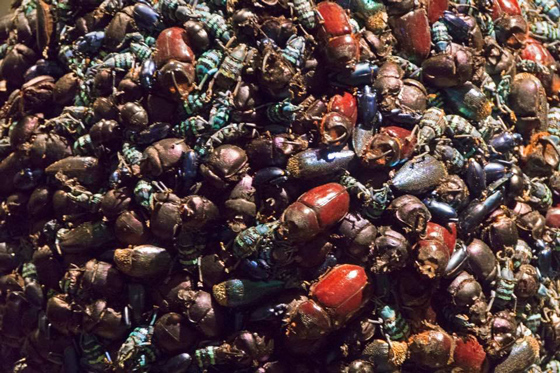
Before going to the exhibition, you are warned by all possible channels that the artist is a descendant of Jean-Henri Fabra, a major entomologist. Because the first impression of the exhibition still needs justification. As if they watched the special issue of “in the world of animals” from the life of insects (or rather, from death). Something between the illustrations of Krylov’s fables and Marvel's “man-man”. Even about the influence of books about the diseases of the oral cavity on Francis Bacon before the exhibition in the same Hermitage, they were not so persistently remembered.
 © State Hermitage
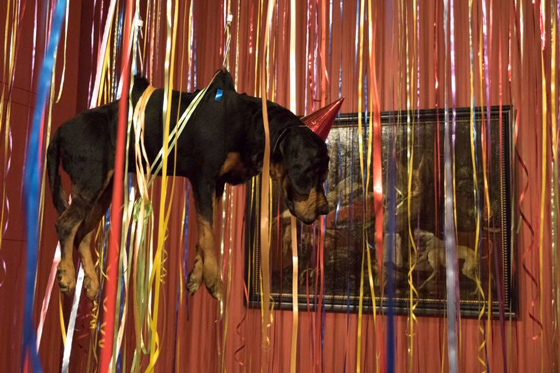
The apotheosis of the exposition of the General Staff falls on Umbrakulum, the Carnival of the Dead Warden and a symmetrical exposition with dead cats. What irony-while the whole country is discussing the Khabarovsk girls-animals, the Fabr is obviously hanging animals at the high ceiling of the headquarters. Around there are ribbons and confetti, restless mongrels are dressed up in carnival caps. In this you can see a still lifted perception in combination with atheism and Flemish traditions, but for a mass viewer without a sense of black humor, a carnival is a simply strange perversion that someone put into an Hermitage. And the Umbrakulum should be deciphered for a long time and consistently. Some ghosts in hoodies made of lace bone plates, flying miracles of orthopedics of the colors of pouring oil (goldfish, seems to be universal material). So we approach another “sharp corner” of Fabra's works. Umbrakulum in an everyday meaning is a yellow-red silk umbrella. In a symbolic dimension, this is the designation of basilica, and the basilica in Catholicism is the title of elected churches. Yana Fabra’s mother was a zealous Catholic, he himself is “fortunately, an atheist,” which allows you to shamelessly juggle with symbols. Scenes of animals, skulls, bones and other material evidence of death for him are the best material. And the goal of the exhibits is not at all “reflection on death”, but its statement in the understanding of the atheist, a kind of fatalism of the atheist.
 © State Hermitage
However, Fabra has another dimension on which the Hermitage Exposition insists. It is patho -called “knight of despair - a warrior of beauty”; It is on the romantic, courteous component that the exhibition in historical halls is emphasized. In his beloved children and impressionable adult Knight's Hall, the artist seduced on the lining of the exposition and put a wasp and a beetle near the horsemen. What is only the next performance of Fabra: a gray-haired artist, dressed in armor on a naked body, turns back and forth a sword. Or the sword turns him, it's hard to say. Again, you envy the Belgian and also want to dress up in the armor. But the most intriguing game moment is by chance to find a fairy in shaded Hermitage halls. It can be huge bird heads or a stuffed rabbit (curtsy durera), a skull holding a painting brush in his hands, finally a couple of Hermitage masterpieces painted with a ballpoint pen. The permutations in the usual halls, the global submission of spaces to the modern artist - Botox injection to the Hermitage as a museum space, the invitation of our conservative viewer to play a bit. And in this sense, the main thing is that there are no degree of delight to the exhibition in the art community, and that thousands of spectators will decide, stumbled upon skulls and stuffed animals where they planned to show the children, for example, Puritan Baroque Van Dyck.