
Translated material
"Now the price of music has fallen very much"
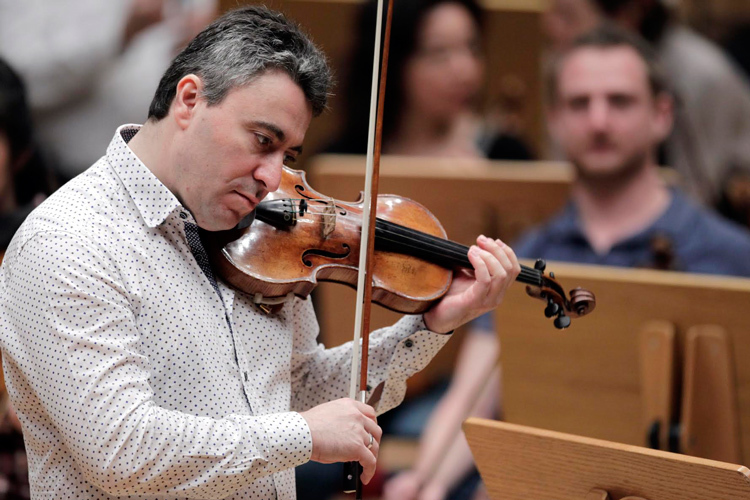
On November 4, a solo concert of Maxim Vengerov will take place in the Great Hall of the Conservatory as part of the II International Violin Festival . The famous violinist called Lyalya Kandaurov.
- Maxim, which country am I calling you?
- Now I am in Poznan, I work as chairman of the jury of the XV violin competition to them. Venyavsky, this is very interesting. Today will be the first listening to the final tour, the level is very high. This is the oldest violin competition in the world , a legendary, in which David Oistrakh, Ida Gandel and Zhinett Neuli participated at different times.
- As a person who knows the competitive process on both sides, have you changed your attitude to competitions?
- Certainly. Today, competitions should be transformed into a certain platform for young talents. They should be a startup for their career.
- Wasn't it before?
- It has always been, but young people come to contests without a large stage experience, so it is very important for them to communicate with the jury members. After each round, we have communication with musicians, everything is quite open and passes in a friendly atmosphere. Therefore, there is no sense of competition, such as before, I am against it.
-You are always represented as a “violin-virtuoso”-does it offend you?
- “Virtuos” is absolutely correct. How to understand this word? Based on music, then the music of Bach and Mozart requires virtuoso reading. This means that the musician should be technically equipped. He should not just be able to play quickly, like virtuoso in the general sense: Paganini or Venyavsky. Each composer dictates his set of technical techniques: for Shostakovich - one technique, for Mozart - is completely different. Often, musicians who can play Paganini well, masterfully, cannot play Mozart. “Virtuos” is the person who can play any music, and today the musicians should not only specialize in any particular era, but be able to play everything.
- But you play a mass of specifically virtuoso music - Paganini, Isai, Venyavsky. At a concert in Moscow you will play Ernst . Are you not tired of such music?
“But I will play still Beethoven, Schubert, Ravel, the twentieth century.” I can’t get tired of playing virtuoso music, because I really love my instrument, and virtuoso music is also remarkable, it is great in its own way. Paganini is the style of Bel Canto , opera, this is also very interesting in its own way. In addition, interest in the tool, in the craft should not be lost. Beethoven, of course, is a brilliant composer, but he never wrote for the instrument, he simply expressed himself through music, and the violin was just an excuse to write music. On the contrary, scripch composers, such as the Izai, Ernst, Paganini, is an era, a great tradition. And David Fedorovich Ostrakh performed virtuoso works, and Haifets. The twentieth century is the most prolific in the sense that the violinists themselves were the composers, and such authors were before that.
What does "making money" mean? To begin with, in the sense in which this expression is customary to use, it is inappropriate here.
- But if we talk about the XIX century, then the performers often contrasted virtuosity with serious art .
- This is a cliche. It depends on how to use the concept of “virtuosity”.
- So, if there was no need to make money, would you play the same music?
- Absolutely. I played from the age of five and also felt like on stage as today. What does "making money" mean? To begin with, in the sense in which this expression is customary to use, it is inappropriate here. Now the prices for musical instruments are very high, and not every musician is able to pay millions of dollars.
- Yes, you sometimes not without pride talk about your fees and often associate them with the prices of tools. Once you said that Haifets could afford to buy a tool after three concerts.
- Certainly. Now the price of music has fallen very much. Not only in a monetary sense, but also in the human. Cultural values fall, and this is expressed, of course, in the fees of musicians. This process at the moment is irreversible, but let's better talk about music.
- What violin do you play?
“I play Stradivari, the Tom tool on which the violinist Rodolf Kreutzer played.”
-That is, this is the same tool that you bought in the late 90s ?
- Yes, the same, but David Fedorovich Ostrakh, for example, had not one, but two violins and even more. Now are other times. But if you want to talk about the payment of musicians, then it’s better not with me - everyone should do their own business.
- Are there any parties to this case that you have to put up with? “Six great composers in one evening. No fakes, only true emotions ”: will you do not make such slogans?
- I am engaged in art, but there is also a PR that attracts the audience. This goes regardless of me, I do not come up with these syllables. And I read the press very little, I don’t have time for this.
- In an interview with 2009, you say: “You know, I can say without false modesty - by the age of eighteen, I could, in principle, end the violinist career. Because he really reached the ceiling in it. ” What is a ceiling in a violinist career?
- Here we are returning to the question of virtuosity. When the musician exhausts himself as an instrumentalist in his craft, reaches a certain perfection, it is necessary to look for other means of expression. This is possible only through the deepest research, a huge love of art. We need to go, develop, revealing new horizons in music and in life. Therefore, already at the age of 20 I went to study - I played on Alt, on the baroque violin, began to develop as a conductor, taught. I never stopped at what I had reached, because I understood that I was not enough to be just a talented musician, a good artisan. I met on my way the most brilliant musicians - Mstislav Rostropovich, Daniel Barenboym, who revealed to me the magical world of music. They were an example for me-both were conducted, and there were many other instrumental-divisors. If I had not met such musicians, I would be just a good violinist.
At 22, I was very dissatisfied with my sound - it seemed to me that he was squeaky.
- Do I understand correctly that under the "ceiling" you then meant technical omnipotence?
- It does not happen - there will always be a person who will play faster and louder, but this is not a sport - is that the matter? Each person sets himself a ceiling, a bar, on which he can say: "Here I jumped above all." But I never did it. Each concert was connected with me with a new discovery, I tried to know something and never calmed down. This is the path of the musician-he is not determined by one or two concerts, a year, a decade. We learn while living.
I noticed that after every experience as a conductor and teacher, when I returned to the same works, I began to interpret them differently. New colors appeared, energy and even sound changed. I won’t forget how, at 22, I was very dissatisfied with my sound - it seemed to me that he was squeaky, I wanted to reach a more baritone sound on the violin. Then I began to listen to many symphonic works and tried to imagine that I was playing not on the violin, but on the cello. Then he picked up Alt, recorded the concert of Walton , and I succeeded - my sound became much richer, other colors appeared. And the personality of the musician determines precisely the sound, and not just virtuosity - how loudly or quickly he can play.
- In the same conversation with Financial Times was such a phrase: “When people come to the temple of music, all political, religious and ethnic disagreements disappear” - do you really believe in it?
- Of course, this is certainly so. Music is a unique universal language that allows you to convey many emotions through sounds.
- And in another conversation , you said that "the world of music is cruel."
- This is elongated from the context - in what sense I said that?
- You talked about competition.
- It depends on how to look at it - he is cruel if you chained yourself. And if you just love music - the world is no longer so cruel, you are doing your favorite thing. And then this is a kiss of the Creator, because not every of us can afford to do a business that he really loves.
- What role does non -classical music play in your life?
- For me there is no separation - classical and non -classical. For me there is a good and less high -quality music. I really love folklore music, it is the primary source in music, widely used by brilliant composers - Russian classics, Viennese classics, and in German music: we will take how I used the gypsy motives of Brams . Therefore, for me, folklore is the source. Then - music written by brilliant composers. And then - popular music that uses classic forms: this is a fact, not my opinion.
“Yes, you mentioned this:“ The well -known fact is that any popular music, epic or jazz, of course, takes its origins in classical music. ”
- I meant that this is not the source, but there, of course, there are discoveries. Take the Beatles - in a harmonious sense, they draw at Henry Persella.
- About the injury of your right hand that led to a four -year pause in your career, you said in one interview that you were "pumped." This is true?
- This is very exaggerated. Indeed, I went to the gym, but this was not the main reason why I stopped for a couple of years and did not play the violin. People love sensations.
When this happened, it gave me huge opportunities to develop as a conductor, as a musician, as an individual, and there is nothing unusual in this pause. I do not compare myself in any case, but the breaks in the quarry happened both in Paganini and the sheet. Vladimir Gorovitz did not play at all for 12 years, he took a timeout three times in the profession. What is a few years on a life scale? Nothing.
- Still shaving?
- Yes. I still swing (laughs) , but I don’t hang for two hours on the horizontal bar.