
Translated material
About the certainty of the article
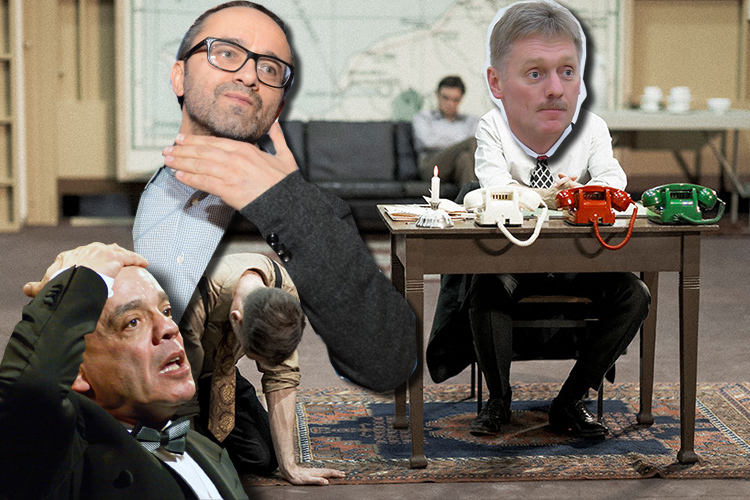
The discussion of censorship and freedom of creativity, erupting after the performance of Konstantin Raikin in the STD , is apparently potentially endless, so it would not be worthwhile even more than to expose it, if not for the sad state of affairs, which she outlined with all clarity. Not in the field of censorship or freedom of creativity - in the field of discussions. In this territory, everything is too easily given to us too long. The society is so polarized that there are no difficulties and subtleties at all. Of course, inside each segment there are evade and their subparagraphs. But on large topics and in rhetorical heat - what questions and doubts can be, who is right and who is to blame around? Disputes, if they continue to be conducted, is that perhaps with grudges, conspiracyrs and snobs, that is, the very last cut, and the arguments in such disputes are exclusively formulas like “all of them in the maza world”, “this is all for the PR”, “this is all for the sake of money”, “what is he before”-cast and incontrovertial in his cretinism. Not far from them, those who adhere to a certain ironly formed and, moreover, is purely individual, for the extravagant, pictures of the world and for each similar reason publish their ornate reasoning, which comes to variations on the topic “I have long said that”. In general, all verdicts are ahead of time. Thinking is replaced by a position, the only function of the text is to strengthen the reputation of the author. And if such a state of affairs has developed, it must be admitted that there was any reason and some sense in it. This meaning is just purely social. The essence of the subject has a distant relationship. Moral correctness is a trump card, but not a jocker. And in fact, it does not replace and does not determine the right, logical correctness. Alas? Well, let alas. And yet.
Take at least the current incident. It also has indisputable things. Well, of course, Raikin is right in everything-in fact, no revelations in his speech were supposed, except that all these, in general, are deeply banal (in the best sense of the word) things for a long time to pronounce high stands and even in the fusion, but he took it and said. Of course, the legislatively approved lack of censorship is good. Of course, the herds of initiative freaks, wandering over exhibitions and performances and responding to outbreaks of aggression to their own fear of any form of freedom, are not only disgusting, but also seriously terrible - perhaps even more terrible than during the times of Schemrin, which was sophisticated. And, of course, the statements of the surgeon or Ramzan Kadyrov do not have any public discussion at all (for the simple reason that any conversation about these characters, not containing non-normative vocabulary, is an act of low and unworthy). In each of these points, everything for sure and does not imply; each of them can be completed by an energetic “and point”; Each of them is almost bored. But where is the side branch of the discussion, which arose from the reaction of a certain Peskov and the response column Andrei Zvyagintsev in Kommersant. The question of moral is right in this confrontation, too, of course, more than idle. The question of the right logical is much more entertaining.
Both with Zvyagintsev and with the echo of Moscow, which he eched to him by Viktor Shenderovich, their moral correctness seems to play a bad joke (with the first of them, however, far from the first time), as well as the lack of articles in the Russian language, when it comes to the authority of power-more precisely, state bodies-at least somehow influence the cultural and aesthetic process. Which power? Generally ( A ) - or specific ( The ), current and local? In the second case, let's say, power (at least from the point of view of Shenderovich) is generally illegitimate-is it definitely not the right to at least indicate anything to artists? Is it definitely not because she is stupid, ignorant and cattle, but solely because she is power? When Shenderovich says “you throw us scraps from our table”, when the Zvyagins exclaims “Who are these people who make an order?” - Would they use the same expressions if, instead of Medinsky and Aristarkhov, it was, for example, about Minister Andre Malro or even to the Minister Maurice Drewone? ..
The state is just a state, and not a bandit and not the Lord, but the artist is precisely an artist, and not an orphan and not a prophet.
The relationship between the authorities and the artist is the theme of impeccably conflict and rich in all kinds of overtones, and the range of historical examples here is that they can be beaten by the opponent, not at all sinking to the prose of pure logic. We will go down, however, and forget for a while, heroically restraining the shudder, about reputations and merits. When a certain Peskov says: “If the state gives money for some kind of production, the state has the right to indicate a particular topic, but this is not censorship,” he, literally, is right. On the topic “The feat of the Soviet people in the Great Patriotic War” can be removed, what is a sin to hide, “Stalingrad”, but it is possible “twenty days without war”; On the topic “Portrait of our contemporary” you can remove the “collector”, but you can generally “Leviathan”. For that discouragingly simple reason (even officials do not suspect this) that the topic itself - decisively determines nothing in a work of art. The artist’s freedom, in particular, is based and idealized by Zvyagintsev, and it is based on that you can’t detract from any “topic”. The crafty Mark Zakharov, commenting on the discussion, cites an example of a foreign play, “where a person fell in love with a goat,” and advises the director “to refrain from the performance by all means”; And yes, the state has the right not to give money for a performance, where love for a goat would be a topic. But if the topic is, say, the same “portrait of our contemporary”, and love for a goat is only (as it turned out in the creative process) the interpreting of this topic necessary for the director, the state is no right to do anything. In short, the state order is made on the topic, but the censorship is interpreted, the result, the finished work. “If the state believes,” Peskov explains his position, “that smoking is harmful to health, then the state has the right to say that no one smokes in the cinema if it pays money for this. Can this be considered censorship? It is forbidden". Oh no, the sweetest, but this is just it. In this case, the state, perhaps, has the right to order a film on the dangers of smoking (unless, of course, there is a madman or a cheap, who will take such an order). But this film, we note, will be very, very difficult to make so that no one smokes in it.
When Zvyagintsev writes that “the situation in our economy and culture is now such” that there are almost no performances and films made without the participation of the state and “almost the entire cultural life of Russia is engaged in power today,” he is right, and this is just a genuine problem - but this is another problem. It is not that the state considers itself the right to distribute state orders, but that it has an actual monopoly. The state is a boring thing, narrow, definite (no matter how much it interests and demonizes itself), and its interests are the same, including in the field of art; On that conflict and is based. For performances and films made with state money, just normal to be boring, boring and musty; The problem begins when for each such performance and the film does not have to be ten other, made with private money. It is possible (and it is necessary) to reproach the state of the fact that it prevents (or does not even contributes) to the “development of the private sector”; But it would be strange if it had changed its own stupid rules rooted in its very device because of this. “Not they,” writes Zvyagintsev about officials, “developed the laws of poetics and aesthetics, formed the directions and course of modern cinema or theater. How can they “order art”? ” And, in fact, what's the problem? Not Julius II developed the laws of the Renaissance perspective, but this somehow did not stop him from making an order from Michelangelo. If it is not necessary to break at least one egg yourself in order to judge the taste of the fried eggs, then to order the scrambled eggs, this is not required at all. And do not hurry to be offended by the fact that with scrambled eggs, they say, God's gift is in the way. For hundreds of years, painters, musicians, poets existed at the expense of orders, and almost none of their customers - whether private or state -owned ones - did not mean anything in the laws of poetics. And yes, this often led to conflicts - when, for example, Bachh needed twenty performers, and Leipzig gave him a budget only for eight. And no, it never became a fundamental conflict. It is possible (and as often as possible) to complain about the inertia of the authorities and passionately desire the best, but if they distribute the money of taxpayers, then this is precisely because they - the authorities are the interests that are almost opposite to artistic interests. The state’s ideas are always given by provincialism and idiocy, so this leviathan is arranged, and this can be considered for a good reason to completely excommunicate the state and aesthetic process from each other. But to demand from him on this basis complete and reckless custody is at least illogical.
When the participants in the discussion resort to a textbook argument that this is “not their money”, but ours, taxpayers, and why they spend it at their discretion, then this argument is only in appearance to an unlimited. No, not ours, we gave them out, the payment of taxes is a gesture of trust, and the fact that in the current situation we are forced to force this gesture, and the confidence, to put it mildly, abuse, there is a purely political issue. In other words, if the scenes and screens do not have performances and films that are necessary (in the opinion of the people, source of power) for the cultural prosperity of the state, and officials are neither in spirit or spirit, then this is an occasion to demand from them to revise the “list of topics”, to enrich, expand, reorganize - and not a reason to cancel. No government has the right to control the creative process, and even more so have their own opinion on its results; But to launch it for those purposes that are available to her understanding is quite. She may not use this right at all, reasonably considering herself incompetent and completely washing her hands, completely giving the art of self -sufficiency; But she cannot use it blindly, unconcorting, renouncing her understanding, for the blindness of the authorities can only be compensated for in such an exhausted society as ours, in general she is not only stupid, but also dangerous. Probably, the predatory and dull practice of “management of culture” in modern Russia is even worse; perhaps. But the ideal that the “moral” participants in the discussion are not just embarrassed and is not only strict and from a practical point of view - it is also vicious.
Actually, the basic models of the coexistence of the artist and the authorities are only two. One - centuries -old, ancient, resting exactly at the state order and, in general, the et who is inherently; Within its framework, Bach worked as a damned over the salary, Rasin and Moliere were flattered to the king, and for Derzhavin there was a governorship at all the source of income, but the Odes were more likely a hobby, which is profitable except in the field of “status”. Another model is a bourgeois, resting on private orders, which is collecting from the art of self -sufficiency, leading Van Gogh to the madness of poverty, while Gorky or Leonid Andreev showered with the golden rain of fees. Soviet culture was built, in essence, according to the first model, and it is its modern Russian government as normal and natural. If it is extremely loaded, the first model (ceteris paribus) gives the artist stability, the second - freedom. The problem is that they cannot be combined. The freedom of creativity, given by the bourgeois model, is not from responsibility to the authorities and the state, it is generally from any communication with them, including the dependency, and it cannot be partial - for the reason that freedom cannot be partial at all. Yes, the artist keeps an answer only to his public - well, for this, the audience pays for tickets; She does not pay taxes for this. And it would be strange if she paid for the artist’s work twice.
... Everything written does not cancel the undeniable: censorship is evil, cultural policy in modern Russia is mediocre and clumsily, and any “social protests” against cultural phenomena, repaired by citizens, soul -sophisticated, should be steadily suppressed by the state on the line that begins “violation of public order”. But even if the norm is perverted repeatedly, regularly and with threatening systemicity, an alternative to this perversion is not the ideal of total connivance (which, in the end, only flatters the favorite idea of current state husbands, that they must decisively interfere in everything), but strict adherence to the essence of public agreements and phenomena, where nothing is absolutely absoluted, everything has its dignity and disadvantages and the state is just that this The state, not a bandit and not the Lord, the artist is precisely the artist, and not the orphan and not the Prophet. It is annoying, of course, that there is no article in Russian; They pretty much contribute to the clarity of thought, especially when it comes to a state in general in a state like ours. The author of the first “Leviathan” was more fortunate here.