
Translated material
Why are nanomashins already created, but the nanocomputer is not yet?

In the last issue of the TRV-hobby, it was about the deposit of three Nobel laureates of this year in chemistry to the creation of nanomashi [1]. It was relatively easy to explain the essence of the achievements of each laureate, because there is hardly a person who does not know that the car is driving, the motor is spinning, the shuttle-he wits back and forth (therefore, a spacecraft flying back and forth was called shuttle). What the computer does, everyone also knows: speaking in the most common words, processes information. But how does he do it? And why are there already molecular nanomashins, and the molecular nanocomputer, which, as well as about nanomashians, “discussed for fun” Richard Feynman, has not yet been created? To understand the reasons for this, we recall the principles of the usual computer.
Almost all modern computers use a binary number system to process information that operates only with two digits - 0 and 1. The information processing occurs using semiconductor logical valves (LV). A signal is supplied to the input of the LV, which can only have values of 0 or 1. The LV output signal can also take only 0 or 1 values, and which exactly depends on the type of valve.
The ratio between the input and output signals is determined by the states table (Truth Table), table. 1. The main LV is an inverter of “not” (not), a valve of logical multiplication (conjunction) “and” (AI) and a valve of logical addition (diesel) “or” (or), with the help of these LV any logical function can be built. Obviously, the inverter invert the signal: if at the entrance “0”, then at the output “1”, and vice versa. Multiplication in logical algebra is similar to the usual one - at the output of "1" only if at both entrances "1". But the logical addition differs from the arithmetic - at the output of “1”, if at least at one entrance “1”, that is, the logical sum of two units also gives one (in logic this corresponds to the rule: the statement is true if at least one of its components). The valve “excluding or” (xor) is still useful to us, which gives “1” at the output if there are different signals (“0” and “1” at the entrances), but if at both entrances the same signals (both “0” or “1”), then at the output “0”.
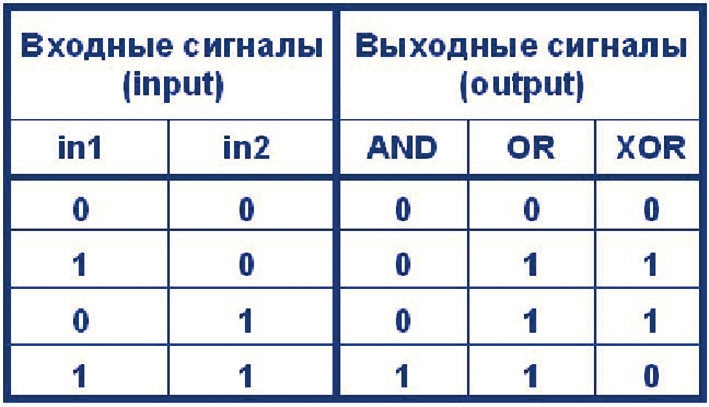
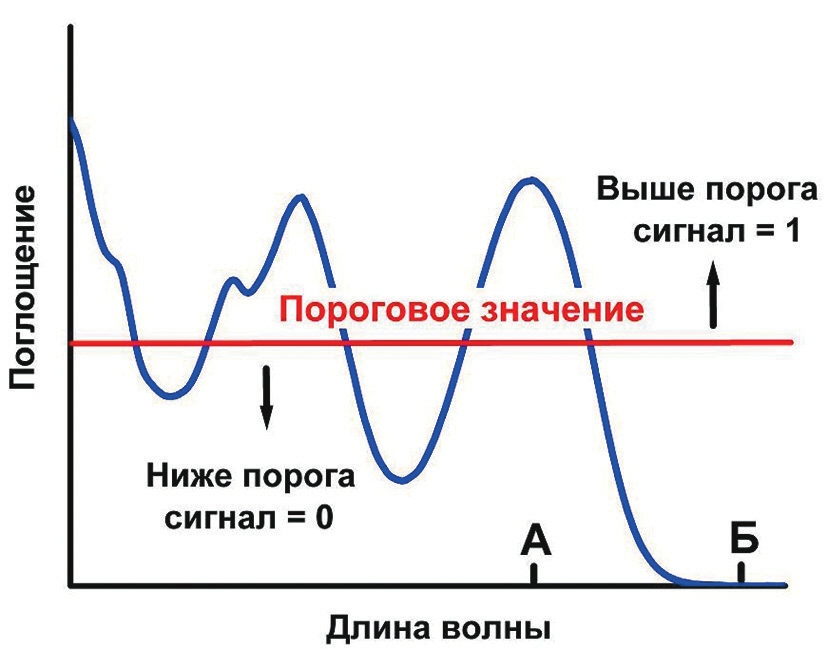
At the material level, the semiconductor LV is a transistor or several transistors connected to a circuit. What is exactly the signal, 0 or 1 is determined by the voltage (potential) on contacts and the threshold value (PZ) of the potential, which is set for each specific circuit. In positive logic, if the potential is below the PZ, the digital signal is taken equal to 0, if above the PZ, then 1. Turning the volts into dimensionless numbers, we thereby make a procedure for translating an analog signal that has an infinite number of values, in a digital signal, which has only two values: 0 or 1.
Transistors are of different types, but the principle of their work is the same-the potential on the output contact depends on the potentials on two input contacts (which perform different functions and are called differently, but now it is not important). Current in metals and semiconductors is a directed movement of electrons (and even when conditionally speak of “hole” conductivity, electrons really move). The flow of electrons, flowing from one contact of the transistor to another, creates the necessary potential, which is interpreted depending on the size as a digital signal “0” or “1”. We will need this conclusion further when comparing a semiconductor and molecular computer.
The computer makes mathematical calculations. How is this done using logical valves? As an example, we consider the simplest addition operation, Fig. 1.
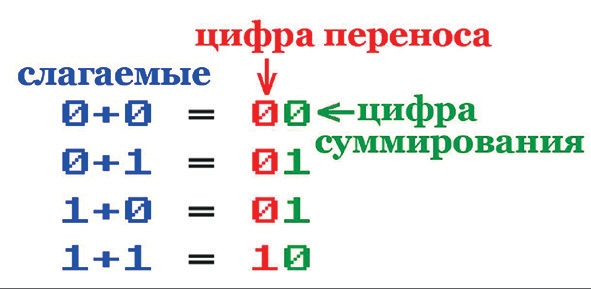
When adding two digits, we also get two digits: the summation figure is the younger category and the transfer figure - the senior category. (In the usual decimal system, such a situation arises when we add, for example, 7 and 8 and get 15, where the unit belongs to the senior category - dozens). Now compare the components (Fig. 1) with the input signals of the LV (Table 1), and the result of addition - with the output signal of the LV. It is immediately evident that the transfer figure to the senior category corresponds to the output signal of the LV and and, and the summation figure in the current category is the output signal of the Leo Xor. Parallel (simultaneous) functioning of these two LV gives a semi -snowmaker (binary summer). Why "semi-"? Because the semi -Summer has only two entrances and folds only two digits, and when adding multi -valued numbers there is another transfer figure from the previous addition. Given this figure, the “full” summer (or just the amount of the TOR) works, for which it is the third input signal, in addition to two input signals for two components.
In 1993, an employee of the University of Royal at the Belfast Amilra de Silva and his colleagues for the first time experimentally showed that the molecule can perform the function of logical multiplication and [2]. How did they do it?
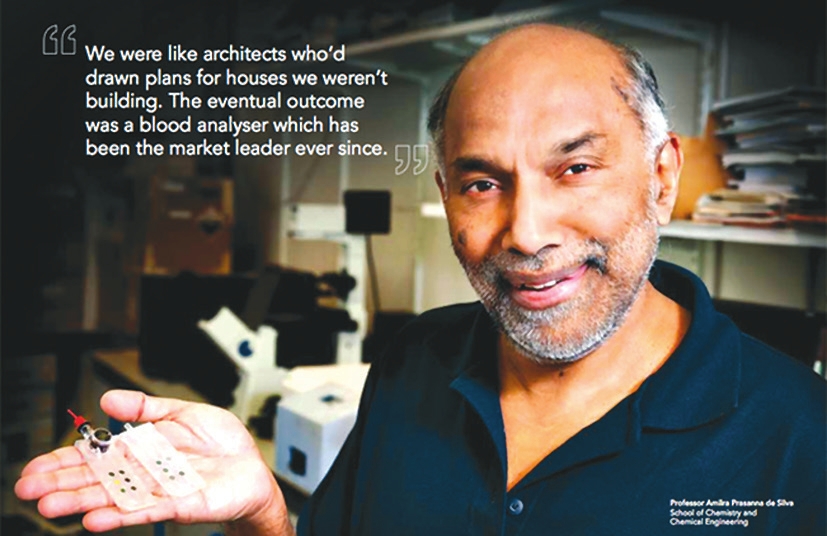
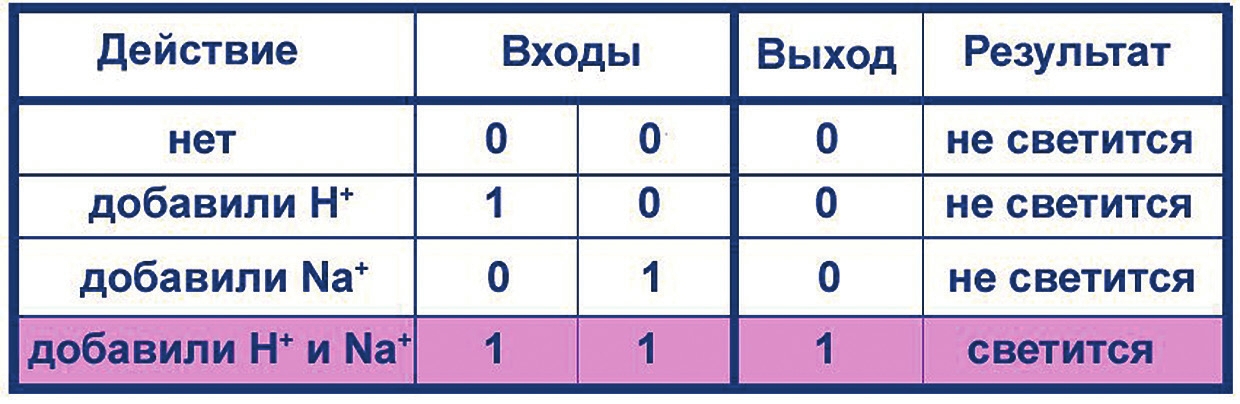
I think that even the most distant from chemistry, readers remember from the school chemistry course that if an indicator is added to a colorless acid solution or alkali solution, then the solution will be painted, and if the luminescent indicator, then the solution will also begin to glow with light (so new road signs in the rays of the headlights). The indicator responding to the presence of metal ion in a solution is called a sensor. De Silva came up with a sensor that responded to the presence of hydrogen ions (protons) and sodium in a solution, and the sensor began to glow only if both types of ions were added to the solution. Now, following de Silva, let's look at the changes that occur during the drain of the solutions through the prism of the logical algebra.
If we do not add anything to the solution - the input signal “0”; If the protons are added - this means that we gave the “1” signal to the first entrance; If you add sodium ions, the signal “1” was given to the second input. If the solution does not shine, it means that the signal “0” at the output, and if it shines, then “1”. As can be seen from the table. 2, with such an interpretation of committed actions and observed phenomena, we, using the sensor molecule, performed the operation of logical multiplication and-received at the output “1” only when at both entrances it was unit.
Since then, dozens of compounds have been investigated, it has been shown that molecular logical valves (mlv) are able to perform all the simplest logical operations, as well as mathematical operations of addition and subtraction, the functions of the Coder and decoder, etc. [3]. The input signal for MLV can be any external chemical or physical impact-the addition of reagents, heating, irradiation of light, etc. The main thing is that under the influence of this molecule signal the structure changes, passes from one state to another and at the same time some changes in the properties. The nature of these changes determines the type of output signal. If you represent a mlv in the form of a “black box”, then in general form the principle of its functioning is shown in Fig. 2.
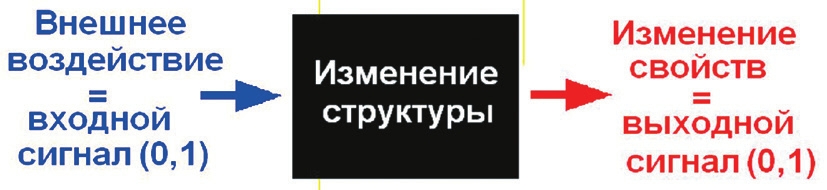
For example, if an ion or molecule is released with external exposure, they serve as an output signal. If the color changes, then the output signal is read by absorption, if the ability to radiate light appears (or disappears) by luminescence. For most investigated mlvs, the input signals have a chemical nature, and the output signals are read by the absorption of light.
The unique properties of molecular logical valves were discovered: compatibility or supervision (Superposability) - when several logical operations (recorded according to various output signals) are performed at the same time, and redistribution (ReconfigURABILITY) - when you can adjust the same valve to different logical operations, changing the input and/or weekend signals. These properties are based on the ability of a molecule, unlike a semiconductor transistor, to issue several output signals at once.
To explain the physical essence of this ability, you must first tell about the absorption spectrum (luminescence). Anyone who knows this or to whom it seems difficult or uninteresting can skip the next few paragraphs and immediately go to the answer to the title question.
The absorption spectrum (or luminescence) characterizes the ability of a substance to absorb (or radiate) light of different wavelengths. The fact that the light has a multi -wave nature, albeit unconsciously, know everyone who saw a rainbow. When the sun's rays, refracting in the myriads of the droplets of rain, as in microdes, give all the colors of the rainbow - this is the proof that the white light is a “complex” light consisting of a set of “simple one -color lights”. And we observe the whole variety of colors in nature thanks to the multiple nature of the light, due to the fact that substances absorb light in different colors, i.e., different wavelengths.
Quantitatively, the dependence of the absorption on the wavelength is expressed by the absorption spectrum (and a similar dependence for radiation - the spectrum of luminescence). Molecules never absorb (and do not radiate) the same light of different wavelengths. For example, a molecule, the spectrum of which is shown in Fig. 3, it absorbs well at the wavelength A, but does not absorb the wavelength B. If now we set the threshold value of the absorption shown by the red line in the rice. 3, and, as made above for transistors, we will translate the analog signal - the absorption - in the digital, then at the wavelength of the wave and we will get a “1” signal, and at the wavelength of the wave B - at the same time! - Signal "0". This differs from the semiconductor transistor, which either passes the current or does not pass, and therefore, on the basis of a transistor, LV can have either “1” or “0”, but not at the same time both values.
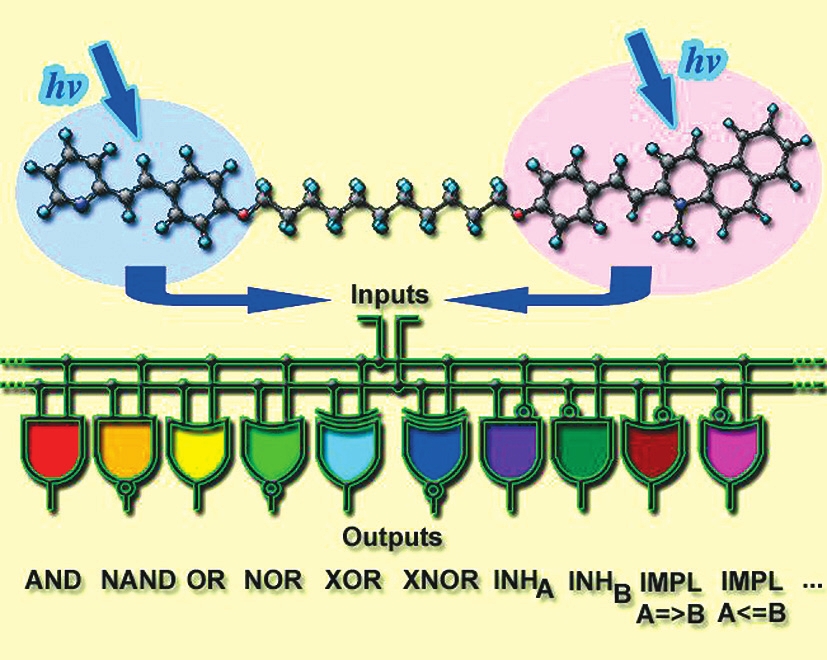
Given these properties of ML in our laboratory of organic and supermolecular photochemistry of the Institute of Chemical Physics of the Russian Academy of Sciences, a compound was developed and synthesized - biphotochromic diades, which is capable of performing the functions of all 16 possible two -dimensional logical valves, see Fig. 4 (the absorption spectrum is used as an example in Fig. 3).
In a chain of several LV, an output signal of one valve must be supplied to the input of another valve. For this, the input and output signals of the LV must be homogeneous (homogeneous). The homogeneity of signals in semiconductor devices is achieved automatically, since both the electron flow is both the input and output signal of each element of the circuit.
Now we can finally answer the question: why has a molecular nanocomputer has not yet been created? Because in most of the studied mlvs, the input and output signals are non -humble (heterogeneous), and this is the main problem that occurs on the path of connecting several mlvs, without which the creation of a molecular computer is impossible.
Partially, the problem of non -melodic signals is solved due to the aforementioned unique property of the MLV - the ability of one molecule to perform several logical operations simultaneously. Therefore, a fundamentally different architecture of constructing chains is possible for a mlv. At the level of small computing blocks, instead of connecting several LVs with each other (consistent integration), you can synthesize the connection with the necessary combination of properties that will perform a given operation (parallel integration). This is how molecular summers, subtractors, multiplexers, etc. work.
There are two options for solving the problem of non -melting signals. The first option uses nature - these are signal converters that “redo” the output signal of one valve so that it is clear to another. This option is realized by our natural computing system - the brain.
Another option is to develop a mlve with homogeneous input and output signals. For example, for some bio-MLVs using the principle of complementarity of nuclear baskets of nucleic acids (“DNA computer”), the input and output signals can be oligonucleotides, which theoretically allows the signal from the exit of one mlv to the input of the other [5].
Another type of mlv, satisfying the requirement of the homogeneity of signals, is completely photon mlvs that use both at the entrance and at the output of light quanta [6]. It is precisely such a photon mlV that is the above -mentioned biphotochromic diades, which switches from one state to another due to the reaction of photoizerization of two photoactive fragments marked with color ovals in Fig. 4.
However, with the functioning of photon mlvs, a number of specific problems arise associated with the very nature of the absorption of light and the properties of excited states of molecules (probabilistic nature of processes, inductive-resonance energy transfer, leading to extinguishing photochromic activity, dissipation of energy, leading to heating the system, etc.). These problems have a fundamental basis, and some of them are fundamentally fatal, while the undesirable consequences of others can be minimized.
The science of MLV arose at the junction of several sciences - chemistry, physics, electronics, logical algebra - and is now at the stage of fundamental research. But there is no doubt that a molecular computer working on a particular principle will be created. Just a computer is a more complex device than a motor or car, it arose much later at the macro level. The more prestigious it will be to make it. This is a challenge possible future Nobel Prize for the design and synthesis of a molecular computer.
PS In the popular science article, some things had to be obviously simplified. An interested reader can always find more stringent and complete definitions in scientific articles on this topic or, which is now easier, on the Internet, but in the latter case it is necessary, of course, to remember that not everything that is written there is true.
Mikhail Budyka ,
doct . chem . sciences , professor , head . Laboratory of organic and supermolecular photochemistry of the Institute of Chemical Physics of the Russian Academy of Sciences
1. Budyka M. Physicists did what physicists have long dreamed // Trv-hunger. No. 215 of October 18, 2016.
2. De Silva Ap, Gunaratne HQN, McCoy CP A Molecular Photoionic and Gate Based on Fluorescent Signaling // 1993. 364. R. 42–44.
3. A) De Silva Ap, Uchiyama S. Molecular Logic and Computing // NAT. Nanotechnol. 2007. 2. P. 399–410; b) Szacilowski K. Digital Information Processing in Molecular Systems // Chem. Rev. 2008. 108. P. 3481–3548; C) Pischel U., Andresson J., Gust D., Pais VF Information Processing with Molecules-Quo Vadis? // chemphyschem. 2013. 14. R. 28–46.
4. Budyka MF, LI VM Multifunctional Photonic Molecular Logic Gate Based on a Biphotochromic Dyad with Reduced Energy Transfer // 2016. DOI: 10.1002/CPHC.201600722.
5. A) Stojanovic mn, Stefanovic D., Rudchenko S. Exercises in Molecular Computing // ACC. Chem. Res. 2014. 47. 1845–1852; b) Orbach R., Willner B., Willner I. Catalytic Nucleic Acids (Dnazymes) as Functional Units for Logic Gates and Circuits: From Basic Principles to Practical Applications // Chem. Commun. 2015. 51. P. 4144–4160.
6. A) Budyka M.F. Photon molecular logical devices // Chemistry of high energies. 44. S. 154; b) Andréasson J., Pischel U. Storage and Processing of Information Using Molecules: The All-Photonic Approach with Simple and Multi-PhotoChromic Switches // ISR. J. CHEM. 2013. 53. P. 236–246.