
Translated material
Selfless questions about the election of the US President
Who are the electors? Can Americans vote for Vladimir Putin? (Yes!)
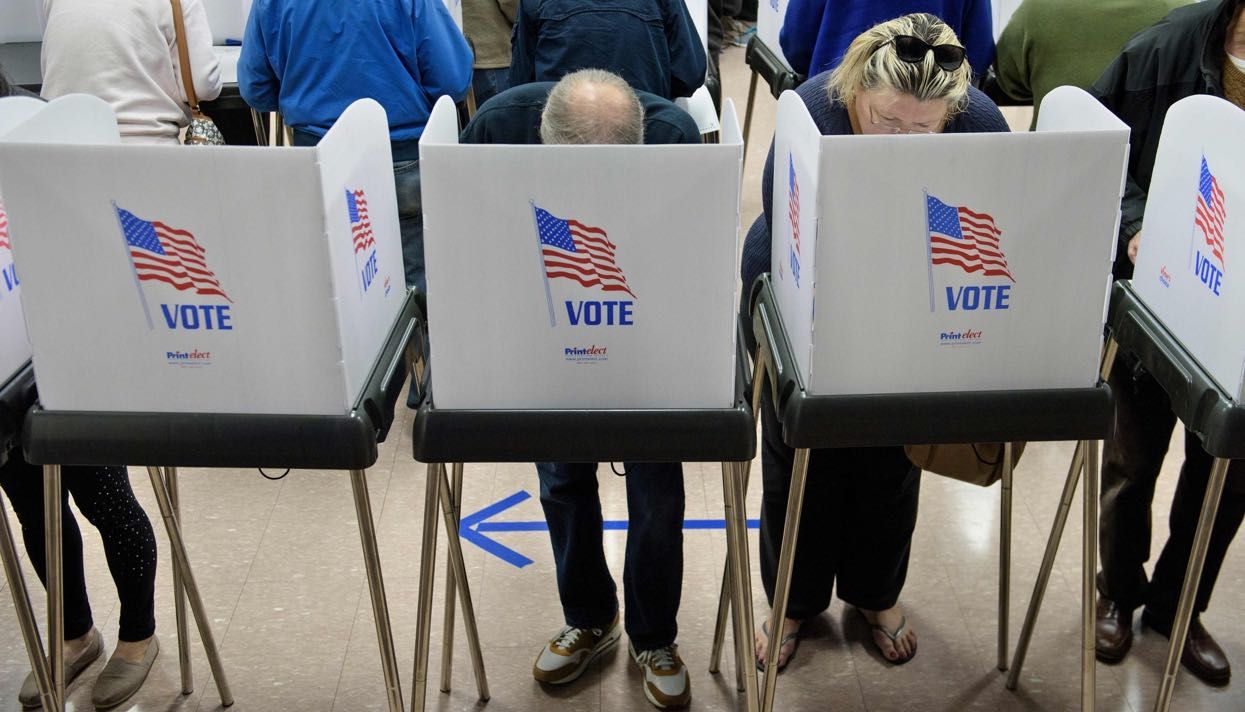
The US presidential election is a difficult procedure, and the candidate that the majority of the population supported is far from always won by them. The Institute of Electors, the ability to enter into the ballot any name and right to vote without a passport make American elections a unique phenomenon. "Medusa" answers the shameful questions that arise during any presidential campaign in the United States.
Is it true that the US election is indirect?
Is it true. Elections are held according to a two -stage system. According to the US Constitution, in the presidential election, residents of the country vote for candidates, but candidates receive their votes not directly, but through the college of electors. In other words, the Americans vote for the electors, and they choose the president. Such a system was born together with the United States as a compromise-it is believed that the founding fathers, although they advocated democracy, were still not ready to completely entrust the choice of the president to the population.
That is, the electors are living people?
These are living people. Electors are appointed in each state of the United States - according to the number of Congress members elected from the staff (both chambers). That is, the higher the population of the state, the more representatives in the congress and the more electors. The most densely populated state of the USA, California, receives 55 electors; The seven most sparsely populated states are three each. In addition, a special amendment assigns the same number of electors behind the capital's district of Colombia as the most sparsely populated state. As a result, a collegium of 538 people is obtained (according to the number of 435 representatives and 100 senators from all 50 states plus three people from Washington). This number also determines the number of votes necessary for the candidate to win the elections is 270 votes of electors. In the case of a nobody winner, a vote in the House of Representatives reveals. To win, you need to get 26 states.
Electors can vote not as voters decided?
In the federal legislation of the United States there are no norms that would oblige electors to vote in one way or another. Some states oblige their electors to promise to vote in accordance with the will of residents. Voting for another candidate or rejection of voting is considered a violation of the oath and in 24 states is punishable by law. At the same time, in the vast majority of cases, electors vote as they are entrusted with the inhabitants of the States, and those who act differently are called “treacherous” (Faithless Electors).
Can you get more votes and lose the elections?
Yes, but this is rarely due to how the electors vote - and even less often with the actions of treacherous electors. Much more important is how each state distributes voters. In 48 states out of 50, electors are assigned according to the “winner receives everything” system, regardless of what result he won. That is, the candidate who won in California gets all 55 electors, even if he scored 51 percent in the elections, and his opponent - 49.
Thus, the situation when the candidate receives the majority of votes, but a minority of votes of electors, is also not uncommon. One of the latest examples is the 2000 campaign , when Democrat El Gore gained 48.4 percent of the vote, and Republican George Bush Jr. is 47.9 percent. At the same time, the votes of the electors were distributed in favor of Bush (271 versus 266), and he was declared the winner. After such incidents, calls invariably appear to reform the electoral system.
Is it true that you don't need a passport? Also, anyone can vote!
Indeed, in most states, a personality certificate is not required to participate in the vote. It is enough to register in advance as a voter and appear on the site on the day of voting, name the name and surname and sign for the ballot. The signature of the voter is overtaken with the one that was left during registration - and this is enough to take part in the elections. In some states, laws obligated to present documents were adopted - their need is most often explained by the fight against falsifications, but in reality cases when they try to vote twice or to impersonate another, there is almost no. The other day, in an early election in Aiov, a resident of the state tried to vote twice for Trump - she was arrested. Other cases of falsifications have not yet been reported.
It is believed that the laws on personality certificates are needed for another: in order to complicate the vote for those who simply do not have such documents (this happens in the USA quite often). Opponents of such laws - mainly liberals and levocentrists - argue that it is unconstitutional to demand a certificate, however, it must be remembered that voters without documents (most often these are poor and representatives of minorities), as a rule , vote for liberals.
Why are there only two candidates in the elections?
There are almost always more candidates than two. Together with candidates from the largest parties - democratic and republican - representatives of less influential parties (green, libertarian, constitutional) and independent candidates are running in the elections. There are six candidates in the 2016 elections, and one of the third candidates is a former New Mexico Governor Gary Johnson is a rather significant politician. However, heavyweights compete in practice - in this case, Hillary Clinton and Donald Trump.
Moreover, if the voter is not satisfied with any of the candidates specified in the ballot, he can enter any name in it and put a checkplace in front of this name (the so-called inscribed candidates, Write-in Candidates; a special column is often provided for them). Sometimes the appearance of such candidates is associated with the illness or sudden death of one of those whose surname stood in the ballot initially, but most often the Americans just joke-for example, in 2012 someone wanted to see Master Yoda from Star Wars, Chuck Norris and even Vladimir Putin .

Did Trump have supporters after all the scandals?
If you believe the FiveThirtyeight site (the site has been named after the number of members of the board of electors; over the past eight years, the FiveThirtyeight election forecasts have been considered the most authoritative), by early November, almost 45 percent of Americans were ready to vote for Donald Trump, and a little less than 49 percent were a little less than 49 percent. Despite the numerous scandalous statements, a stable reputation of a sexist and poor relations with influential Republicans, Trump remains a very popular candidate. Thanks to his populist rhetoric, the billionaire has become for many Americans a symbol of struggle with everything that they are not satisfied with in modern American society, whether it is illegal migration, excessive political correctness or incompetence of Washington politicians.
And why do they write that Hillary will definitely win?
Because, as mentioned above, the support of the population is not the key to the US presidential election. Despite the almost equal support of the Americans, Hillary Clinton’s chances to become president , that is, to gain 270 votes of electors, significantly exceed Trump's chances. According to estimates of the same FiveThirtyeight, the probability of Klinton’s victory is about 71 percent, and two weeks ago (before the news of the next check of the FBI due to Hillary's e -mail) was estimated at 87 percent . So now the victory Clinton does not look so unambiguous.
How is the voting of the board of electors?
The results of the general vote are announced immediately after the election day (traditionally this is Tuesday after the first Monday of November, in 2016 it fell on the 8th). The voting day of electors is also always known in advance - this is Monday, following the second Wednesday of December (December 19, 2016). The college of electors is never going in full force: the electors vote in the building of the Capitol of their state. Those present choose the president and vice president, then the voices are calculated and entered into the protocol drawn up in several copies.
Protocols in sealed envelopes are sent to the chairman of the US Senate (as a rule, this is a valid vice president), the US Archivist, the Secretary of the Senate of the Court and the main judge of the district court. Addressers should receive protocols within nine days. A special session of the US Congress will be engaged in the calculation of votes, as a result of which the Senate Chairman should name the names of the new president and vice president of the country. This should happen on January 6.
Konstantin Benyumov