
Translated material
Walking memory of Istanbul
"My strange thoughts" as an apology of the beloved city of Orhan Pamuke
On November 2, the laureates of the Literary Prize "Yasnaya Polyana" were announced. In the nomination “Foreign Literature”, the novel by Orhan Pamuke “My Strange Thoughts” won - at the moment, probably, one of the most significant books of the Nobel laureate from Turkey. What it is important, says Lisa Birger.The nomination “Foreign Literature” of the Yasnaya Polyana Prize is an amazing undertaking: the second year in Yasnaya Polyana on behalf of, so to speak, Leo Tolstoy himself, they choose “The most significant and bright foreign book of the 21st century”. One already long list is such a Creme de La Creme, a ready -made list of recommendations, which can be very frivolous, albeit pleasant books (Sisters Brothers Patrick de Witt), but more often the prize experts nominated large nominations that have already had a significant impact on the literature of the 21st century: “Benefit” of Jonathan Littlela, “submission” of Michelle Welbeck, “Children's Book” by Anthony Bayette, “Hungry of the End” by Julian Barnes. It must be understood that the Pamuke’s novel was chosen from about such a series that it is notable in itself. You can explain this choice by form: if you remove “my strange thoughts” from the context, you get an ideal modernist novel, in our times directly the classic, is the noise of time heard and told by the hero (heroes) without any participation of the author. One can hope that the jury managed to evaluate what grandiose work was done by Pamuk, preserving all the movements of the Istanbul history of the twentieth century in the fate of the heroes, or saw an urban tragedy, a novel about the destruction of Istanbul. And perhaps, they still noted the translator: if Orhan did not have Pamuk Apollinaria Avrutina, maybe Pamuk himself would not have happened in Russian.
Although the award is awarded precisely for the book, and not for the translation (the author gets pleasant even a million rubles at the current rate, and the translator is only incentive 200 thousand), there is no doubt that in the case of Pamuk, the personality of the translator played an important role. Apollinaria Avrutin - more than just a chopper that shifts the books of Pamuke from one tongue to another. She is his faithful representative in Russian and culture, trying to make speech and signs of everyday life, so carefully described by him, recognizable. It is sometimes possible to argue with Avrutina (as well as with most brilliant Russian translators of the last century): it is not entirely clear, for example, why the Boz's drink turned into “Buza” in its translation, and the general oddity that inhabites the head of the main character has become “strange thoughts”. But one thing is undoubted - thanks to her attentive and painstaking work, Pamuk prose has his own rhythm and tongue, and Pamuk becomes a “Russian” writer for us.
However, not a single book of Pamuke affirms the difference between Turkish and Russian history, culture and modernity with such force as “My strange thoughts”-a story about the life of one street peddler, becoming a story about the history of Istanbul of the second half of the twentieth century: from the 1970s to the end of the zero. The life of the protagonist who came to Istanbul in 1969 from the village, in order to sell Yogurt and Boza on his father, with army serviceability under the blows of history: pogroms, political movements, military coups, each of which swept the pedigree from the streets of Istanbul, so that they then return with persistence; After all, ataturk, the father of the Turkish nation, said that "street merchants are like nightingales for the streets, they are the joy and life of Istanbul."
If Orhan did not have Apollinaria Apollinaria Avrutina, maybe Pamuk himself would not have happened in Russian
Street merchants really still play a huge role in the daily life of Istanbul: and today dozens of sellers of Simits, fresh fish, pilaf with chickpeas and chicken, sweets, corn, fried cakes of gzemlem passes along its streets. As soon as it gets colder, the scream of Bozaaji is spreading along the same streets - this notifies the bosom breaker about its approach. Although the VEF shop with the best Boza in the world still stands in its place under the mosque of Suleimania, modern merchants no longer take a bose for sale there, but mix their finished powder, which is why it does not become better. But the novel is romance so that everything in it is a little perfect. His hero, meblying, with all the oddities in the head and unsightness of the biography, possesses the same inner nobility that various Bey, who inhabited Pamuke’s novels earlier, and he has only the first freshness.
“My strange thoughts” are revealed by the image of the genealogical tree of the protagonist Mevlyut Karatash - this picture alone tells a lot about the goals and objectives of the novel. About twenty years ago, such a hero would be inconceivable on the pages of the Turkish novel, only invisible, background could be present in him. After all, Turkish street peddles can not have any genealogy: they are a real poor that came from the depths of the village Anatolia. They do not proudly bear the story of a kind and the memory of the acts of the ancestors. In Pamuk, such a hero first appears in the novel, but in the script of the film by the British director Grant Ji “Innocence of the memories”, where the camera, wandering around the night city, grabs from the darkness of its inhabitants - garbage collectors and flocks of wild dogs. Mevlut is also one of these night residents, facing the streets with the onset of darkness. But although the hero does not belong to the noble family, by his actions he is not a steering, not deceiving, not assigning someone else's - a real “Efendi”. This duality is also reflected in his name. The surname is Karatash, black stone, refers to the separation of the Turks into white and black, that is, blue blood and no. Mevlut means ritual chant in Islam. From the very beginning of his story, the protagonist writes letters - first to his father, then his beloved. It is important for him to monitor how written, laying on paper, turns into a "mysterious text with a completely different meaning." He is not just the night owner of the city, he is the master of the word about this city, and his story becomes life, and the story becomes a liturgy.
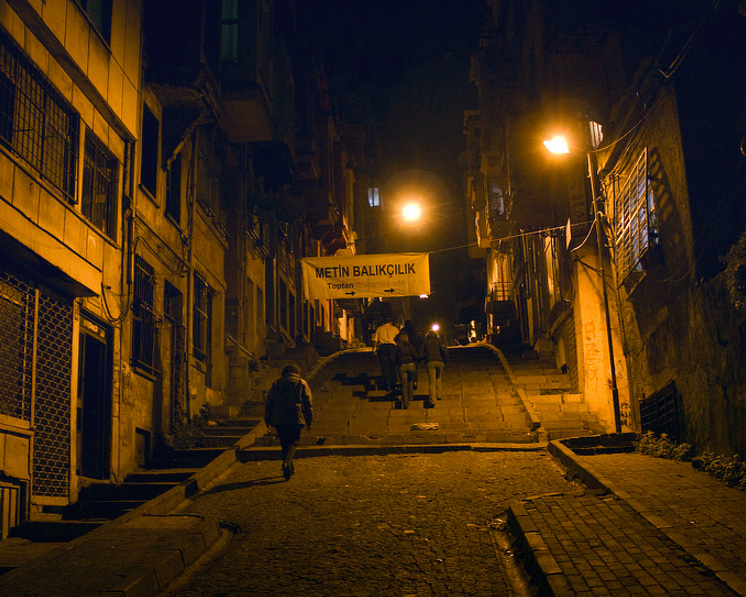
Photo: ALINE BELFORT
Such a shift in the hero cannot help but entail a change of topic. In a classic large family novel, such as Buddenbrokov, the history of the fall is the main topic, the hero in the finale in the most literal sense falls and dies. While “my strange thoughts” is the story of the rise. Of the invisible, secondary inhabitants of Istanbul to the final of the novel, little people become the Lords of the city. If in a classic modernist novel the city grows, destroying a person, then the city, excessively growing, dies over the city, and the person ascends: at the end, the heroes observe the lights of the night Istanbul from their own apartments built on hills, whose land they once captured by truth and by crook.
All this, of course, is a reflection of the huge social process in Turkey of the last decades: yesterday's poor have become a new support for the current government and almost the main political force in the country. But in modern Turkey, where some believe that they drive them to Iran with kicks, while others are afraid that hijabs break them off with jerks, there is a huge gap between yesterday's elites and, directly, the Erdogan Erdogan Elector. Orhan Pamuk, of course, does not write a political novel. With incredible skill, he never gives his voice to sound behind the hero's voice (more precisely, the heroes - the novel polyphonically gives himself to speak out to other history participants), his own opinions and beliefs are unimportant, even unknown. According to the plot, this is a story only Mevlut: the years of his teachings in a meaningless institution called the male lyceum Ataturk; decades of trade on the streets of the city; The story of great love, when he saw a girl at the wedding of a cousin, wrote her passionate letters for four years, stole her, found out that instead of the beauty of the younger sister, he was slipped the eldest, and he lived with an older marriage for thirteen years. But first of all, it is the history of the city that Mevlut observes, walking in the evenings along its streets.
If in a classic modernist novel the city grows, destroying a person, then in Pamuk the city, excessively growing, dies, and the person ascends
The geography of these walks, if you draw them on the Istanbul map, is huge. From the old areas along the Golden Horn past the Sirkegi station, up the Trickli Street, along the troubled district of Tarlabashi, from where after the pogrom of 1955 and the violent deportation of 1964 all Greek, Jewish and Armenian inhabitants were expelled; To the hills behind the Majidec region, which survived the first invasion of the Anatolian poor: in the 1960s, each visiting tried to shield the corner of the earth here, in the zero, multi-storey buildings were erected on it, where yesterday's migrants received new apartments.
Once again, the Pamuk composes the encyclopedia of Turkish life: if in the “Museum of Innocial” its subject was the Istanbul life of the 1980s, then the landscape itself became the “my strange thoughts”-an endless construction, which grows from the 1960s, capturing all new bridges, hills, areas, without a trace destroying the memory of old people. Each new military revolution makes its changes to city life - and we see them with the eyes of Mevlut. At the beginning of the book, only the first Bosphorus bridge is being built, and after its end it will open the third. The Tarlabashi area, which was Greek yesterday, is half demolished for the sake of a six -lane highway, then its remains turn into a criminalized heart of the city. Mevlut never mourns the old city, only changes routes along it. But for the Istanbul resident, these changes look like the city again and again, for forty years, they open it to shift the tile.
Mevlut, who lived almost the entire novel in the dilapidated shack in Tarlabashi, until the district turned into a criminal so much that it became impossible to leave the house without weapons, becomes a symbol of not these changes, but, on the contrary, the confrontation of destruction, walking memory of the past. And not even because he captures these streets in memory, wandering around them at night. Whenever a conversation about Bose and the alcohol contained in it, the merchant honestly replies: "Buza is sacred." “People are pleased to know that Buza was a favorite drink of our ancestors. This is what the cries of a merchant Buza remind them of, and it is pleasant for people to hear them. ” Only memory can resist destruction - but the main thing in the novel of Pamuke, that the same hero became the symbol of memory as the symbol of the devastation.