
Translated material
From the Turkish Informburo
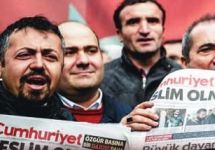
In Turkey, the editor -in -chief Murat Sabungju and eight employees of the opposition newspaper Cumhuriyet were arrested on charges of supporting terrorism. It is reported by Reuters with reference to local media.
Journalists were detained on October 31, searches were held in their homes. In total, 13 newspaper employees were discharged for detention.
The arrested was charged with "committing crimes in the interests of a terrorist organization not consisting in it." The Turkish authorities believe that some newspaper publications contained a call for public disobedience and rebellion. In addition, journalists are accused of manipulating public opinion in the interests of a certain “fethullahist terrorist organization”, allegedly connected with the preacher in the United States, Fethullah Gulen, as well as the Kurdistan Workers' Party. The court noted that such conducting journalistic activities "does not meet the principles of the profession and is not combined with provisions on freedom of speech."
The detention of Cumhuriyet employees was called a number of European politicians "intersection of the red line" in pressure pressure.
On Friday night in Turkey, popular social networks were blocked , including Facebook, Instagram, Twitter, Skype, WhatsApp, as well as YouTube. At the level of local Internet providers, a data transfer (restriction) was carried out. You can get around the lock using VPN services. Restrictions on the work of social networks on this scale have been used in Turkey for the first time since mass protests on Taxim Square in 2013.
The blocking is associated with the detention of 12 deputies of the Turkish parliament on Friday from the Prourdish Party of Democracy of Peoples, including its co -chairs of Selahattina Demirtash and Figen Yucedag. Eight deputies were arrested by courts. The Turkish authorities explained this by the fact that after the failure of inviolability from the parliament deputies, some of them were charged, and they were summoned to the court to testify. Since these challenges were ignored by them, it was decided to detain them.
The Supreme Representative of the European Union for Foreign Affairs Federica Mogherinini announced that he was convening an EU ambassadors in Ankara in connection with the detention of Prokurdsk deputies. German Foreign Minister Frank-Walter Steinmeier and a number of other European politicians sharply condemned the actions of the Turkish authorities. On October 23, the Minister of Justice of Turkey, Bekir Bozdag, said that about 35 thousand people were arrested in the country on suspicion of relations with Gulen, whom the authorities consider the inspirer and organizer of the failed coup. The minister noted that after an attempt by a coup, 82 thousand people were checked for ties with a preacher. 26 thousand people were released from arrest, but are under supervision. There are 3907 more people on the wanted list.
Bozdag criticized the US authorities, which do not fulfill Turkey’s demand for the arrest and issuance of Gulen. WITH