
Translated material
"Kuznetsov" in the Mediterranean
The campaign of the Russian squadron to the shores of Syria means that the world war in the General Staff is not expected, but they expect a budget increase
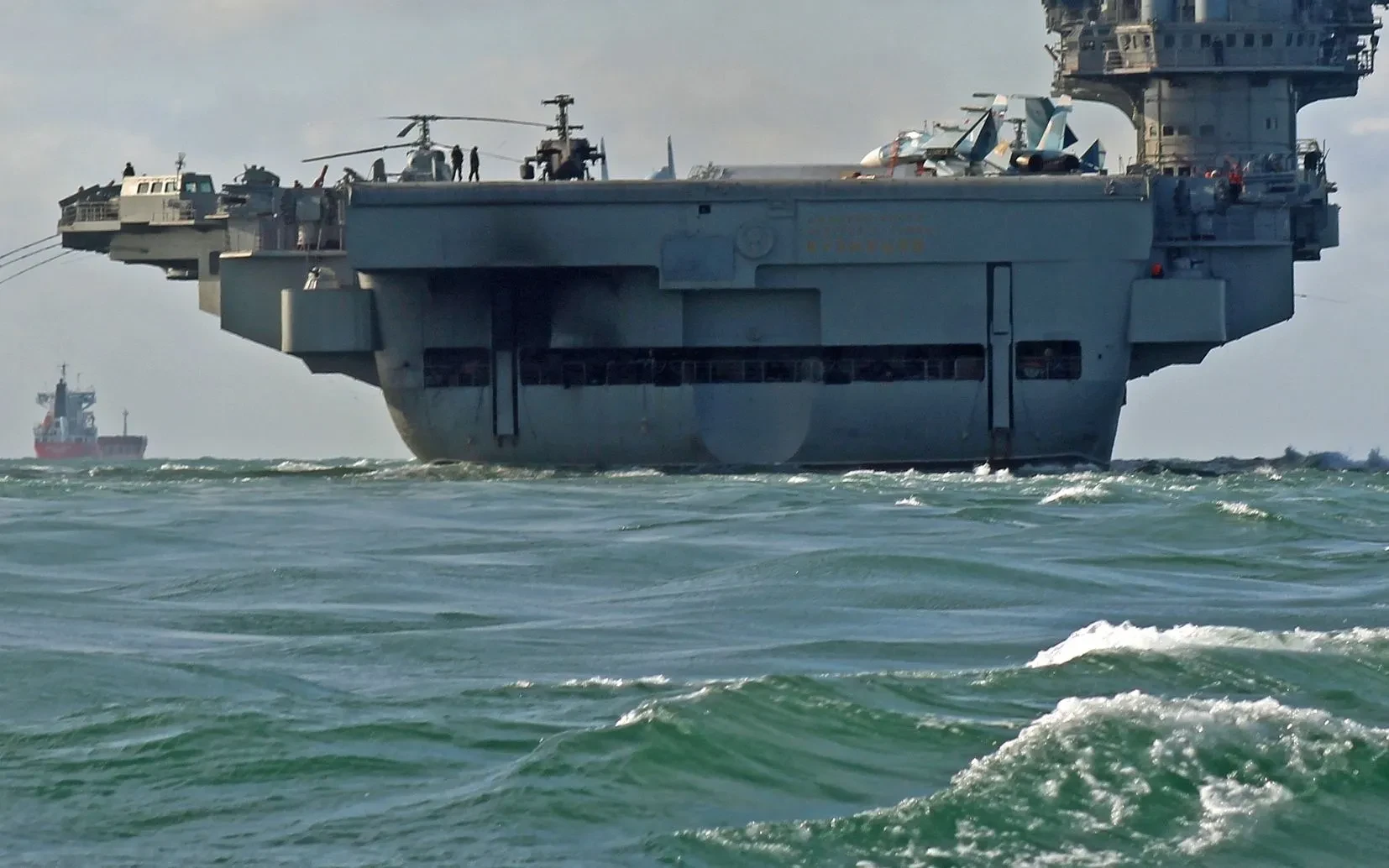
The Russian “Airman” - the heavy aircraft carrier “Admiral Kuznetsov” hung up to Syria from Severomorsk along with escort ships, including the Peter the Great nuclear missile cruiser. For almost a month, the average speed was less than 9 knots. More than a thousand years ago, the Vikings on Drackers passed the same route in a fair wind faster. The low -flowing “blacksmiths” will be almost useless in the Mediterranean Sea and certainly will not be able to influence the situation with the blockade and possible assault on Aleppo: to run planes with full combat loading, the aircraft carrier must go in full swing against the wind. Of course, for the “Kuznetsov” television, the planes can run, but without ammunition, in fact, for the sake of show -offs.
The Russian squadron can firing Syria with winged missiles from surface ships and submarines, but the Caliber NK has a range of more than 2000 km, so it makes no sense to drag to the Syrian shores and even more so “Kuznetsov” and “Peter the Great” there, which have old Supermining Anti-Corgound missiles P-700 granite for large strokes for large ships (American aircraft carriers). It is possible to use "granite" for ground purposes in principle, but ineffective. However, the high -precision NK Caliber also roads (up to 6 million dollars) and are designed to destroy stationary, pre -identified goals in the conditions of powerful enemy air defense, when the bomber and the attack aircraft do not break through. Use the Caliber NC to hit the Syrian opposition militants on pickups with machine guns - an insanely expensive fireworks, such as the Olympics in Sochi.
“Kuznetsov” was built in Soviet times in Nikolaev not to go on long campaigns, like American aircraft carriers, but, for example, in the Barents Sea as a floating fighter airfield to cover the deployment area of strategic underwater atomic cruisers. It was assumed that all terrestrial airfields can be destroyed by nuclear blows, and relatively mobile “Kuznetsov” can survive and confront the impudent American fleet and its aircraft carriers, who, by the end of the First Week of the World War, could come very close to the Russian coasts. The basis of the Kuznetsov air group Su-33 (Su-27K) is clean fighters. Kuznetsov does not have a catapult, the Su-33 take off from the springboard due to traction and cannot carry a lot of weapons or fuel-only relatively light airframe rockets.
On Kuznetsov, of course, there are several new MiG-29K and shock KA-52K, which can even inflict a couple of blows to the Syrian opposition detachments, but this will not affect anything. It seems that the command of the Navy and the General Staff does not believe that the Syrian crisis can lead to a “big” war with the United States and with NATO and you can show off, depicting an aircraft carrier group, like the Americans. The fact that Kuznetsova with powerful accompaniment without a special military need was sent to Syria, essentially exposing the Barents Sea is a good sign.
It seems that the command of the Navy and the General Staff does not believe that the Syrian crisis can lead to a “big” war with the United States and with NATO and you can show off, depicting an aircraft carrier group, like the Americans
The cruiser "Peter the Great" also has nothing to do in Mediterranean shallow water. Unlike Kuznetsov, it is an ocean raider with two nuclear reactors and a vast stroke range, really limited only by a margin of potatoes and cabbage on board. In a special period before the war with the United States and NATO, Peter the Great should be made for a suicidal single attack-interception of the transatlantic military convoy, which takes the American mechanized (tank) division to Europe.
And so-the “Kuznetsov” will somehow reach Syria and then return home, will get into a large long-term repair and re-equipment for the MiG-29K instead of the Su-33, which are only 10 pieces left and is no longer produced. From Kuznetsov should also be removed by granite missiles, which are no longer produced. And “Peter the Great” should soon stand up for a lot of repairs - to change the same “granites” to more universal launchers “Caliber”.
The farewell voyage of Kuznetsov and “Peter the Great” is virtually little connected with the assault of Aleppo, and you can understand our sincere indignation “The position of individual countries” (Spain, Malta and, it seems, Algeria), who refused to let the warships into their ports. The matter, of course, is not so much in American pressure (Washington because of the elections is not at all) as in the growing public indignation in Europe and in the Muslim Sunni world, which can ultimately put Moscow in no less isolation than during the Afghan war in the eighties.
But among military sailors, ours and Western, other specific problems. The English Admiralty did not have a single aircraft carrier left: the last light HMS Illustrious was sold for scrap metal this year. The new HMS Queen Elizabeth is already practically built, and the other-HMS Prince of Wales-is being built, but American F-35b shortened take-off and vertical planting will begin to act only after 2018. In the context of the budget and financial crisis due to Brexit, the British shipbuilding program can be adjusted, and the parliament may consider operating expenses associated with aircraft carriers too high. If the main enemy is terrorists on pickups, why is a wildly expensive mighty fleet? And then the "Kuznetsov" smokes in the la-chans in time. The Admiralty immediately sent an escort from warships and expressed “concern”, and many other Western Navy sent ships to the sea - everyone had their own budget problems. London made the final decision to build two new large aircraft carriers in 2014, after the Crimea, at the NATO summit-such a good luck fell to the Admiralty, otherwise they would sit on old laurels, looking at the historical paintings of the great trafalgar victory of the 1805th. Glory and honor "green little men."
The construction and weapons of one new atomic submarine should be about how to give each pensioner 5 thousand rubles, and such boats are planned for more than a dozen, but also frigates ...
Our Navy has its own tasks: by July, a new (until 2025) program of weapons should be finally reconciled, and the gap between the request of the Ministry of Defense and the proposal of the Ministry of Finance - 10 trillion rubles. The construction and weapons of one new atomic submarine-that the strategic “bore-a”, that the multi-purpose “ash”-should be approximately how to give each pensioner 5 thousand rubles, and such boats are planned for more than a dozen, and also frigates, and watchdogs, and new bases, and everything else. Tank generals, who traditionally (and now) lead the General Staff, always, from the Soviet era, considered the requests of the Navy excessively overstated and simply harmful in the conditions of resource deficit. The generals of the construction programs were especially annoyed by the powerful ocean surface fleet: all the same, the Americans do not surpass the Americans, and they are guaranteed to stop this fleet for half an hour. Therefore, the admirals were so seized for the reason to bring in the Mediterranean everything that is possible and impossible to impress one person in the Kremlin. And let the army generals understand Aleppo.
The besieging Aleppo detachments of foreign (Shiite) mercenaries from Iraq, Livan and Afghanistan under the Iranian leadership and the wreckage of the Syrian army, and some other local motley militias are either poorly prepared, or demoralized, or both at once. The allies are uninitiated and reluctantly go ahead, but quickly retreat when desperate Syrian militants apply sensitive counterattacks, letting the armored trucks or Betheers with tons of explosives with tons of self-killer drivers. Such a kind of controlled weapon in terms of effectiveness is no worse than expensive NK Caliber.
When it is bad to bomb and not bomb - it’s not good, sometimes it seems that Moscow is ready for any conditions, if only the militants left Aleppo or, even better, crossed out (albeit at least formally) and became part of a certain “national reconciliation”, as “Kadyrovites” in Chechnya. Moscow seems to be ready to give Ankara the zone of influence and occupation in Northern Syria, if only the Turks agreed to somehow bring or “repaint” the opposition fighters in Aleppo, but so far without much success. In September, the Russian military leaders (with the support of Damascus) threw a strategically very profitable agreement on a truce and political settlement in the urn, which Sergei Lavrov bargained by Secretary of State John Kerry. The generals seemed to promise if they do not interfere with bombing, Aleppo will be cleaned in a week, but it did not work out. Of course, our superiors needed not so much Aleppo as an urgent aggravation of the conflict with the United States, and everything turned out: under the conversations about the third world, the final version of the defense budget for 2016 was approved by the new Duma by almost 4 trillion (6% of GDP).