
Translated material
Not thaw, but slush
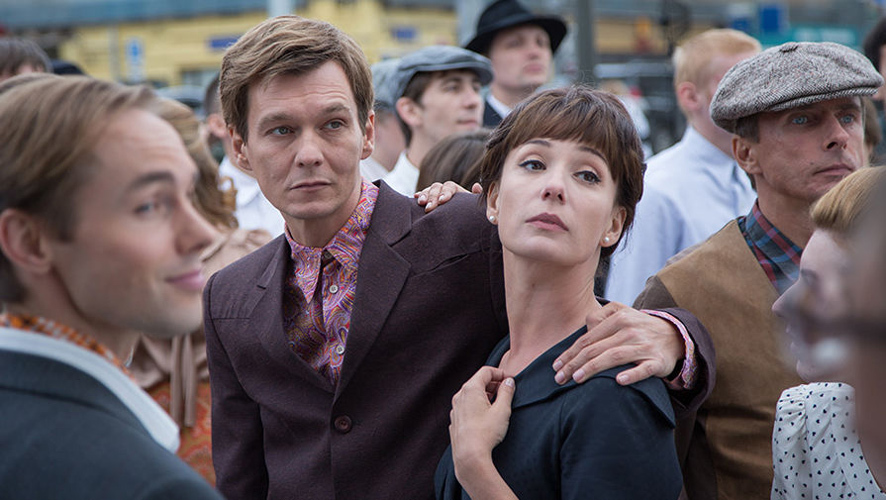
The series "The mysterious passion" was announced by the first channel as an event. The channel tried, in Andrei Malakhov, the surviving characters flashed, the dialogue between Yevgeny Yevtushenko and Solomon Volkov, ousted the popular Ivan Urgant from the air. The frame is rich, served with pathos.
In the producers of the series - Konstantin Ernst and Denis Evstigneev, the son of Evgeny Evstigneev and Galina Volchek, who was born a little later than the events described in the late and, as it were, the autobiographical novel by Vasily Aksenov, but still indirectly guaranteeing its presence a certain level of authenticity, authenticity. In the roles of the sixties - artists, a whole constellation, the best in their generation, with portrait makeup, in natural decorations, on wooden sunbeds against the backdrop of a real karadag ...
And, of course, old songs about the main thing: a night trolley with a grape bone.
The meaning of turning to history is to add new knowledge to the past or at least a new intonation.
However, it turned out that Aksenov’s novel was only the starting point. The script is composed by Elena Rayska, who is considered a strong pro: four dozen plots belong to her Peru, the most famous of which is “Once in Rostov”, a love melodrama against the background of an uprising in Novocherkassk.
Interest in the series, intensely repaired by the channel, is clearly very great. What his numerous silent spectators think, we do not know, but the part that has access to public space is terribly upset. Instead of the nostalgic memories of the 60s, the viewer was literally offered by simulacra-plastic likenesses of their favorite poets, to the literality of outwardly similar copies, mannequins, which while behaving like all serial characters: roll their eyes, mean feelings and that are the funniest-they write a drunkenly and read poetry with pathos with a pen of paper: oh my shabby hero ... Oh! ABOUT!
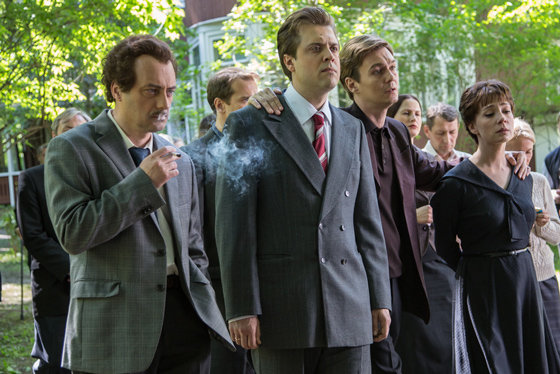 © Channel One
It is quite obvious that the enlightened spectators are right in their indignation, they otherwise perceive that era. But, on the other hand, it is strange to worry: after all, the characters of the series are as similar to their prototypes as all other Russian serial heroes. They are also far from real Aksenov, Voznesensky, Yevtushenko and Akhmadulina, like serial cops are far from real police officers, and doctors from films about the hospital are not like real doctors.
The matter, of course, is not literally coincidences. There are not many those who remember that in the real house of writers in a restaurant never danced, and the real circumstances of the life of the mentioned characters are very remotely reminiscent of those that were shown on TV. It is worse that the series, in principle, does not create any atmosphere, it is outside the style of time, outside the aura of art. However, excuse me, this easily forgive the telephone designed for everyday consumption. Yes, there is no taste, smell and charm, but usually we go around. But there is a trick: look, find out - okudzhava? Do not find out? Well, we don’t need, we designated it in general terms. There is a sign of Vysotsky, and even the mannequins of Pasternak and Ernst Unknown - this latter is not very familiar to the public, so sculptures are sculpted in the frame so that they do not mix up. In general, everything is as it should: the heroes listen to the “voice of America”, here they are discussing events in Novocherkassk, they bury Pasternak, and here Khrushchev is prohibitively waved his index finger. It would seem that what is more than you are unhappy?
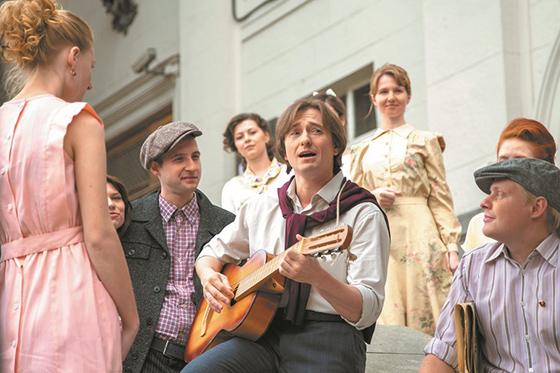 © Channel One
In fact, it seems to me that people who make claims to this series simply have not watched another streaming television product for a long time, that is, for them, modern Russian adaptation to mass taste seems incredibly offended, since there are holy names unusable and banalization: Vysotsky and Okudzhava, Efros and Lyubimov, Yevtushenko and Brodsky, Akhmadulin and Lavrova, Akhmadulina, Akhmadulina, Akhmadulina, Akhmadulina, Akhmadulina, Akhmadulin. Efremov and Aksenov ... A row can be continued. The idols of the 60s and 70s, the iconic figures of our short intellectual spring, and if you shoot the movie about them, then only the July Rain.
But no, get in standard packaging. We live this way, turning everything into banality, for any original idea is found in hostility, it is already disclosed at the entrance. Time is not risk. Do not try. There are no Germanniks with her “schools” now, this is not in trend. Behind each frame is the conditional deputy of Mizulin or Minister Vasiliev with a pointer, accurately determining the boundaries of our capabilities. The point is not that there is censorship. She, of course, is, took root and settled for a long time. But even before censorship, a habit of banality triggers.
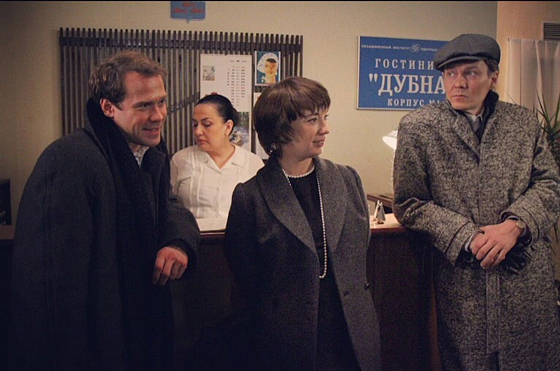 © Channel One
The series “The mysterious passion” is not bad what distorts historical facts, but by the fact that banal is like a verse of a graphomaniac. Everything in it is predictable and secondary: the relations of the heroes, and their motives, and their protest, and their conformism. All this was just repeatedly, it was discussed: at first, as usual, hotly and passionately, then - sluggish and familiar, now - rotten and annoyingly. This cannot be corrected at the level of one series. This is the level of modern domestic mass culture, poisoned by aesthetic stagnation.
Whatever the cultural heroes of the sixties, they were new and alive, and for this they fell in love. It is a shame to show them in forms cast in the early eighties, time has passed. The meaning of turning to history is to add new knowledge to the past or at least a new intonation.
But the series “The mysterious passion” is dullly trying to repeat the old, but still obsessively sounding in the ears, not forgotten, although the past enthusiasm and dare, the motive.