
Translated material
Great family
Brief guide for coastal literature, part II
Continuing a review of the Far Eastern literature, at the request of Gorky, writer Vasily Avchenko focused on a single book - the Rock Brinner, published in Vladivostok, describes the epic history of the Brinner family: the julya pirate, the miner Boris and actor Yul.The first plot: Briners and Russian-Japanese War
The book of Rock is a family chronicle of the Swiss-Russian kind and at the same time a historical essay. Every now and then she seems to be an adventure novel: there are too many adventurous plots in her and historical characters in a strange way. The founder of the Far Eastern branch of the Brineers clan (the surname was previously written with one “en”) a real pirate was, which, perhaps, explains the adventurous vein with his descendants. The Swiss young man Jules settled down on a corsar, which robbed merchant ships, and eventually ended up in Japan, where he was among the companions of the English shipping company. When the cartridge died, the enterprise passed to Jules. With this, the Brinera business empire began. Jules moved to Vladivostok-the young Porto-Franco, where he began to call Julius Ivanovich, and founded in 1880 the company “Briner, Kuznetsov and Co.” (then it will flush into Fesco-the Far Eastern Shipping Company). There were many foreigners in Vladivostok. Europeans and Americans - Lindholm, Clarkson, Kustr, Cooper, Kunst with Albers - have the most diverse business here.
The entrepreneur, philanthropist, public figure Julius Briner became a noticeable figure in the city. In 1890, Chekhov drank tea on Brineers on the way back with Sakhalin. A year later, the writer will have a nephew Mikhail, who will play an important role in the fate of the grandson of Julia - Yul.
At the very end of the 19th century, Jules acquired the rights to harvest forests in the north of Korea, reselling them to the Russian king, which gave rise to the version: was he not a secret agent of St. Petersburg? Forest concessions strengthened the position of Russia in the region, allowing, under the guise of protecting, fishing entered the troops into Korea. This is exactly what, coupled with the promotion of the Zheltorossia project (Port Arthur, District, Southern Branch of the CRC)-prompted Japan to attack Russia.
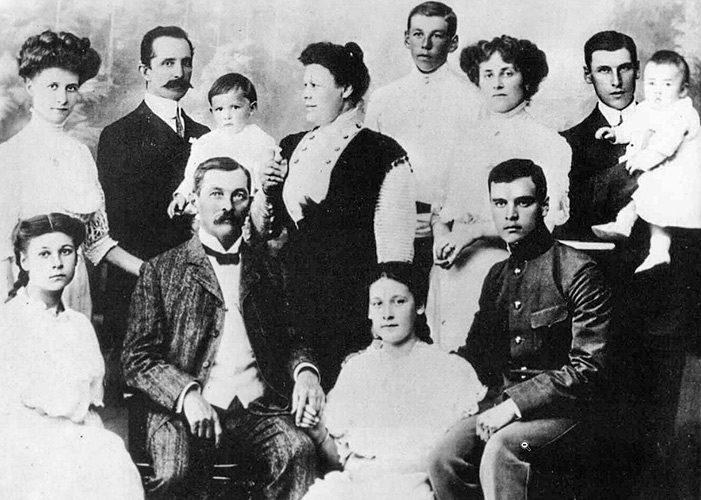
Family of Brineers, 1914. The side of Jules is his son Boris, dressed in the cadet uniform of St. Petersburg Mining University
Total plot: The Last Soviet Capitalist
At the beginning of the twentieth century, Julius started a mountain business in Tetyuha (current Primorsky Dalnegorsk). The father of the father was to continue the son, Boris Yulievich Briner. To do this, in 1910 he was sent to study at St. Petersburg Mountain. In St. Petersburg, Boris gets acquainted with Marusya Probzer, the daughter of a Russian doctor, also from Vladivostok. They marry and return to Primorye, and in 1920 they have a son Julius - the future Oscar -Monk Yul Brinner, a skin -headed hero of the “magnificent seven”. A few years later, Boris will fall in love with actress Ekaterina Kornakova and leave his family.
In the same 1920, Julius Sr. dies, he was buried in the family crypt of Brineers in the sites (now-Bezoverkhovo, in the south of Primorye). After the Civil War (Boris Felix's brother served with Kolchak and Kappel, and his sister Maria married the red commander Sergei Khvitsky) Boris Briner, who managed to work as Minister of Industry and Trade of the Far Eastern Republic, is found in Moscow with the Dzerzhinsky - head of the Higher Council of the National Economy. The concession in Tetyuha is preserved, Boris (he was called the “last capitalist of the USSR”) creates a joint company with an English investor and starts mines again.
In 1890, Chekhov drank tea on Brineers on the way back with Sakhalin
However, soon world prices for lead and zinc collapsed, by 1931 the company was in debt, and the British investor Batey began its liquidation. The Soviets agreed to compensate for 932 thousand pounds, stretched for 18 years, and, as Baty reported, "behaved very honestly." The new head of the mining enterprise in Tetyuha was Mikhail Kokshenov (father of the film artist). It will be shot in 1938, and the lead-zinc "Dalpolmetal"-the heir to Brineer mines-is also functioning. Boris and Katya move to Harbin - the most Russian city of China, the capital of the CRC. Here, by this time, the first wife of Boris, Maroussia, with children - Vera and Julia lived. Soon she will leave for Europe, and Boris will remain and calmly live in Harbin until 1945; This year, the Soviet military, who entered Manchuria, will arrest him with his wife to defeat the Kwantun Army. They treated Brineers respectfully - as guests, not prisoners - and eventually exchanged six Soviet intelligence officers revealed in Switzerland. So Boris was in the historical homeland.
Plot third: King Siam is from Vladivostok
Yul Brinner, who was known in the USSR as Chris from the “magnificent seven”, saving peasants from bandits, was born in Vladivostok on July 11, 1920. This happened in the Brinera mansion on the Aleutskaya, 15b, where in Soviet times it was located in the party of the most Far Eastern Shipping Company. A few years ago, a statue of Jul appeared near this house.
Formally, he was born in the territory of the Far Eastern Republic. Outside the door of the room where the baby was taken, Japanese interventions were sleeping. In January 1921, Julius Borisovich Briner was baptized in the St. Nicholas Church. In 1927, with his mother and sister, he ended up in Harbin, studied at the school of the Association of Young Christians, where classes went in Russian. In Harbin, Soviet artists toured, Yul heard Lemeshev. I immediately tried Opi. At the beginning of 1932, Marusya with children went to Europe: Yul, who is not and 12, is lucky in the guitar of the opium and the dear reads Dostoevsky; Or is it the beginning of his myth? Paris, acquaintance with the gypsies of artists Dimitrievich. Seven -string guitar, Russian romances. Work in the circus, back injury. The addiction to the opium (Yul even supplied the drug and playwright Jean Coctele), the deliverance from which was long and not easy.
1940, New York. The future king Broadway studies English and supplies the surname with the second “n” so that it is not read as “Briner”. Learns acting with Mikhail Chekhov. In 1955, Chekhov will ask Yul to write a preface to his book about the technique of acting-it will be placed by Marilyn Monroe, who dreamed of playing Grushenka in the Karamazov brothers. She will not succeed-but Yul with Marilyn, according to his son Rock, turned out something. After Pearl Harbor, Yul asks for the US Army, but it is not taken because of the scars in the lungs. He works in the management of military information: transfers reports to the French fighters of resistance, in Russian - Soviet allies.
Yul, who is not and 12, is lucky in the guitar of the opium and the road reads Dostoevsky
Submitting documents for American citizenship, he indicated the place of birth "Sakhalin, USSR." Further in each interview, Yul systematically misinformed the world about the date and place of his birth, called either a Sakhalin, then a Mongol, then a gypsy (the secret of the unusual appearance of Jul - in impurities of Buryat blood). Such hoaxes were loved by his friends of Dimitrievich, who believed that the "gadge" (that is, strangers, Netskians) can be lie.
Thinking about the reasons for his father’s craving for myth -making, Rock calls for the aid of Berdyaev, who wrote about self -posterity as a purely Russian phenomenon. But the national identity of Yul is a complex question. Yes, before leaving for Paris, he spoke and thought in Russian. Rock every now and then emphasizes its origin and Far Eastern roots: on the stage it moves “with the grace of the Amur Tiger”, and the villains from the “magnificent seven” are similar to the Khunhuz who attacked the sidema. Again, it is no coincidence that Yul starred in the film adaptations of Gogol and Dostoevsky ... But Rock himself admits: “What did he remember about the Russian Far East? Only a few vague images remained in the memory. ” He left Russia too young. Judging by the late records with Alesha Dimitrievich, the Russian language Yul in the end almost lost.
In his book, Rock describes the little-known Yul: he plays Taras Bulbu and Mitya Karamazov, then the Soviet officer suppressing the Hungarian uprising of 1956, then-long before Schwarzenegger-a killer robot. And Yul was a public figure. At the turn of the 1950-1960s, he worked as a special consultant to the UN Supreme Commissioner for refugees and wrote the book “Bring children: a journey to the forgotten peoples of Europe and the Middle East”. In 1974 he went to Vietnam and adopted two orphaned girls. Later he became an honorary president of the International Gypsy Union.
The Russian language Yul in the end almost lost
Yul Brinner created a corporate brutal image, an important role in which a shaved head plays - the influence of this image on fashion is still felt. And the reason for the first time to appear with a sparkling crown was the role of King Siam, who shaved his head in the Buddhist monastery. The step was defiant: in the 1940s, Rock writes, Lysin was considered if not shameful, then comic, and Yul even wore a wig at one time. But it was for the role of King Siam that he received an Oscar. In 1965, Yul abandoned US citizenship, not wanting to pay high taxes from fees. Today he could, like Department, accept Russian citizenship and even move to his native Vladivostok. But seriously ill (spinal injury, stroke, lung cancer) Yul died in 1985-and the son of Rock returned to Vladivostok.
Plot fourth: Russian rock
The historian Rock Brinner, who will turn 70 in December, lived no less amazing life than his father: drove trucks, guarded Mohammed Ali, programmed at BASICA ... In 2003, the organizer of the Tikho Meridian film festival invited him to Vladivostok - since then Rock is often in Russia. He is friends with Lisa Arzamasova, walks in a cowboy hat along Vladivostok, calls him "beloved second home."
In Vladivostok, Rock met with rock musician Alexander F. Sklyar, who at one time was influenced by Gypsy songs performed by Yulu and Alesha Dimitrievich. Sklyar in the 1980s served as a Soviet diplomat in North Korea-in Chondzhin, very close to Novina, the Yankovsky estate (friends and relatives of Brineers), where Jul visited, and not far from Jules’s forest concessions. It was there that Sklyar wrote the song “Argentina”, in which “gypsy Alyosha” is mentioned. And after meeting Rock, the musician became the author of the preface to his book “Yul: a man who would be a king” - his father’s biography.
Rock Brinner looped the Odyssey of his family, walking along Vladivostok in the very boots in which Yul played in the "magnificent seven". Now, writes Rock, the Russian and the American in it "finally reconciled." He wants his ashes someday dispelled over the hill near the Rock House in the state of New York, over the Lake Geneva and the Amur Bay in Vladivostok.