
Translated material
I will not Give Up!

He dreamed of becoming a chef, but became a military man. At 24, he was left without arms and legs. Now he is 31. As a result of one of the most difficult transplant operations, he had hands and hope to sort out with them someday
John Pek grew up in the city of Rockford, Illinois. He does not like to remember his childhood. He wanted to quickly become an adult, so that his mother would no longer be exhausted at work in a military hospital, so that she would not cry secretly before Christmas, deciding what money is for - a gift from good Santa or only for dinner. He dreamed of becoming a chef, visiting Paris and Tokyo. He does not know if he would choose the same path again. But he doesn't give up
***
It was my leg
2007, Iraq, al-Anbar province. The platoon of marine infantrymen patrolled the surroundings. They were already returning to the base when the head car, in which Sergeant John Pek rode, was blown up on a home -made mine. Cotton, flash, darkness. He was thrown by an explosive wave and hit his head on a machine gun.
When John woke up in the hospital, he did not remember anything. Hodo-brain injury, vision, hearing and orientation problems. He had to learn everything again. Doctors said that he had a little chance of fully recovery. He did not believe them.
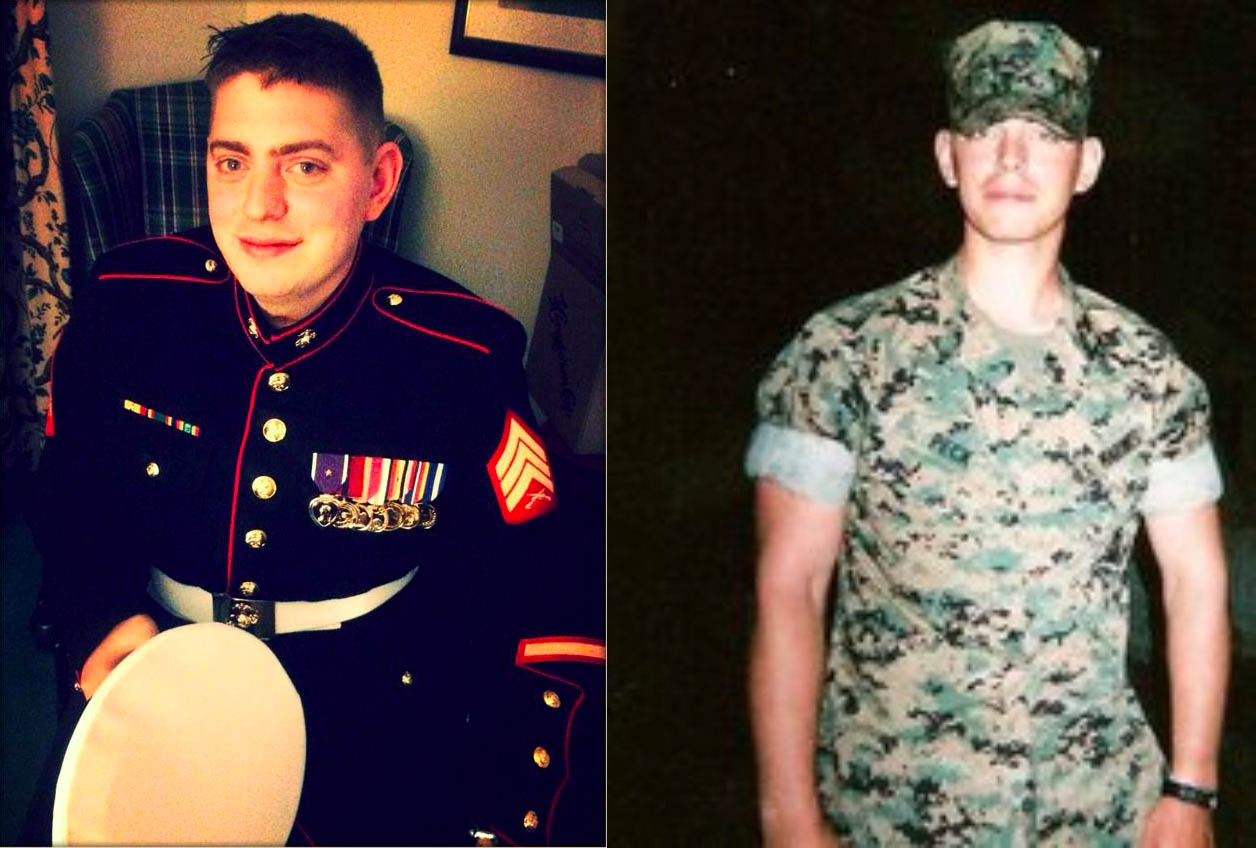 Retired Marine Corps sergeant John Peck photo: provided by Johnpackjourney.org
John was then awarded the Medal "purple heart." He could stay at home and try to live a peaceful life. Find a job, drink beer in a bar with friends, go on dates, call mom once a week and say that everything is fine. Or not find a job, sit in the evenings in front of the TV, remember Iraq, scold the democrats. Marry, take a mortgage, teach your son to play baseball. John was going on for the twenty -second year, he, in general, still did not begin to live. But he wanted to return to the army: "This is not for the sake of money or benefits, for the sake of those guys who were there next to me."
After two years of treatment and rehabilitation, John went to war again. Only now he was sent to Afghanistan.
On May 24, 2010, a detachment of marine infantrymen entered a small village in the Gilmain province. They were looking for caches with weapons and had to check if the Taliban were hiding there. “We were warned that you should not go into the houses, if there is no one there, it could be dangerous,” John recalls. “But our commander decided that we should check everything and make sure that there is empty.”
This is not for the sake of money or benefits, for the sake of those guys who were there next to meJohn with a metal detector entered the building first. “Everything was clean there,” he says. “I told the commander that I was going to go out, turned, took a step, and took off into the air.” He did not feel pain, only something hit him in the head. "I think it was my torn leg."
"I remember that I shouted to the guys who carried me:" I do not want to die here! " “And then he turned off.”
The explosion of John tore his right hand and both legs. He woke up when he was loaded into a helicopter - for a minute to hear from the doctor: "Everything will be in order, everything will be in order, but now you need to sleep."
John dies and lives
From the end of May to early August, John has been done by 27 operations in the Washington Army Medical Center Walter Reed. His condition worsened, blood poisoning began. The immune system refused. Once his mother was informed with a terrible night that John was dying.
When he came to his senses - after two months in a coma - he could not move. Due to the spreading infection, the doctors had to amputate his left hand to the forearm, as well as completely remove his left leg. “It was not me, I did not believe that it was my body, nothing was left of him.”
 John Pek in the hospital after undermining on a home -made explosive device during his second business trip to Afghanistan Photo: provided by Johnpackjourney.org
His lungs were damaged. At first, John remained connected to the artificial respiration apparatus and could only speak with a special device. After numerous operations, the skin became hypersensitive: any movement or touch caused painful pain. Again, he had to learn everything again - swallow, breathe, talk.
For two years it took rehabilitation and recovery. Daily exercises, physiotherapy. Sometimes John thought he could not stand it. That it makes no sense to make such efforts if he still remains completely helpless until the end of days. “You do not know what it feels like to live without hands. I could not do the simplest things that people do not even think about - open a jar of soda, fasten the shorts, and wash. Were there moments when I wanted all this to stop? Certainly".
When the stumps were suffered enough, John received hands and legs prostheses. He learned to walk with the help of manual prostheses specially designed for him - metallic canes that were attached to the forearms and replaced crutches. He says that he hated them because he would have to use them all his life. As a child, he dreamed of becoming a chef, visiting culinary courses in France and Italy. And now he could not even bring a spoon to his mouth.
I did not believe that this was my body, nothing was left of himIn 2012, John moved to his new house in the Oktsilweini district, Virginia. The program of the Stefanna Siller Foundation, a fireman who died during the salvation of people from the twin towers in September 2001, is building “smart” houses for the military who have received serious injuries. Each house is equipped using “adaptive technologies” so as to create the most comfortable conditions and allow people with disabilities to become more independent in everyday life and need less help.
Two more charitable foundations paid for the purchase of furniture, and actor Gary Siniz, who played in the film “Forrest Gump” by Lieutenant Dan, who lost his legs in the Vietnamese war, gave several charity concerts with his group “LT. Dan Band ”to collect money to help John and other wounded soldiers.
 John Pek at the restoration in the hospital after undermining on a home -made explosive device photo: provided by Johnpeckjourney.org
John is grateful to everyone who took part in his fate. Psychologically, it was very important for him that he could do something for himself. But he wanted more. He still visited the rehabilitation center and was engaged in a physiotherapist. He came up with motivation to continue recovery-he jumped in tandem with a parachute instructor, was engaged in diving in Ki-Wester. And he continued to dream that someday he would cook at least the simplest breakfast.
Hard to talk
John thought about the operation of hand transplantation for a long time. He wanted and was afraid to believe that there is such an opportunity. He decided that he was almost ready to put up with his feet. But hands! It was hard to even talk without them!
In the fall of 2013, John contacted Brigham and Women's Hospital in Boston, where three successful transplant operations have already been performed. Of course, he understood that the chances were small - to become a candidate for transplantation, it is necessary to undergo a detailed medical examination so that the doctors are convinced that the candidate will be able to undergo the operation not only physically, but also psychologically. In addition, it was very expensive.
And all the same, on the day when they called him from the hospital and offered to come to a consultation, Nadezhda returned. In January 2014, John spent a week at Brigham and Women's Hospital, where he was completely examined. The next six months, John did not part with the phone. In August, he was informed that he became a candidate for a double hand transplant. And the hospital will take on all the costs of the operation.
But that was only the beginning. I had to come to terms with a long expectation. He shuddered from each phone call. I bought a large black suitcase and collected everything that he could need in the hospital. The suitcase dusted in the closet. John says that his nerves were tense to the limit, he constantly thought about what future awaited him. In February 2016, John met a social network with Jessica. They began to meet. And in the summer, John wrote on his blog that all he dreams about now is not a trip and not even the opportunity to do everything on his own, no - he would most like to just take his girlfriend by the hand.
Read also
 Svetlana Komarova: You can’t bury it! He fell on my head - a trailer for the extension. I do not remember his last name, but I will never forget him
In August 2016, John called from the hospital. “They told me to come. That they have a donor. I was so happy! And only a few minutes later I realized that I rejoiced at someone’s death. ” John expressed condolences to the donor family and promised that he would protect his new hands, and this gift would not be in vain.
Before the operation itself, when John had to give anesthesia, he was truly scared. “Everything will be fine,” said the nurse. And before disconnecting, he remembered where and when he heard the same words.
Feel a drop of rain
The operation lasted 14 hours, 12 surgeons participated in it. First, they combined the bones of the hands with the bones of the hand of the donor, then sewed the veins, arteries and muscles and finally connected the nerves and skin. “This every time seems like a miracle when you see how blood begins to enter transplanted hands, how they gradually pink and come to life,” recalls one of the surgeons.
On John's left hand there was part of a tattoo of a man who died and gave him his hands.
When he came to his senses after anesthesia, Jessica was there. “John opened his eyes and was silent. I said - yes, yes. And he whispered - I have hands again. "
It was so painful that he asked the nurse to call the doctor and screamed on the phone that he could not tolerate, let him take these hands backSimon Talbot, the head of the transplantation department of the upper extremities, said at a press conference that the operation was successful, but there was a risk of rejection of donor authorities. “One night,” John recalls, “it was so painful that I cried, I asked the nurse to call Dr. Talbot and shouted on the phone that I could no longer endure, let him take these hands back. But no, this is not true, I do not want to part with them anymore, in fact they are perfect. ”
This will be a painful and long process, and the results should be expected no earlier than in a year. “Patients said that sensitivity is restored unexpectedly. At some point, one suddenly felt a rain drop fell on his hand. The other felt the roughness of the page when he read the book. Unfortunately, we can’t guarantee anything yet. In some cases, the sensitivity is not restored, ”says Simon Talbot.
But John believes that he will succeed. He already began to live twice first.
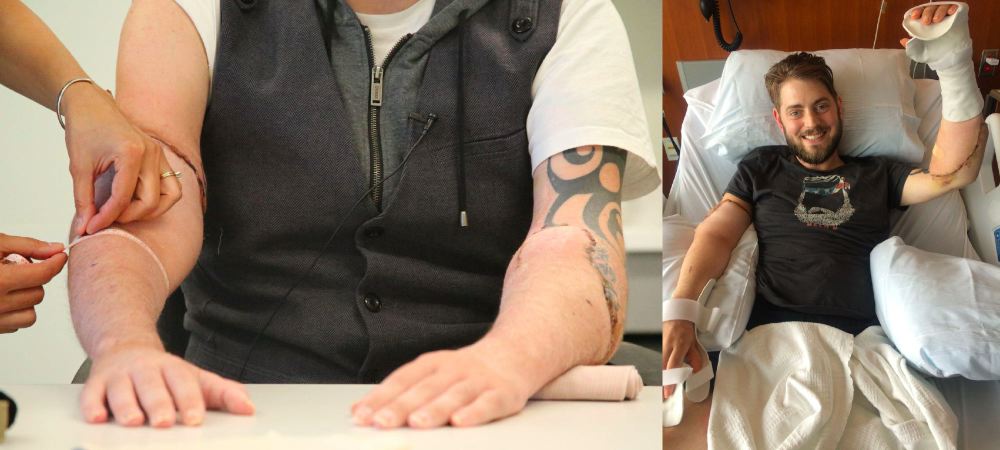 John Pek after transplantation photo: Brigham and Women's Hospital
Now John's new hands are protected by special brackets, any cut or burn can negate all the efforts of surgeons. He learns the simplest things - to comb, brush his teeth, bring a spoon to his mouth. Jessica helps him in everything - after the operation, they engaged and plan a wedding.
Read also Manual work The history of the Russian startup, which is engaged in the development and production of unique brush prostheses
Next year, John is going to take part in the Food Network Star television culinary show. He hopes that he can become a winner. And he wants to open his restaurant, he dreamed about this since the age of twelve.
“I understand that my body at any moment can say“ no, that's enough, ”that my hands may not take root, that I can never, touching Jessica, feel the warmth of her skin,” says John. - Well, then I will just live, work and rejoice at what is. And I will not give up. "
John Peck's Journey, CBS News, Stars and Stripes, National Public Radio, CNN, Fox News were used in the preparation of the article