
Translated material
Peresvet bank will have to be saved according to the traditional scheme
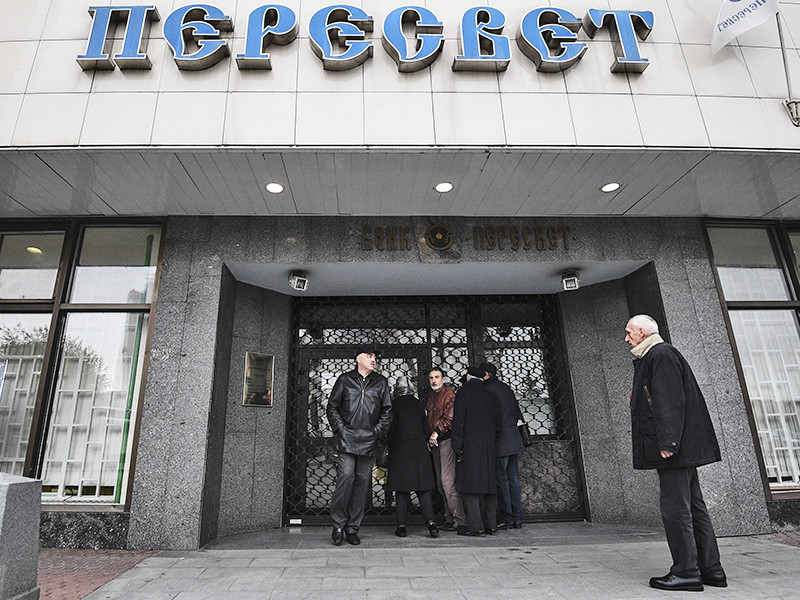
The Peresvet bank is sanitized according to the old scheme - at the expense of the deposit insurance agency (DIA) with the involvement of an external spacecraft, as well as using the Bail -in mechanism (converting the bank’s debt to creditors to its capital), writes the Kommersant newspaper with reference to the results of the meeting in the Central Bank.
It is assumed that the 28 largest bank creditors with the balance of funds as of November 1, in the amount of 61.93 billion rubles, convert 85% of these funds (52.6 billion rubles) into a subordinated loan of 0.51% for a period of 15 years. Under the same conditions, 90% (18.6 billion rubles) of debt is converted to the four largest shareholders of the bank with the amount of funds in it 20.6 billion rubles.
In addition, the DIA will provide a loan to the sanatorium for 35 billion rubles also 0.51% for 15 years. Thus, the price of salvation of the bank can be estimated at 106.2 billion rubles.
According to the publication, the choice of the Sanator of Peresvet is among its creditors such as Rosselkhozbank, Soskombank, Tatfondbank and FC Opening.
Earlier, the main contender for the reorganization of the problem bank "Kommersant" was called the Rosneft controlled by the All -Russian Bank of the Development of Regions (VBRR).
The Board of Directors of Peresvet was supposed to consider on Monday, November 14, to consider the issue of the form, nature and timing of the implementation of measures for the financial recovery of the bank.
On the same day, RBC and Kommersant wrote that the Central Bank is really trying to negotiate with banks and companies that kept funds on bank accounts, on the conversion of debt into a subordinated deposit. "The subordinate is discussed for a period of 15 years at 1% per annum," said one of the interlocutors of RBC. According to him, the conversion does not yet provide for the write -off of part of the debt.
According to another source, creditors are counting on the support of the regulator, but the Central Bank is ready to allocate funds only in an amount comparable to the portfolio of individuals of individuals - this is about 12-13 billion rubles.
However, large creditors, who are mainly represented by state -owned companies, the conditions proposed by the Central Bank do not suit, because, according to preliminary calculations, the “hole” in Peresvet may be much more than previously called. The discussion resulted in an open conflict between one group of creditors and the regulator.
According to the results of the third quarter of 2016, the Peresvet bank took 42nd place in terms of assets in the Interfax-100 Ranking, prepared by Interfax-SEA.
Recall that the Central Bank of the Russian Federation since October 21, 2016 appointed the Provisional Administration for the Management of the Peresvet bank for a period of six months. Such a decision was made in connection with the dissatisfaction of the claims of creditors for monetary obligations in terms of seven days from the date of the date of their satisfaction. For the period of the interim administration, the powers of the executive bodies of the Peresvet bank are suspended. In addition, the Central Bank of the Russian Federation introduced a moratorium on satisfying the claims of bank creditors.
A credit institution with the full name "Joint-Stock Commercial Bank for Charity Promoting and the Spiritual Development of the Fatherland" Peresvet "(Joint-Stock Company)" takes 41st place in terms of assets in the Russian banking system. The Bank serves and credits state structures, commercial enterprises, small and medium -sized businesses, as well as infrastructure projects, provided with revenue from state contracts.
According to the statements of the bank itself, its loan portfolio is dominated by enterprises with state participation and companies, which are a significant share of the business of which falls on contracts with various regions or federal structures.
According to the latest data, the largest shareholder of the bank (share of 36.5%) is the religious organization "Financial and economic department of the Russian Orthodox Church (Moscow Patriarchate)." The second largest shareholder (24.4%) is JSC Expocenter, owned by the Chamber of Commerce and Industry of Russia.
Another 13.2% of the bank’s shares are at LLC Assistance, which belongs to the Russian Orthodox Church by 100%. Another company with the same name, owned by the head of the bank Alexander Shvets, controls another 12.4%. Russian citizens Viktor Litvyakova and Lydia Makeeva own 5% and 4.5%, respectively. "LLC" Vnukovo-Invest "owns 1.7% of the bank, another 2.4% of the shares are in the hands of minority.
The Russian Orthodox Church, we note, in the last days of October stated that she had nothing to do with the problem jar and asks not to call it church.
Earlier, the New Gazeta recalled that Peresvet was a pillar of the financial system of the Moscow Patriarchate. Created in the early 1990s on the initiative of Metropolitan Cyril, the current Patriarch, he was under the direct control of the patriarchy (together 49.6% of two church structures), but he also had a state cover in the person of the second shareholder-the Chamber of Commerce and Industry of the Russian Federation.
About a third of all funds of the Russian Orthodox Church hid in Peresvet, although experts say that the church hierarchs managed to withdraw part of the money. What is happening may be either the beginning of the flight of church capital from Russia, or a decisive blow to the authorities on the church pocket.