
Translated material
Heter Lee: "I just obey"
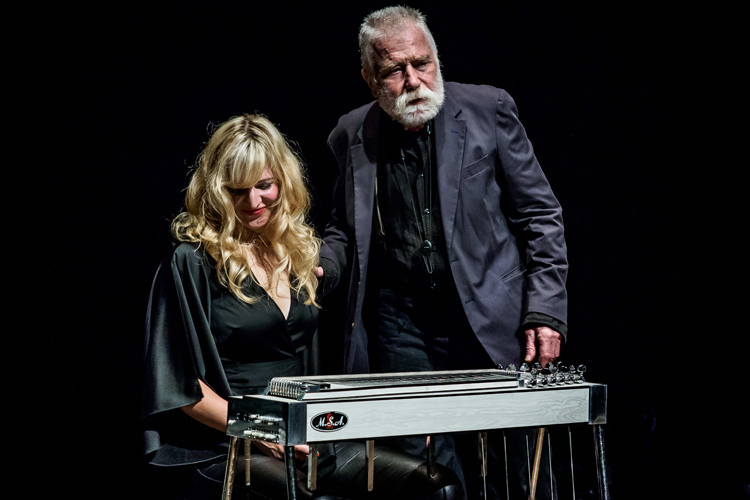
On November 25, in the cultural center, the house is one of the most famous figures of the European Free Jazz, a saxophonist, the leader of numerous projects of free improvisational music Peter Breetsmann, who recently celebrated the 75th anniversary. The concert will be held in two departments that differ in musical content. The second compartment will be given to the Trio of Brezmann with two British musicians - smuggler John Edwards and drummer Steve Nounl. In the first department, an American Heter Lee, a singer and a performer on a pedal styl guitar will play with the famous saxophonist. Before meeting with logs, Lee was also engaged in free improvisation, but with the musicians a slightly different circle - the Americans who came to this world mainly from the world of experimental rock. Last year, Heter Lee released the solo album "I Abused Animal". The pedal styl-guitar is one or two guitar vultures with at least ten strings each, lying on a special table in front of the performer who plays on them, sliding along the strings with a slide-a cylindrical object on a finger. To change the construction of the tool, a foot pedal and knee levers are used. However, Heter is resorting to other methods of sound recovery.
- What is the peculiarity of your duet with Peter Brewsman, if you compare with other ensembles playing the improvisational music in which you participate?
-I love strange combinations of tools, the winds are very interestingly acoustically interact with the pedal styl gitar. The sound of the pedal styl-gitar merges well with the sound of the winds. We study extreme manifestations in terms of volume, space and rhythm. At the same time, in our music there is always a blues shape. This is not a free jazz. I think both of us like to confront expectations, especially in improvisational music, where there are recognizable techniques that we both can not stand, so we try to avoid getting into these traps and play, based primarily from what we feel. I recall the weekend in Krakow, where we recorded the album "Ears are filled with Wonder" . I told Brewsmann: "You know, I never studied music, I do not know how to read notes." He interrupted me: "And I can’t even say what note sounds !!!" We immediately had mutual understanding. And since, playing music, we proceed from the principle of complete freedom, we are not constrained by the bonds of the genre or tradition, I think this allows us to make breakthroughs and find new approaches in each other's game. On the stage, we always solve complex problems, sometimes we even conduct a battle. At the same time, everything happens in a natural and very convenient way, so we can deeply immerse ourselves in music and continue to open something new. We are both completely ready to move to where the music leads us, and find what we can. As always says Brewsmann, "we will try."
This is not a free jazz!
- After you started working with logsman, you happened to play with some of its regular partners. Is it different how you work with them, from how you work with other musicians? For example, play with Chris Korsano (an American drummer, a participant in various ensembles performing experimental rock, as well as chamber improvisation ensembles, collaborated with Bjork. - G.D. ) - the same as the musicians from the circle of logsman?
- Not the same. Korsano and I initially played a duet. And the previous projects in which I participated were mostly duets. With the partners, I played more in the ensembles. In addition, Korsano belongs to approximately the same underground community as I, these are musicians and artists from the north-west of the United States, who perform at the same sites, cooperate with each other and value illegal notes. It is interesting that I played with the saxophonist for the first time when, together with Christina Carter, I performed with Chris Korsano and Paul Flartorti (Paul Flartorty is a saxophonist playing free improvisational music, Christina Carter is a guitarist, founder of the Charalalambides group, combining the elements of Folka, Psydelia and improvisation music. - G.D. ). At that time I played with Christina Carter, which was called Scorces . This joint project arose when our duets took part in Brattleboro Free Folk Festival in 2003. The question was suggested, he was also felt in the public among other musicians: how could this union function? After all, the sound of our duets is so different. Nevertheless, everything turned out better than we could assume, precisely because we are so different. Perhaps in this sense there is a similarity with work with Korsano. But when you play with musicians like William Parker (American smuggler, a participant and leader of a huge number of improvisational projects, one of the organizers of the The Vision Festival art festival in New York.-G.D. ), which belongs to a jazz tradition that has been going out of decades, it is as if you are in another world. Although Parker, McFy (Joe McFi - a saxophonist, a performer on a pocket pipe, a patriarch of modern improvisational music. - G.D. ) and other musicians with whom I played with Peter were surprisingly open to me, we listen to each other and together decide what we can do. After a concert in Krakow, Peter told me: “It seems to me that we can all learn a lot from you.” I was very touched. I think he had in mind how good it is when a person who does not belong to your world joins the ensemble and offers a new sound on a strange instrument (he sometimes calls it a stupid tool, this is its specific humor). It is amazing me that I play with these musicians, whom I respect so much and who I listened as far as as a teenager. Brewsmann also knows how to collect ensembles very well, he has a flair, he understands that he can work. So I try not to offer anything, but simply obey how he organizes everything. One of my favorite duets that he organized is with Tosinori Kondo (Japanese avant -garde trumpeter, a frequent partner of American and European stars of improvisational music. - G.D. ), we are very well suitable for each other.
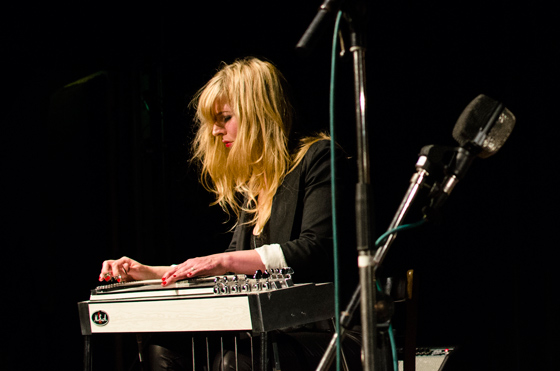 © Hans Van Der Linden
- Do you sing when playing with logs?
- I have not tried it yet. I like that I need to limit myself only to playing a styl guitar in a duet, to force myself to be an instrumentalist. Sometimes I sing a little quietly, so maybe I can make singing more noticeable, we'll see.
-Do you perceive your voice as the same tool as Style-gitar?
- Yes.
- What other instruments have you played lately?
“Only Steal Gitar and Voice.”
We study extreme manifestations in terms of volume, space and rhythm.
-Why did you choose a pedal styl-guitar as the main tool?
-In a sense, it seems to me that she chose me. I was presented to me by another performer on a pedal styl guitar. It was in Texas. She saw how I play a slide (a cylindrical item put on a finger to drive them on the strings.- G.D .) on a six-string electric guitar, came up to me after the concert and advised me to try to play on a pedal styl guitar. She went on - gave me a twelve -string MSA , I still play on it. This is an expensive tool that requires deep immersion if you want to reveal its secrets. And, of course, at that time I could not afford such an investment. It was a real turning point in the game and in life. I fell in love with this tool - in its size, his energy, his endless possibilities.
- Have you worked with a song form before you began to record the album I Abused Animal ?
- Yes. The song form has always been part of my work, although I Abused Animal is a departure from more spontaneous writing, that is, now I worked on songs and words in a coordinated way, this was not the case before. At the same time, the songs still change every time I play them-I make them longer, change the rhythm, even slightly change words or melody. I am not able to play something exactly the same twice, for me it is unnatural, and I would like to be so further.
-Do you use any elements from your songs during performances with other musicians?
- No, when I play with other musicians, I improvise. My solo work is worth a mansion from joint projects.
- Are there any musicians with whom you dream to play?
-I would very much like to play with Milford Graves (an American drummer who played with leading figures of Free jazz; it is believed that it was he who was the first in the history of jazz to free the drum from the need to keep the rhythm.- G.D .). But I would also like to play with someone completely unexpected, whom I had not even thought about. I never associate myself with a specific genre and I want to be ready for surprises.
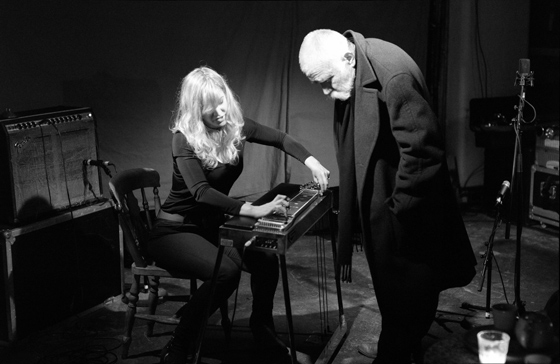 © Fabio Lugaro
- Which of the joint projects with your participation would you call the most amazing, most unexpected, most unusual?
- The duet with Peter Brewsman is suitable for all these definitions. We have a completely different background, I am twice younger than it, the pedal styl-guitar and the saxophone is a very strange, unique combination. And at the same time, the first time we played together, mutual understanding and musical intimacy arose between us, which continue to open all the time. We always offer each other new opportunities. We once had a concert that I did not like, then I discussed it with logsman, and he said: “I don’t think that one of us knew what we were doing at the concert today, and while we played, we asked this question-and I really like it!” We are always trying to open something new in music. Our music is raw, vulnerable and, despite the fact that we worked very seriously for a year, still mysterious for both of us.