
Translated material
There is such a couple
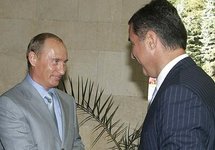
The organizers of the failed attempt on Montenegro Prime Minister Milia Dzhukanovich are Russian citizens Eduard Shirokov and Vladimir Popov. This was reported by Vijesti with reference to the prosecutor's office of the country.
The occupation of the activities of Shirokov and Popov is not specified.
The mass riots of the bought -out (parliament) were supposed to lead the previously arrested former commander of the gendarmerie Serbia Bratislav Dikich, as well as a certain Montenegrin politician from the opposition democratic front, whose name is not given in the prosecutor’s office.
Last month, the Montenegrin authorities detained 20 citizens of this country on the border with Serbia, including Dikich. It was claimed that they were preparing after the parliamentary elections on October 16 to capture the buying up, as well as arrange shooting at the opposition rally in order to provoke the assault on the parliament building. On October 25, this information was confirmed by the Prime Minister of Serbia Alexander Vucich. At the same time, he added that terrorists planned their shares "in coordination with foreigners."
On October 26, Nikolai Patrushev, Secretary of the Council of People's Commissars of Russia, arrived in Belgrade. He met with the highest leaders of the country. At the same time, the visit was not announced in advance, and his goal was not clearly formulated in official messages.
On October 28, on the last day of Patrushev’s stay in Belgrade, the Serbian media reported that a group of Russian citizens involved in the preparation of terrorist attacks in Montenegro was sent from the country. However, on the 30th, the head of the country's Ministry of Internal Affairs, Neboish Stefanovich , said that during a meeting with Patrushev , "there was no question of any citizens, Serbia did not deport anyone and there was no situation that someone left with Mr. Patrushev, who did not arrive with him."
Later on the same day, the police found a cache with a weapon near the house in the Belgrade microdistrict of Yainz, where the parents of Prime Minister Vuchich live, to whom he regularly comes to visit. The weapon was in the bushes at the intersection, where the Vuchich motorcade dumps speed to almost 10 kilometers per hour. Among other things, a grenade launcher, hand grenades and cartridges for a rifle were found.
On November 6, the main special prosecutor of Montenegro, Miliy Katnich said that some “nationalists from Russia” prepared the murder of Dzhukanovich in case of the victory of his party. Having killed the prime minister, the official explained, the conspirators intended to bring opposition force to power - which one, he did not specify.
"The criminal group was formed in the territories of Montenegro, Serbia and Russia," the prosecutor also said. "Nationalists from Russia" were the organizers of the conspiracy. The prime minister was supposed to shoot a sniper. Investigation of the conspiracy, added Katnich, is conducted in cooperation with the Serbian authorities.
On November 7, Vladimir Putin’s press secretary Dmitry Peskov said that the Kremlin was not involved in the preparation of the murder of Dzhukanovich. When the official asked if the Montenegrin authorities turned to Russian with requests as part of the investigation, he replied: “There were no requests on the official line. I don’t know if there were requests for special services.”
On November 11, The Guardian, citing a certain source close to the government of Serbia, said that during a visit to Belgrade, Patrushev apologized for the Russians who were preparing a coup in Montenegro. He assured that the conspirators acted without the sanction of the Kremlin. It was noted that the detainees of Russians were deported from Serbia only after the intervention of the Secretary of the Council of People's Commissars.
The press service of the Council of People's Commissars, however, said that Patrushev "did not apologize to anyone, since there was nothing to do with it."
The official representative of the Russian Foreign Ministry Maria Zakharova called the publication of The Guardian "a classic provocation, which consists in the spread of knowingly false information."