
Translated material
Book with History: Old "New Main"
1.
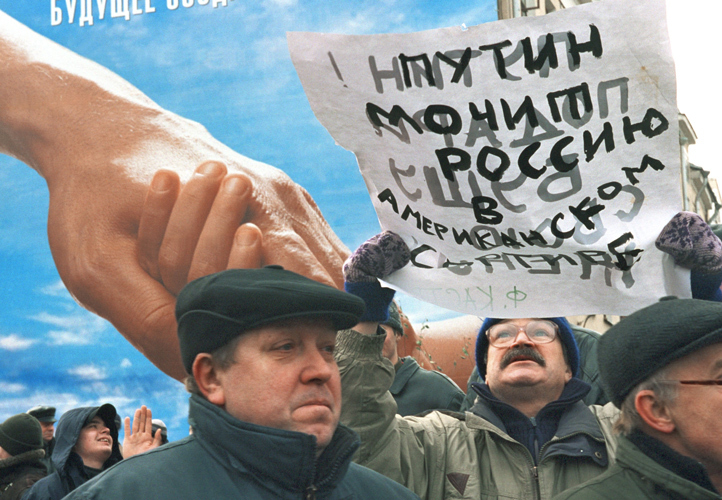
Until May 2001, there was no Russian Wikipedia yet, student rewritten the necessary information from thick encyclopedias. The year began with a grand celebration of Millennium. Putin was in power until recently and at that time said to himself and his team that "we are hired managers." The head of his administration at that time was still Voloshin. In Kyiv in January there was a protest tent town, in March there were contractions with Berkut. But they overthrew not Yanukovych, not Yushchenko, but only Kuchma. Russian society, very tired of Yeltsin, was just looking at Putin. The media continuously wrote that he was completely non -independent and the “petty protege” of the Yeltsin family and its environment. NTV showed Putin in the program “Dolls” in the form of “TsaCES crumbs”. The battle around NTV, which began in the summer of 2000, led to the fact that in March 2001, 20,000 people came to defend freedom of speech in Moscow. And only Pavlovsky continuously produced pathos texts that conceptualize Putin as a symbol of the fact that “the revolution is over”, the “Termidor” (in a good sense) has come, that the “vertical of power” (in a good way) will now be “equivalent” (also in a good way), etc.
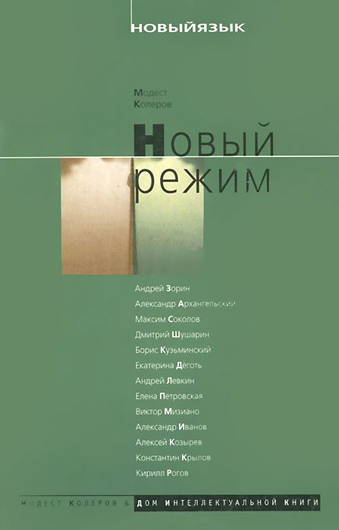
About this atmosphere-and it is also mythologized and forgotten in its then consistency-Modest Kolrov decided to make an interview with smart people about how the political language is changing, how the emerging new is perceived against the background of the 90s. This turned out to be a completely brilliant book called "New Main", published in August 2001. He recorded conversations with Andrei Zorin, Alexander Arkhangelsky, Maxim Sokolov, Dmitry Shusharin, Boris Kuzminsky, Ekaterina Dygot, Andrei Levkin, Elena Petrovskaya, Viktor Misiano, Alexander Ivanov, Alexei Kozyrev, Konstantin Krylov and Kirill Rogov.
At that time, Krerov was a completely different person, with a different thinking. This is now, after he was breathing in poisoned fumes from the mouth of Leviathan, he gives the impression of a person with a broken speech, excited, in front of the eyes of losing adequacy. And then it was simply an educated historian, the publisher of Russian religious philosophy, a media manager and a smart person, a good conversation. He chose for conversations not just the leaders of some average of that time (Misiano and the tar-from Art, Kozyrev and Zorin-from the history of Russian thought, Ivanov-from publishers, etc.), not just talented and noticeable publicists. He chose people who were able to support the conversation about the language, i.e. knowingly knowing that politics, social orders, social movement - all this happens, generally speaking, in the field of metaphor. That is, where, as a result of a language game, it is possible to find a new metaphor that creates an “additional value”, which is understandable to many, covers the minds. And therefore, it is made further by a kind of new “payment system” of politics. People begin to join in various projections of this new metaphor, exchange these projections - and pay with each other with these new notes, not money, but rather bills. Since this exchange of a new language is addressed to the future, to its formation. That is why “ideological futures”, “bills” and “bonds of political promises” arise in the language. Krerov chose people who, together with him, look at the transition from the 90s to zero from such optics of concepts that design the future. And at the same time-to ask them about what remains of the 90s. In the preface, he wrote very concisely: “The new regime striving to become an clarified and functional system of socio-political control in order to subjugate the phobias and hopes that has gone that has gathered it will be forced to tame the only thing that unites us: history and language.”
2.
Reading these conversations is incredibly interesting. In them-"air of the end of the end of the 90s." The entire Internet Landscape of Expertocracy then consisted of Polit.ru and the Russian Journal. All, as then expressed, “manufacturers of meanings” were published there. Maxim Sokolov still remained the “icon of style” (although the texts show that even then - at the end). Alexander Arkhangelsky was just starting as a publicist and tried on this new role. Andrei Levkin, Boris Kuzminsky, Alexander Ivanov were perceived as people who had just recently created not just new editorial offices and departments of editorial offices, but entire “cultural phenomena”, institutions. The ends of the 90s at that moment were perceived quite differently than today. It was an amazing decade when every active person doesn’t matter if he created a magazine, a gallery, publishing house or a bank - he felt like a pioneer, a free person in a unique life situation acting at his own peril and risk. Any institution was created with a sense of mission. This is now any activity was routine and immediately occurs in the channel of ready -made schemes described in brief manuals for “startups”. And then these were “garage startups” - with the entire living, friendly atmosphere, with the rapidly forming public reputations of successful creators. And what is a "mission"? This is the confidence that you are not just creating a “project” (named after him Legion), but you participate in the creation of a new cultural infrastructure. Victor Misiano says so in an interview with the tint: it was an “infrastructure” project - bearing in mind that a cultural institution is created, which is included in the landscape, creating new opportunities in it, giving rise to a whole direction of labor and thought, making an irremovable element of “humanitarian infrastructure”.
And so Krerov asks these “infrastructures” about what role Russian nationalism (Krylov, Kozyrev) will play in the new government, whether the optics of the left idea (Petrovskaya, the Leste, Misiano) can help with something, how a conservative turn and statehood (Rogov, Zorin) correlate. At that moment, Putinism itself did not exist yet. And even more: in conversations it is clear that even the transition of power from Yeltsin to Putin was the central moment in the understanding of the changes that are taking place. There were three central moments: the reaction of Russian society on Kosovo (1998), the Luzhkov concept of the social state (“municipal socialism”) as a strong alternative to Yeltsinism and a public turning to conservatism, which then has not yet gained any face. And Krerov asks each interlocutor questions about how these phenomena influenced the political language, who, according to the interlocutor, can assign through the political language these expectations of society in relation to the new statehood, a new nation. The answers demonstrate the exact hits. “In our history, the office that our current chapter is represented by played the role not the most happy. And therefore, the return of her in all her relics to government does not reassure too much ” - so Elena Petrovskaya then answered the question" What are the worst are afraid of the worst? " Dmitry Shusharin, in response to the question of the results of the first year of Putin, says: “... we voted for his determination, giving him time to goal setting. Now we see all the signs of an old administrative disease - determination without goal -setting ... Relations between the government and the “society” are reduced to the demonstration of non -existent power on the part of the authorities and the declaration of missing principles from society ... ”Kirill Rogov:“ ... a significant political threat is the rental structure of the economy in the conditions of high demand for raw materials exports. We just carry a stone down ... The Asian model is so attractive. This can end with a very sharp crisis ... Technocracy managed to play a very important role in solving the problem of the Yeltsin successor, but, in my opinion, it completely inadequately evaluates its capabilities. She all the time is engaged in the destruction of the fact that in the event of a crisis it will be a necessary and natural support of statehood. In the most general form, this can be called “public sanity”. It has its own institutes and infrastructure ... "
3.
And so, in 15 years, the same “we”, that is, the authors and readers of the “new regime”, historical witnesses of early Putinism, clearly approached the new line.
Yes, the "office" won, society is immobilized, the infrastructure of "common sense" has disappeared. All ideological options, which were reflected only as possible in 2001, have already been used. All drivers and all social energies have already worked out their own in this system. The client is so dead that all the projects of searching for drivers turned into a ritual tambourine about the “creative economy”, about “technology and new knowledge”, “restarting small business”, and so on.
And in 2016, this is quite clearly noticeable in all large public forums - in Berlin and Brussels at the Nemtsovsky Forum, in Moscow - at Gaidarovsky and at the Kudrin forum. The universal new feeling that hangs in the atmosphere - now we must generally go beyond the Coordinates of the Putin system and proceed to the discussion of the "post -Putin language". Because, as in 1999-2001, the question is not who further claims to power, but what are the contours of the political language of the next historical stage. And this, of course, cannot just be the right words from the normative theory. These are not political programs for an imaginary government.
These are bitcoin words. These are metaphors of the new “ideological payment system”, which people of different social strata can use, identifying their desired future in these words.
Modest Kingov. New mode. - M.: The House of the Intellectual Book and Modest Korrov, 2001. 200 p.