
Translated material
Garage Sale at the Stieglitz Academy
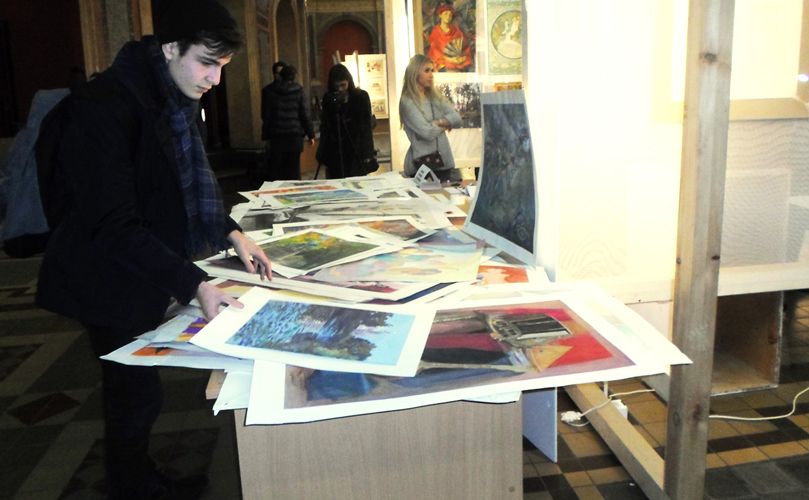
On weekends on November 18–20, 2016, at the Academy of Stieglits (St. Petersburg State Art and Industry Academy named after A.L. Stieglits) sold the university’s method funds . The price tags are more than humane (from 300 rubles, decent painting can be found for 3-5 thousand), there is a vintage of the 1970s and very fresh works. The proceeds will be directed to the development of the departments, and in proportion to commercial success at the exhibition. In the information message on the Academy’s website, the event was called the first traditional “salon” from the tsarist times-an exhibition and sale of actual art. We are used to going to creative universities for views and exhibitions, to see a clearly need for budget art education. But the temple of art, the monastery of young muses - and commerce? Over the decades of the hegemony of budget money in the field of culture, the viewer is weaned to bind art and monetary benefits, and in 2016, students are completely ready to defend copyrights.
Under the joyful news about the revival of the “salons” in the official community of the Stieglits Academy - several delicate comments in the spirit of “What about copyright?”. It's time to figure out what a method is a method, why it is needed and who is the owner in it is the university administration or the authors.
The fund is formed from the best student works, which the commission determines according to the results of each semester. We are talking about works created as part of the curriculum, and not about all the products of young artists. If, after going around your canvas, a sweeping letter “F” appeared, be proud of your work and photograph it because it was recruited to the fund. Some students manage to steal the marked work if it is too expensive for them. In the funds of the Stieglits Academy - painting, drawing, graphics, sculpture, monumental and decorative plastic, artistic textiles, furniture and everything that is created in specialized departments, up to work on car design (sketches, of course, and not the cars themselves). All these are manuals for future generations of students.
The question of copyright arises: nevertheless, the university sells other people's work without copyright deductions, abandoning their methodological purpose in favor of monetary benefits. The author of the idea of "salon" is the acting The rector of the Academy Vasily Kicheggi , a former vice-governor of St. Petersburg. He just gives an interview with television, talking about the revival of the "salons" when I get to the hall. His appointment in 2015 and subsequent personnel permutations at the Academy were accompanied by local scandals among students and graduates of the university. On the camera, Kicelsi says that the exhibition shows samples of imperfect student skill, while the work of teachers is much more expensive. “Imperfect skill”, however, was designed in the baguette and supplemented with price tags.
Students are ambiguous. On the one hand, the sale of work warms vanity, because in the fund it can collect dust for years. On the other hand, timid objections sound: "But what about the diplomas?" And what about the copyright? Representatives of the Academy reply firmly to such comments of former students: "All the exclusive rights to products made during the educational process belong to the Academy."
If, after going around your canvas, a sweeping letter “F” appeared, be proud of your work and photograph it because it was recruited to the fund.
“According to the current legislation, the author is the person who created the work with his creative work (Clause 1, Article 1228 of the Civil Code of the Russian Federation),” commented the situation by the lawyer for intellectual rights Ivan Bardov. - Persons who provided financial, technical or other assistance, as the Academy in this case, are not authors or co -authors. The copyright complex initially arises in the author. The most economically important of them is the exceptional - property. And such rights can be transferred (alienated) only in certain cases, for example, when concluding an agreement on the alienation of the exclusive right or arise with the employer if their implementation is provided for by the labor function of the employee. At the same time, students are not employees of the Academy, and if they did not transfer the exclusive right to the work, they did not conclude licensed agreements with the Academy, then the Academy has the right to use works only within the limits provided for by law. For example, use for educational purposes in accordance with paragraph 1 of Art. 1274 of the Civil Code of the Russian Federation. " The lawyer emphasizes that in 90% of cases of violation of copyright students they do not sign any contracts. And if they are signed, then this is not an agreement on the transfer of exclusive law.
Students of the Academy of Stieglits did not sign any documents. Tanya Yanchurova from the faculty of monumental and decorative art confidently said that they were even given a lecture about copyright and the Academy could pick up and sell student work. The teacher of the Academy Alexander Romanov called a partial sale of funds with the necessary bloodletting. According to her, every year it is more difficult to fit new work in the premises, from something-for example, large furniture-you have to refuse. And the students themselves burn part of the work in the courtyard of the academy, because they have nowhere to store them. “Every year after the session, bonfires are blazing from works that have nowhere to store, and the best go to the fund where they are dusty, they can’t even get them to show students,” says Romanova. The devil, as you know, is in the little things. Another ambiguity is in the supply of students with materials. After talking with the graduates of the 1990s, I realized that 20-30 years ago the Academy provided students with materials. In this situation, it seemed natural that the educational work belonged to the university. Now the university clearly does not cover all the student’s costs for raw materials.
“The sale from the method can mean a lot: unprofessionalism, poverty, crumbling, change of artistic and pedagogical guidelines, the weakness of the school,” said Alexei Grigoryevich Boyko, head of the educational and information technology sector of the Russian Museum. - In the method funds are the best - exemplary! - on execution, educational works. They do not necessarily express the creative personality of the student, the artistic image is not always captured in them, but the steps in mastering the skill in them should be evident. Why is the academy parting with them? The first thing that comes to mind was ceased to be exemplary. This is possible if they used to be taught one, and now another, if the previous school has lost its position. ”
Students themselves burn part of the work in the courtyard of the Academy, because they have nowhere to store them.
But the time to delve into such complex matters of the leadership of the university was hardly. Only two to three weeks have passed from the idea to the exhibition and sale, the head of the Department of External Relations of the Academy of Stieglits Alexei Abakumov tells me. “For many years, there were no such events within the walls of the Academy,” says Alexei. “Our students and teachers went out with their work at different citywide fairs, but there were no works from the funds of the departments.” The choice of works that can be sold, as well as their assessment and all material liability fell on the departments. “All these works are essentially exercises, many of them are typical, so the choice of the departments is large,” continues Alexei. The financial issue is important: in the academy - lack of equipment, insufficient salaries, the departments need to update the material base.
The fatal “f” is also at the Institute named after Repin Academy of Arts - the main antagonist of the Academy of Stieglits. This is not only about local “graters” - the head institute of the Academy brings a different tradition, it insists on mastering academic principles and is quite conservative, due to which the academic school is preserved. “Repin” is older than the “fly” (the Academy of Stieglits until 1994 was called the Mukhinsky school) and, as is commonly believed, does not allow young artists to express themselves, forcing the subject to study. But there, students take away from views of work recruited to the fund, and there the method funds are crowded. And since the Academy of Arts is still the main artistic university of the country, the question arises: will it follow the trend of the “revival of the salons”?
The rector of the Repin Institute, the rector of the Repin Institute, refused to comment on the activities of colleagues from the Stieglitz Academy, and reacted to his funds reverently. “In principle, this is not prohibited,” Semyon Mikhailovsky commented on the sale of works from the method funds. - The Ministry of Culture discussed such an opportunity. Yes, there was once factor in our academy, there were sales of art works. Yes, this is a world practice. Young artists are now of interest not only in London. I saw how the works of students of the Philadelphia Academy of Arts were sold, interested in conditions, mechanisms. Perhaps in the future we will deal with commercial exhibitions in favor of the institution, in favor of students. But you should not get excited. As for the funds, then one must be extremely careful. By the way, recently, one extravagant Italian mayor proposed selling museum things, which caused a storm of anger. "
Most of all, the dissimilarity of the “salon” at the Stieglits Academy of what we imagine, reading the “salons” of Didro, for example. It would seem that this is a traditional model of the sale of art, but the strange spirit of the garage-store or the “Fair of Masters” who in St. Petersburg in every second courtyard is alarming. Among the ceremonial interior, multi -colored marble, you see how not yet matured identity, juicy and good student art is sold, and it itself thinks: is it really nothing forever? After all, the cherished letter “F” on paper for each of the authors of four decades was a ticket to eternity, recognizing their “exercise” by art. Or such a perception - only mine and, in fact, an unnecessary barrier, which was obtained with a diploma of academic education? In tsarist times, such sales occurred twice a year. And now the idea has worked-my journalist colleagues took off the pile of painting from the exhibition, taking the names of the Mukhintsy outside the university.