
Translated material
"Normal human tail"
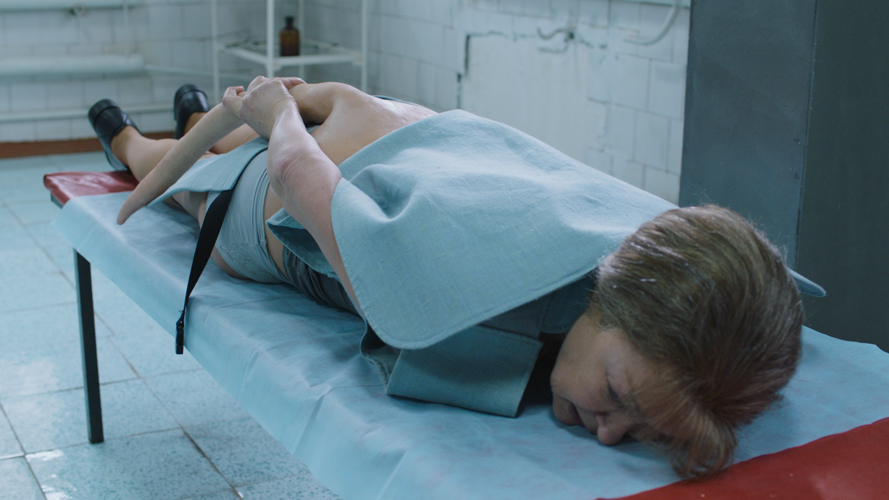
- How did the idea of the tail arise?
- The idea arose spontaneously. We sat with the producers and discussed the time in which we live. They argued, cursed: what is happening to us, how to show it in the cinema, through what you can go here. And at some point, someone said: "And what will happen if a man with his tail goes out into the street today?" I believed that this tail would not attract attention: well, the tail and tail. And they argued that everyone would immediately write letters to the Prosecutor General and so on. We somehow quarreled on this, but the idea of the tail in me sunk-like an anecdote. It seemed to me that it was very funny: a woman’s tail grows up, funny. But when it became clear that Natalia Pavlenkova should play this woman, then everything was exploded immediately inside, and I realized that this was not an anecdote, but a movie. I wrote the script precisely for it; If you remember, in the “Correction Class” she makes a significant part of the picture and works for the final, it develops precisely thanks to it. So after the “Class Class”, I really wanted to work with her and take it to some material for the main role.
-You wrote “Zoology” as a drama or, after all, as a comedy?
- Initially, I did not lay any genre there. I assumed that this story could end sadly, and did not think that it could be a comedy. But he did not prescribe it as a heavy drama. Everything was transformed from a slight plan into a difficult growing story, so some gags remained until the end of the filming. Now they are annoying me, because I began to take the film seriously. When I look at it myself, he affects me sharply enough, and those jokes that arise there, I do not need the viewer, of course. But at the time of writing the script, I wanted not to miss this moment of a funny situation: if a woman’s tail falls out on the street somewhere, how will people react? In this sense, the cinema, of course, was originally made as a multi -wire.
-Did the tail have some kind of metaphorical dimension?
- In relation to Russia, the tail, of course, carries a metaphor, to the final, it seems to me that this is very clearly visible. But at some point I thought that this whole story could happen anywhere. The place of action is quite conditional, it is pressed to the edge, to some kind of abyss. This poor heroine, Natasha Medvedeva, constantly rests on the sea and due to the fact that she has nowhere to run further, forced to turn around and go solve her problems. Slowly, slowly proceed to solving the issue - what to do with this tail at all? But at some point she gets used to the fact that she has this tail. He begins to feel it as his organ, he ceases to be superfluous - even, on the contrary, changes her life in the right direction. She lived for 55 years with her mother, who gathered her to school, to work, and all this would once end-she would have buried her mother and would later lay down somewhere nearby. And here there is some kind of growth through this tail, it becomes not quite a man, although I take the fact that this is an ordinary woman for the starting point.
- Yes, it can be seen there that her real place is not in human society, but among animals, in the zoo. And why is her tail rated? And how did you do it-is it CGI or something like a prosthesis?
- He's not rat! Normal human tail! I fantasized exactly what the tail would look like if it were our normal organ. I do not think that it would be some kind of sweet and fluffy tail, like a hare. In my view, he would have just such a volume, such a length. And due to the age of the heroine, some deformation of her body, he also acquires, perhaps a somewhat unaesthetic look. But he does not scare me off at all.
We had a large German company in the co -producers, which is engaged in computer graphics, but in the film, in fact, there are very few CGI . For me and for actors, it is important that there are some rules and laws that we cannot violate. How to play a tail that is not? It is important for me that the actress feels him. The tail, of course, can be somehow conditionally designated, but this convention will be visible on the screen. Therefore, we made animatronics - this is such a silicone thing with mechanisms inside. Special people sat in front of the monitor with a small remote control, and I conducted it, showed how this tail should behave.
- How did you work with animals? Did they somehow specially prepare for the scenes shot in the zoo?
- No, this is almost a documentary episode. The actress with a small film crew simply walked around the zoo and fed animals, no one trained them, did not persecute them on the frame. This, of course, is a simple technical task - you can go to the zoo with your child and take off, as he feeds animals, on a mobile.
- How fundamental to you is documentary, ultrarealist aesthetics of shooting? Still, this manual, mobile, shaking camera now looks somewhat anachronically-realistic cinema today, as it seems to me, has become clearer, it strives for greater transparency, the invisibility of the medium. And in many episodes, the camera is a full -fledged hero of the film.
- I grew up in the family of a documentaryist, and documentary cinema all the time with me. The stylistics that we are talking about, perhaps, is 10 years ago or more, but I was formed and studied at a film school at a time when they shot like that. Not that I choose some special plastic image for this film and I want to emphasize something. I just have some working tools, certain rules of my work with the operator that form just such an image.
 © "Arthouse"
- Is there any correlation between the style of shooting and the nature of history in your films?
- I have some approaches to how history is being removed. Of course, all dictates dramaturgy, but in terms of the visual series these are rather some tonal solutions, the choice of location, etc. The nature of the shooting and choreography of the camera are completely independent of this, they are dictated by the artist’s behavior in the frame. I can't program it in advance. Roughly speaking, I can’t do the storyboards-so I would clamp myself in some kind of framework, from which I would not get out of it later. I honestly tried to work with another approach in terms of a stylistic solution, but ... I get some personnel, what to do with them later, I don’t know ... And when I am a participant in the story-in the form of this camera that follows the heroes-it’s easier for me, I begin to understand and navigate already there, inside the frame.
I do not use the text, I have no dialogs in the script at all, so it is difficult to work with me at first to the new actors. I have a very clear content of scenes, a very strict order is spelled out of what the characters communicate about, there are main events, turning points that they take as a basis as a dramatic skeleton. But as the actors will say this, I do not care, I do not find fault with the order of words, I am interested in the process of birth of replicas from those circumstances that are registered in the scenes.
- So what is more important to you - a picture or dramaturgy?
- Drama, of course. Well, that is, as the viewer to me, the visual part, of course, is more interesting than the story that is happening. But as a director in my films, I am a little visible to the visual, he is expressed with minimal means.
- The model of relations within the zoo team seems artificially transferred from the school film, as if you are transplanting the same disposition from the Class Classes into a new picture. Is this intentionally to emphasize the infantility of these characters?
- Of course, yes. But this kind of relationship develops in any team. Not necessarily at school - and at the zoo, anywhere. I myself managed to work in the office space, in different productions on the TV channels, and everything was about the same there, the atmosphere there was exactly the same as the director, who sits like a toad, and everyone else has such a zoological look there. On the screen, of course, all this acquires a shade of caricature - but, it seems to me, people behave like that in life.
-Have you once calculated the audience’s conjuncture, made a film under the Russian or international market?
-Yes, I somehow can't think about it. And in the case of “zoology” at the stage of the plan, it seemed completely impossible that it would be interesting to the foreign public. And it so happened that she has a good festival fate, in the European market and in America it goes better than in Russian. But I can’t program this, I can’t lay a high probability of getting to the Toronto festival at the script writing stage, for example.