
Translated material
"I have been writing music for more than 70 years"
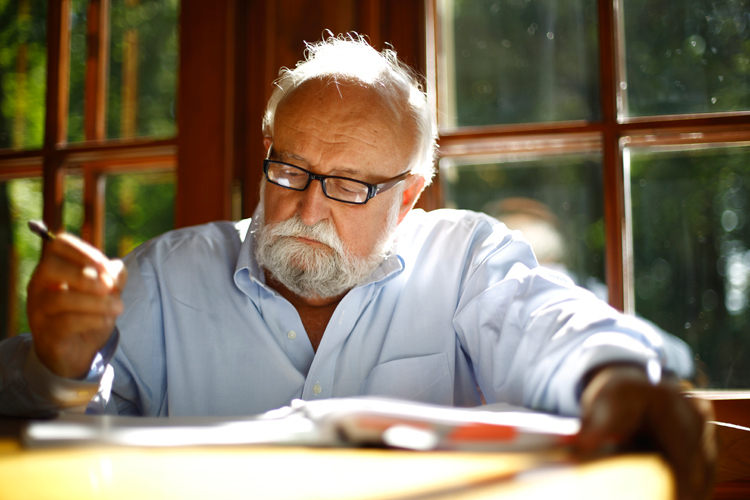
Krzyshtof Penderetsky, a living classic of Polish music, arrived in St. Petersburg at the invitation of the Diaghilev festival. Postscript ”in order to attend the ballet“ Tristan and Isolda ”, set by his music by Izadora Weiss and the troupe“ White Theater of Dance ”from Poland on the stage of the Alexandrinsky Theater. And also in order to get from the hands of the artistic director of the festival Natalia Metelitsa, the Honorary Prize "surprise Me". That is how the young composers and choreographers, Sergei Diaghilev himself, entangled, instructing them to come up with something new and extraordinary - for example, to write “Sacred Spring”.
Pan Kshishtof, however, has not been striving to shock the audience for about fifty years. He also had sins of youth-at the turn of the 50-60s, he was carried away by the new possibilities of orchestral writing and organizing textures, aleatoric and sonorism. But Penderetsky quickly became ill with a disease of the leftist: the sorior period lasted for five years, no more. And starting with the famous “Passion on Luke” (1966), he resolutely turns onto the beaten path of academism - in the highest meaning of the word, which he still runs up to this day.
Today, Penderetsky is one of the most executable (and, we add, revered) composers of our time, which has gained worldwide glory and gifted with all possible musical prizes, awards, orders and titles, the list of which occupies more than one page. It is enough to mention that he is an honorary member of the Vienna Musikverein and his portrait hangs there, in the Pantheon of the Great, next to Schubert, Brahms, Mravinsky and Jansons.
Penderetsky arrives in St. Petersburg often and willingly. Almost all of his large works sounded here. He is the holder of the medal “On the 300th anniversary of St. Petersburg”, the cavalier of the Order of the Baltic Star, Dr. Honoris Causa of St. Petersburg State University and an honorary professor of the St. Petersburg Conservatory. On November 23, Pan Penderetsky was 83 years old, so the commemorative prize "surprised me" was a gift for his birthday.
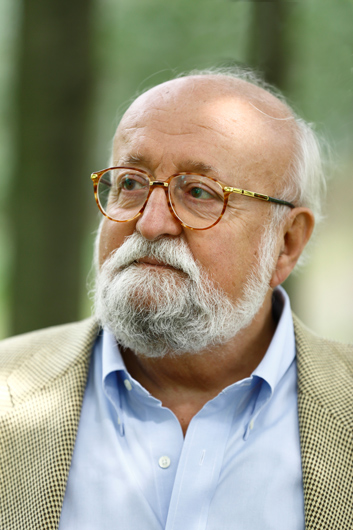 © Bruno Fidrych
- Pan Penderetsky, tonight was shown a new ballet of Izadora Weiss Tristan and Isolda to your music. Did you take part in the preparation of musical canvas?
- It's a shame to admit, but - no. I did not participate in the creation of ballet. Pani Izadora herself chose fragments from my works of different years and made a musical composition of them. I was only invited to the premiere, and I came here to see the performance. I can’t even list exactly what exactly sounds in the ballet. So far, I recognized my first symphonette.
- We have been talking to you about five years, so it turns out. I looked at the previous interview with you; About ten years ago, you said that you feel like the final of the era. That you are fully belonging to the age of xx - according to the attitude, aesthetics, and the manner of writing. Has your sensation changed? Still, 16 years have passed since the beginning of the new century ...
-I still think and feel so. Young people today write differently, none of the generation of 30-40-year-olds writes, like me, large orchestral works and symphony-in the most traditional sense of the genre. So far, I do not see truly innovative areas in the composition. It seems to me that we are still operating the styles and techniques that were open 50 and 60 years ago.
- “We” - in the sense of you personally? In my opinion, young composers today just work with the material in a completely different way. They have developed a new range of funds - at their disposal visual effects, electronics put to the service of music ... Yes, and attitude to sound and timbre, forming have changed a lot under the influence of a new digital era ...
- Well, if so. I am glad that they are looking for a new one, but, in my opinion, they have not yet found anything worthwhile.
- And what new works have you written already in the twentieth century ? When we saw each other the last time, you said that you write the eighth symphony with difficult to transmit in the Russian name. Now you have completed it - and what happened in the end? Are other works appeared?
- Yes, I really ended the eighth symphony. This essay is important for me: his plan arose under the impression of the flowering of my garden. This is a "symphony of trees", those that I put it with my own hands. Of course, trees, their growth were only the primary incentive to create a new symphony. As I wrote her, she turned into something larger and significant. The name of the symphony is “songs of oblivion”, or, perhaps, more precisely, “songs of the past”, in the Russian language there is no accurate equivalent of translation. It sounds about 75 minutes.
- Is the idea of organic growth of trees in the forming symphony of the symphony?
- Expensive - no. Symphony develops according to musical laws, although its music is very symbolic. There are also features of the oratorio in it: I introduced a choir and vocal parties into the score on the texts of German poets - Eichendorf, Goethe, Rilke. Nevertheless, this opus for me is a symphony by the type of presentation and the method of developing material. Shostakovich has a 14th symphony with text.
Now I am writing the sixth symphony, which I started twenty years ago, and never finished.
- Have you already thought about writing the ninth symphony?
- If I have time (laughs) .
- You turned to the genre of the symphony quite late when you were 40 years old. Despite the fact that they gained fame at the age of 28, when they won an anonymous composition in composition. Three of your works presented under different motto received the first, second and third awards, respectively. Then there was a relatively short period of passion for sonorism - and a cardinal turn towards a more academic manner of writing. So why did the first symphony appear so late?
- I believe that a real symphony is not by formal signs, but in fact - only a mature person can write. The one who already has an experienced emotional, sensual experience that knew the suffering and drama of life - then he has something to say to people. Now I am just at the age when I need to write symphony.
- However, Mozart began to write his symphonies at a very tender age ...
- Well, then there was a different style and time. In the XVIII century, everyone wrote 50-100 symphonies. In the era of romanticism, the number of symphonies in the creative baggage of the composer decreased sharply: Beethoven already has only nine symphonies, not to mention Schuman and Brahms. But each symphony is completely special for them.
The same picture is in the twentieth century. Tyskovsky wrote twenty -seven symphonies - and this is a lot for our time. Shostakovich has fifteen.
- But Shostakovich wrote his first symphony, being a young man - and how is this consistent with what you say?
-Well, Shostakovich is an exception ... I think before you start writing symphony, your individual style and tongue should somehow settled, stabilize. First you need to find your style - and then take up the symphony. My professor also said: Until forty years, you will not write a standing symphony.
- Many of your symphonies are equipped with software headlines: the second is “Christmas”, the fifth is “Korean”. The seventh is generally almost an oratorio, "the seven gates of Jerusalem."
- This is not a rule; I wrote the “Korean” symphony by Seoul - and introduced several folk Korean melodies into the score. But not all my symphonies are programmans: the third and fourth - without names, purely orchestral music. Now I am writing the sixth symphony, which I started twenty years ago, and never finished. Because at that time I received an urgent order from Israel: write a major essay on an important reason-the 3000th anniversary of Israel. So the “seven gates of Jerusalem” appeared. Then I began to end in the eighth, and the sixth failed to finish.
Religious disputes were constantly in the house, all sorts of clashes on religious ground occurred. What is not surprising: representatives of three branches of Christianity came together in our family, this is a lot. But I grew up a very tolerant person. Tolerant. Not an anti -Semite, not a fanatic.
- Rumors have reached that you are going to write a new opera - “Fedra”. Is that so?
- Not anymore. The plans are changing, and what was interesting to me a few years ago, today is notactive. I really thought about Fedra. But now another plot occupies me much more. I am considering the plan of the opera Austeria according to the famous novel by Julian Strykovsky. The novel describes the life of a Jewish place in the east of Poland in the 19th century, the central moment of the plot is a Jewish pogrom. The novel is really very famous, he received a literary prize, and the film was even shot on it.
- German, Armenian, Polish blood are mixed in you. You said that in your family there were even friction about confessional differences ...
- Yes, true. From my father, German blood is injected into me. My great -grandfather came from Germany and settled in Poland. He was the main forester in the lands of the princes of the Rachinsky. Perhaps from him I inherited the love of plants and the forest. I have an extensive botanical garden near Krakow, on thirty hectares. There I collect rare breeds of trees and shrubs: I have already collected 1800 varieties. I have five gardeners - I myself can’t cope.
My grandfather is German, he was not a Catholic, but a Protestant. Grandfather served in the Austrian army. The town of Stanislav, where his regiment stood, was so small that there was no church in it. Therefore, when my father was born, he was baptized in the Uniate Church.
My mother was an Armenian and belonged to the Gregorian church. Armenians who fled from Turkey and Iran lived in Poland. There were especially many of them in Lviv and Stanislav. Grandmother said that their family comes from Isfahan is such a city in Iran. So the southern blood in me also wanders.
My other grandmother was a zealous Catholic. Therefore, religious disputes were constantly in the house, all sorts of clashes on religious ground occurred. What is not surprising: representatives of three branches of Christianity came together in our family, this is a lot. But I grew up a very tolerant person. Tolerant. Not an anti -Semite, not a fanatic. However, I myself was baptized in childhood in a Catholic cathedral.
- You are also married in a Catholic cathedral?
- The first time - yes. And more than once it is impossible. The second marriage, with Elzhbuta, we registered simply in the registry office.
Since the 60s, the definition of Penderetsky-Sonourist has been haunting me like a nickname, like a label.
- You often turn in your work to religious topics, to Latin canonical texts, to the genres of cult music. Is the Catholic tradition for you a living tradition?
- What do you think? Yes, I am a believer. Grandfather went to the church constantly, father too. Therefore, since childhood, religious music of the XVI -XVIII centuries is close to me. I love Johann Sebastian Bach, for example. Although I wrote works on both Orthodox texts and in line with the Protestant tradition - “Passion for Luke”, “Psalms of David”.
But, in principle, I adhere to the belief that God is one for everyone: for Armenians, and for Catholics, and for Protestants. And in what language he will pray - everyone chooses for himself.
- What part of your works are related to religious topics?
- Almost half. Starting from the Psalms of David, which I wrote in 1957, even when I studied at the academy. There are a lot of large works: “Passion for Luke”, “Matins” - there are two parts in it: “Regulations in the coffin” and “Resurrection”. Then also TE Deum , Magnificat , “Seven Gates of Jerusalem”, “From the Apocalypse” - I took the texts out of the revelation of St. John. But he never wrote the full Catholic mass - and probably I will not write. There are only separate parts - dies IRAE , Credo , BeneDictus . I wrote the last in honor of my granddaughter; She was then one and a half year.
- Could you characterize your style?
- This is very difficult - especially when you are limited by several phrases of the interview. I think this is a business of musicologists - to formulate, analyze, not mine.
Although theorists have been writing articles on this topic for years. Since the 60s, the definition of Penderetsky-Sonourist has been haunting me like a nickname, like a label. Yes, there was a period when I was intensively interested in the sound, but it did not last long. In this vein, “Crying about the victims of Hiroshima”, “Anaclaxis” are written. But in the same 60s I wrote Stabat Mater , the work is quite polyphonic.
- I do not strive to stick shortcuts at all. But what is creativity for you? Why are you writing music? Are you striving to say something to people? Or is creativity for you - the game of the mind, a fascinating self -eating?
- I have been writing music for more than 70 years. I was 10-11 years old when I wrote my first play for the violin. Then I learned to play the violin, but there was no notes in post -war Poland. And I myself wrote a learning play - rather complex, by the way. In fact, music for me is the necessity, need and means of communication with other people.
I write by order the same way as the shoemaker sews boots.
- Does you visit you such a sense of satisfaction after the end of a new thing, which, say, the carpenter who made a solid table experiences?
- An artist is, in essence, a craftsman. I try to write the work as professional as possible, and the music comes myself.
- Does this mean that you, like the ancient Greeks, think that art is a high craft?
- Yes, I think so. I write on order in the same way as the shoemaker sews boots: trying to complete the order as best as possible, so that others are ordered from him. This is a production necessity: I did nothing else in my life - I just wrote music.
- Have you experienced the influence of your senior colleagues on the composer shop - for example, Lutoslavsky?
- Absolutely not. If we talk about influences, then, rather, I experienced the influence of Shimanovsky's music. But actually, I have my own style, independent of Polish music as a whole. Rather, I rely on the German tradition: Beethoven, Brahms, Mahler. In Poland, before me, one might say, no one wrote symphonies in general. They wrote in the Czech Republic, but in Poland - no.
“But Shimanovsky has written three symphones?”
- Only by name. Formally, this is not quite a symphony. The third, for example, can rather be attributed to the oratian genre. So I consider myself the founder of the Polish symphony genre. This is still a living form that interests me.
-Once you complained that your conducting activity takes too much time and prevents the composition of music. In those years, you gave 60-80 concerts per year. And now?
- Much less, of course, is about 30 concerts a year. I do not want to waste the remaining time for the performance; I'll write something else better.
- In recent years, you have established strong creative ties with Beijing. Do you often go to China?
- Yes, I was there a month ago and go again in December - to speak with the Beijing Symphony Orchestra. I was also part of the committee of the Beijing Music Festival; Perhaps I am still listing there. But I do not guise any more festivals; I am only an art consultant to the Big Beethoven festival, which is organized by my wife, Mrs. Elzhbet. For ten years I led the Casalis festival in Puerto Rico-but this story ended.
- There was still a Penderetsky festival in Krakow, which was held every five years. And now?
- Unfortunately, this festival had to be closed. The Polish government has no money to hold it. In general, with money to culture it became tight.