
Translated material
Democracy infantrymen
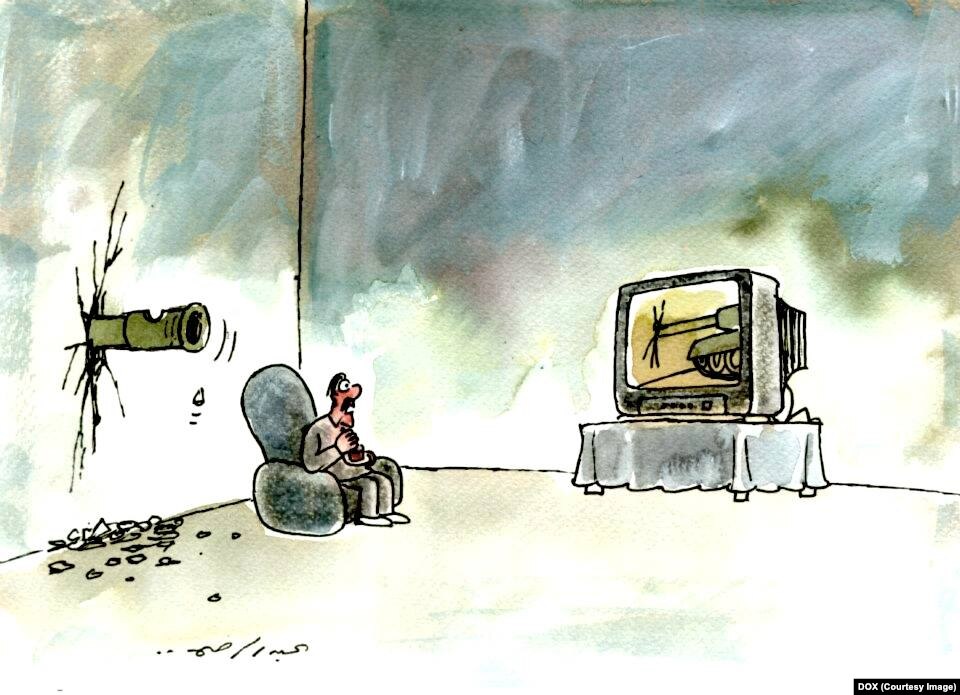
Arab caricaturists talk about revolutionary trends in their art
The presidential election, the migration crisis in Europe, the difficulties of international relations, violations of human rights, the problems of freedom of speech are the main plots of the works of political cartoonists from the Arab countries. Most of them began to draw caricatures during the Arab Spring. They call this genre “revolution in art” and “new weapons” against political games and empty promises of officials.
In the Prague Center for Modern Art of DOX, an exhibition of caricatures "Love of Freedom" was opened. It opened on time: the political caricature in November was at the peak of popularity - Donald Trump and Hillary Clinton became the heroes of hundreds of satirical illustrations published in the media and common in social networks. Caricaturists turned to the non -alien approach of the elected US president with migrants and women, to his friendly attitude towards Vladimir Putin, to the problems of freedom of speech. Artists depicted a crippled and sobbing statue of freedom on the way to exile in Canada. Clinton in caricatures was ridiculed mainly due to corruption scandals associated with the fund it head.
Several caricatures on Trump were created by Iraqi artist Abdul Rakhim Yassir and Sudanese illustrator Halid Albaykh, and their colleague from Tunisia Nadia Kyari focused on the problems of his own country - however, characteristic of many states of the world. The works of these three very different artists became the basis of the exposition of the Line of Freedom.
Sudanese cartoonist Khalid Albaykh publishes his work in a public Khartoon on Facebook (the game "Cartoon" and "Khartum" - the capital of Sudan). Albaykh believes that the genre of satirical drawing can be compared with independent journalism - the consequences for the authors are equally unpredictable.
For me, this is real journalism - when you criticize both your enemies and your friends
- I was introduced to political caricatures when I was a teenager. The first to have a great influence on me and showed that political caricature could affect power was the artist of Naji Al-Ali, who criticized the governments of different Arab states. His drawings were not comic, but life, very sad, raising serious problems. He was killed in London, and it was a political murder - still not disclosed. For me, this is real journalism - when you criticize both your enemies and your friends. Of course, there is a self -censorship, but I would rather call this a matter of choice: which audience should one or another caricature achieve, ”said Khalid Albaykh Radio Liberty.
Albaykh has Sudanese roots, he was born in Romania, lives in Qatar. He is ready to call all these countries his homeland, but says that the most correct address of his place of residence is the Internet:
-My Sudanese passport does not make it possible to travel-because of visa restrictions, and the Internet allows me to be in different countries, get acquainted with different people, it gives me freedom. Qatar is a small country with a small population, very rich and stable. But people in Qatar, if they want to talk about politics, go to a demonstration, will have to face the resistance of the state. Nevertheless, given which region there are Qatar, we can say: this is a fairly free country-to take at least the fact that the headquarters of such important regional media as Al Jazeera and Doha News are in Doha. Qatar is not the safest place for the caricaturist, but working there is something else than in Sudan. In Sudan, you never know what will happen if you just open your mouth.
Having left for Qatar, Albaykh, however, continues to monitor the situation in Sudan. One of his first works was the caricature of “Hug Sudan”, created shortly before the split of the country after the referendum in South Sudan:
- We were the largest country in Africa, in which representatives of many ethnic groups lived. Then there was a split. Today in Sudan, nevertheless, something can be proud of something, but the state is not able to give citizens the necessary information and education. When the same president runs the country for more than twenty years, the confidence of people in their abilities disappears.
My Favorite Khartoon! #SUDAN NEEDS A HUG ... I DID THIS WAY BACK in 2010 ... Still Feel the Same. ... http://t.co/sy4fxfjyrr
- ود الimeshes (@khalidalbaih) August 31, 2014
In the summer of this year, Albaykh reacted to events in Syria, devoting several works to the war and victims among the civilians:
- In an indirect conflict between Russia and the United States, new participants are drawn. Sometimes it seems to me: for politicians it is just a game - to see who will win, who will receive more influence. Meanwhile, people die.
Albaykh caricatures of the victims of the war in Syria and refugees, according to the artist, are an appeal to European countries that refuse to accept people who are saving from the misfortune. Albaykh says that he considers himself a refugee that his children could be in the same situation as Syrian children.
- I hope that my caricatures will push people to a conversation, make you think about what they did not think about before, to see what they had not noticed before is what exists in reality. I try to be honest. Since my works are published on the Internet, they can have at least some influence on people around the world.
Iraqi artist Abdul Yassir talked about how independent caricaturists work in his native country:
There is always a certain level of self -censorship, it is also needed to calm society
- Previously, Iraqi caricaturists in paradoxically did not face real danger, because everything in Iraq was censored. Many cartoons were rejected by the editorial offices and not published. In recent years, more freedom has appeared, we can criticize the state, but, on the other hand, officials are unable to protect us from “unofficial” authorities not related to the state. There is always a certain level of self -censorship - however, it is also needed to calm society, so as not to provoke even more serious problems.
One of the political works of Jassier is about the empty promises of politicians:
- They use so many words in their speeches that they simply forget about people and their problems.
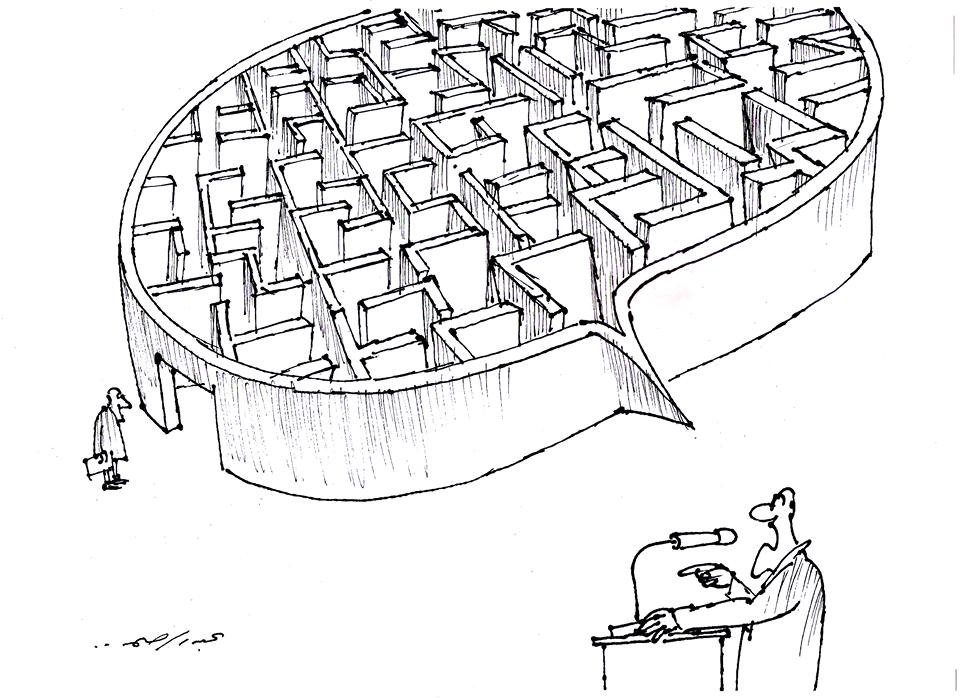
For the exposition in Prague, the Yassir came up with the definition uniting all artists-"infantrymen of democracy", believing that their work is changing the attitude of people to what is happening.
Nadia Kyari, an artist from Tunisia - began to draw cartoons during the "Arab Spring", when the popular demonstrations in her country led to the overthrow of the regime of President Ben Ali. The hero of the work of Kyari is the cat Willis from tunis - the prototype of the president. Nadia came up with a cat on January 13, 2011, during the last appeal of Ben Ali to the people - in this speech he promised the country the freedom of access to information, the lack of censorship on the Internet, freedom of speech and self -expression. Kyari decided to check whether the truth of the head of state corresponds to the truth, but did not have time to do this: the next day, Ben Ali was dismissed. According to Kyari, after the fall of the authoritarian regime, Tunisian citizens had to learn to live in conditions of freedom.
The silent majority is ready to sacrifice many rights for the sake of security
In his works, Kyari also focuses on the problem of the lack of a civil position among many members of society. The "silent majority" is ready to sacrifice many of their rights and rights of other people for the sake of security, "Kyari says. - But this security is not absolutely absolute. "
“I don’t give a damn about human rights! I don’t give a damn about the revolution! I don’t give a damn about freedom! I want security!” - "Happy now? Are you safe"
After the tragedy in the editorial office of Charlie Hebdo in January 2015, when artists and journalists of the French satirical newspaper became victims of a terrorist attack, it became more difficult to draw caricatures. The issue of security is now considered completely different.