
Translated material
Jokes. Who pays for culture?
Anecdote 1
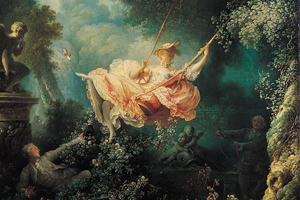
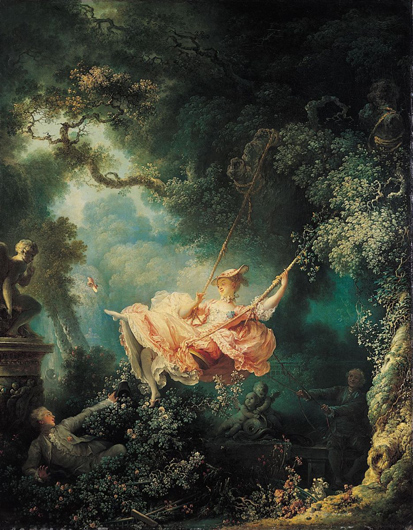 Jean-Oonore Fragonar. The happy capabilities of the swing. 1767
Baron de Saint-Julien was a baron and therefore did not pay taxes. On the contrary, they were paid to him: he was the main tax collector of the French Assembly of the clergy. Baron de Saint-Julien enjoyed the advantages of his situation and as a feudal lord, who has business with the clergy, and as a person involved in the financial affairs of the bourgeoisie. Such a double benefit was provided by the absolute state to the aristocrats, who were hired to the service.
The baron was famous for free mores, and the proximity to the clergy did not interfere with him at all. Even the opposite. Here is one example: the picture of the artist Jean-Oonor Fragonar “The Happy Possibility of the Swings”. At first, the baron tried to order this picture to another artist, Gabriel-Franesu Dwine. He turned to him with such a proposal: “I would want you to portray Madame (pointing to your mistress) on the swing, which the bishop swing. And you will put me in such a way that the legs of this lovely creation are visible to me; And the more you want to make fun into this work, the better it will be. ” A wonderful metaphor for the social role of the clergy in the absolutist concern of the baron! Dwayen refused to order, advising a fragonar who performed the required work in his place, although he made the figure of the “bishop” unrecognizable.
Baron de Saint-Julien died on time-on the eve of the French bourgeois revolution, in 1788. The revolution, which began in 1789, killed the French absolute state. The revolution brought a lot of anxieties to all the not yet dead barons, as well as the artist Fragonar, like other artists of the aristocrats. The aristocracy and the clergy lost their estate privileges, and the fragonar - their orders. The “artist of the revolution” by the bourgeoisie proclaimed the classicist Jacques-Louis David, the aesthetic opponent of the master Rococo Fragonar. The performer of the "happy possibilities of a swing" died in poverty, left by glory.
A joke 2
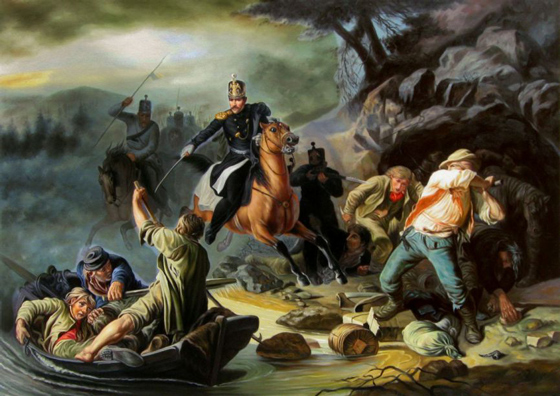 Vasily Khudyakov. A skirmish with Finnish smugglers. 1853
Behind the best life, Varvara moved from the village to Kostroma, took off the corner in one of the houses on the outskirts of the city and got a job for a linen manufactory. Since then, an hour after an hour, year after year, coming to the factory, she repeated the same movements. The simultaneous knock of hundreds of machines was continuously intertwined into the most difficult rhythmic canvas. Flax dust stood in the air, settled on clothes, on her hair, in her mouth. The factory did not idle either day or night: they worked in three shifts. Barbara began work at six in the morning and worked until noon. Then an hour and a half for lunch and work again - until six in the evening.
Flax fabrics were sold at fairs, as well as sewing manufactories and workshops. One of the family members of the factory owners, Pavel, began to buy the paintings of artists from the sales from sales. The first he bought a “skirmish with Finnish smugglers” by Vasily Khudyakov. Soon Paul decided that his duty to the Russian people was to make his meeting a public one. He said this: “Do I have the right to be tormented? The money that I spend is not mine. This is the money of the Tretyakov workers factories. The gallery was not created by me, but by them. I am only trusted. And I am making money in order to return the people acquired from society. In the form of useful institutions. " Since then, a year after the year Paul purchased new and new paintings. The ark for the treasures of the nation, the building of the gallery, was built, of course, in the forms of the Russian tower. At the opening of the gallery, the rumble of hundreds of voices was intertwined into the most difficult sound canvas. In honor of the owner of the fabricant and philanthropist Paul, the Gallery began to be called the Tretyakovskaya.
Barbara in this gallery, of course, was not.
Junction 3
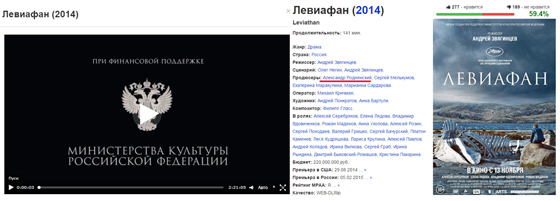
Recently, the statement of the film director Andrei Zvyagintsev made a noise in Media, who noticed that Russian officials consider money distributed from the budget for culture, their property, they have to sponsor works of art something like a private order. Quote:
“The key feature, indicating the immorality of our power, consists of that it is completely convinced: the money that they manage belong to them . They forgot, with some amazing ease, they seized a simple and obvious thought from their consciousness that this was not their money, but ours . General. The money for which they “order” their agites are taken from the people. And among the people there live such a huge wealth of opinions and desires that they never guess any power. Once I happened to be discussed with Mr. Medinsky around the same topic, and I was surprised with which sincere conviction he believes that they give us money. That is the simple circumstance that this money is as mine as him, it simply does not occur to him . ”
Many commentators understood this in such a way that Zvyagintsev spoke of “ our money” as taxpayers' money, recalling the function of the social state as a redistributor of wealth. However, what is the Russian budget made of? The share of VAT (value added tax) is about a third in it - and these taxes produces the society with its labor, which Zvyagintsev talks about. At the same time, taxes for the production and sale of oil and gas are half the budget of the Russian Federation. Large private corporations are engaged in the prey and sale of these resources, whose shareholders and owners are a very limited circle of persons close to the main government officials. So, to a fair amount of culture, these owners of the subsoil sponsor - which is associated with the Minister of Culture of Medinsky.
Did Zvyagintsev mean, speaking of “ our money”, that the bowels should belong to the people?
ANECDOT 4
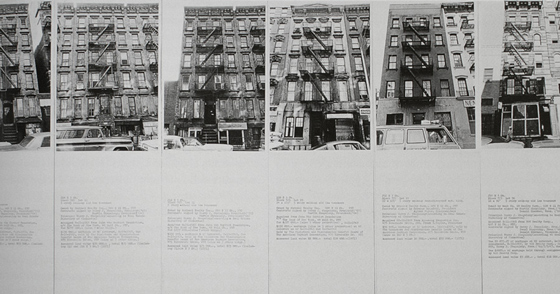 Hans Haak. Real estate in Manhattan, belonging to Shapolski, etc., social system in real time, the state of affairs as of May 1, 1971
He barely made ends meet. He urgently needed housing, and the real estate company offered him a room in Harlem. Dirty apartment in a multi -storey brick house. But every month he hardly scrapped for rent.
Apartments. At home. Real estate. Many apartments. The more real estate you have in a particular area, the more you can influence the cost of renting in the area. In Hasde and Harlem, Harry Shapolski had a lot of real estate. But Shapolski was modest and not too much advertised it. Therefore, he had many different real estate companies where his relatives and friends worked. These companies concluded transactions with tenants.
Shapolski was rich and successful. NN was very friends with Shapolski, and also loved contemporary art. Recently, NN liked one witty artist - the author of the work “Plexiglass Cube”: a transparent cube of organic glass, inside which a little water is poured. Water evaporates under the rays of museum lamps, condenses on the walls, dripping from the ceiling ... NN with someone joked about this work: "This is not a pure pure art!" NN , out of his love for art, became a member of the Board of Trustees of the Guggenheim Museum. NN was so friends with Shapolski that he was his business partner. However, it seems, on the contrary, their friendship began with business.
And the museum suggested an artist who came up with a cube to hold a personal exhibition. NN warmly supported this decision. The artist did the job for a long time specifically for the exhibition. When it turned out what kind of work it was, NN was very upset. It turned out that the artist photographed houses belonging to different real estate companies of his friend and business partner of Shapolski. Many multi -storey brick houses. And under each photograph, made signatures with information about real estate transactions. Shapolski was also upset by the artist’s act. It was rude and even outrageous. As NN said to someone about this: "This is no longer art!"
The exhibition was canceled. But it only turned out worse - friends of the artist, other artists, offended for him, made a noise and arranged an ugly scandal.
After this incident, the artist who arranged the exposure of Guggenheim became very famous. Shapolski, too, did not remain at a loss - his affairs went uphill.
Anecdote 5
To exist for crowdfunding, you need to want you to - they want to also in monetary equivalent. The more people want what you do, more precisely, the more solvent people want what you do, the better. Working as an editor on the website "Kolta. All about the culture and the spirit of time ”, spontaneously comprehend the basics of media popularity and SMM. The mention of a celebrity in the title, whether Putin or Pavlensky, immediately increases the number of views. At one time, the records of popularity beat a text called "And after Putin - Putin."
Society pays for crowdfunding - but a society soldered to the market. The modernity is preoccupied with the quantitative measurement of human relations, attachments and interests - the economy of likes and attendance claims to express the Libido economy in numbers. Which, of course, is imagination: the power of desire is not summarized and not deducted. And a strong desire to give money to support the project is not directly connected with its popularity in social networks. As, however, the desire to give money does not coincide with the opportunity to give this money.
We are mired in numbers, but it is necessary to distinguish between three economies. The economy of desire. The economy of popularity. And the economy of money. Who now and then pretend to be each other.
Junction 6
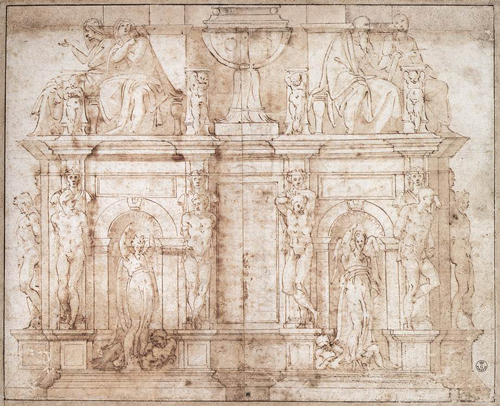 Michelangelo Buonarroti. Sketch of the tomb of Pope Julia II. The second option
When the Pope ordered him a project of his tomb (it was in 1505), he still did not know his life and therefore allowed his imagination to play out. The customer is serious, you can turn around, he began to imagine the most magnificent paintings. 10! 20! No, 40 or 50 figures, on three tiers, in the grandiose architectural framing of columns and arches! He was so eager to work that he presented sketches in two weeks. Yes, the scope is considerable, the project will take a lot of time, but dad is still wow, for five years to be enough. The main thing is that marble is brought in time and pay him and apprentices. He personally goes to the quarry of Karrara, then rushes back - he urgently needs a sanction to buy one hundred tons of selected marble!
But dad does not give an audience for a week. It seems that his pressure was frightened. The development of the project is delayed, dad connected to the architectural decision to Brahmante, for sure to put sticks in the wheels, he seems to trust him more. Marble is delivered with interruptions, the project is forced to redo and reduce, paying reluctance. Now dad got into the head of the head to paint an empty arch in one Vatican chapel, you see, more urgently - the tomb will have to be postponed! The case is delayed. Five years pass, and then all eight. Then dad take it and die - did not reach seventy, but it seemed that a strong old man, went to fight, and there he caught a cold. And who will pay for the completion of work? The new dad is not interested, he is not a relative to the past, and the heirs do not burn with the desire to fork out for the ambition of the deceased. But half of the sculptures are already ready, you won’t take the money back, the project is inconvenient, too much is invested. Again they cut in the living, they are inquired as they can, they do not care about the art. He remade the project in 1516, 1525-1526, 1532, 1542. Everyone has already forgotten about the deceased dad. If he knew in the 1505th that the story will stretch until 1545, I would have found an excuse.
ANECDOT 7
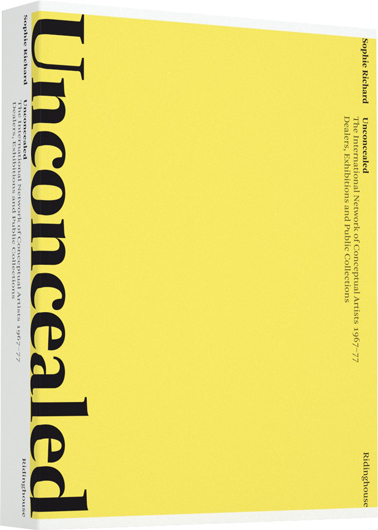
Herr Ludwig owned a chocolate factory in Aachen. He began to buy conceptualism only because he wanted to have other examples of contemporary art in his collection of pop art. Herr Strier was from Darmstadt. He worked in Wella . Once in 1967, he bought a whole exhibition of Joseph Boyce. Dr. Shpek was a therapist from Cologne. He also began with Boyce in the 1960s. Dr. Habrig was a chemist from Munich. He bought Nauman, Buren and Huller. Herr Hawk was a banker from Crefeld. He collected Levitt and Weiner. Dr. Mattis was a psychiatrist from a derly, this is under the gent. He bought himself Karl Andre, Levitt and Jean Dibbets. Dr. Peters was from Bruges. He had Stella, Morris and Jadd. Herr Geminne was from Genta. Herr Perlstain sold diamonds in Antwerp and often flew on business in New York. There he began to collect American conceptualism. Herr Fishman also traded diamonds and also in Antwerp. Spouses German and Henriette Van Helen from Amsterdam: he was the first male photograph in Holland, she was a speech therapist. Herr Martin Visser from Amsterdam designed furniture. Mr. Peter Palumbo from London was a major developer. And Mr. Ted Power worked in Murphy Radios in Cambridge [*] .
[*] Data is given from the book: Sophie Richard. Unconcealed. The International Network of Conceptual Artists, 1967-1977. Dealers, Exhibitions and Public Collection.
Anecdote 8

For the fact that I am now with you here, I want to express gratitude: dad and mom for their inexhaustible support and for the fact that for years they paid for my tutors, because more than anything else they were afraid that I would not receive higher education. The Soviet state for the fact that after its end it allowed me to get this higher education for free. Putin's Russia for not allowing to work for salary and engage in science, but allowed to get invaluable life experience. Thanks to the VAC Foundation (“Victoria - the art of being modern”) for paying money, but did not let me become famous, my university in the United States of America, which now pays me a graduate school, and all its corporate sponsors, which, according to rumors, invest in private prisons and have dark cases in Qatar, but they created an academic paradise on the shore, and personally a Varonka family, and personally bar. About whom I do not know and I am afraid to find out, for their generous assistance to the faculty of the history of art; Thanks to the colta.ru portal, which exists thanks to crowdfunding, that is, thanks to you, friends, and pays for notes exactly so much that you can assume that you are almost a volunteer; Thanks to Garah and Abramovich, thanks to Breus and Potanin, Michelson and Prokhorov, Coca - Cola and Tiffany & Co , Vacheron Constantin , Carrera Y Carrera , Longines and Patek Philippe , Lexus and Absolute List, for the holiday of art and culture that they give us; Thanks to the sponsor of “Disagreements”, which provides us with the opportunity to accommodate this gratitude, as well as one oligarch, whose fund I am now counting on and therefore I will not mention it. Thanks to capitalism, but thanks to socialism, more than more, because it is imaginary and because from each by abilities, everyone in labor, and for this you can not thank you, thank you very much.
Download the entire issue of the magazine "Disagreements" (No. 10) "Who pays for culture?": PDF , mobi , epube