Translated material
Refuse the claim
The court did not accept the lawsuit against the OP, filed by human rights activists who were not included in the new composition
“A judge who does not know how to separate public relations from other types of legal relations needs to be verified by its legal qualifications”
On November 21, we (Elena Masyuk, Lyubov Volkova and Lidia Dubikova) through his representatives - Doctor of Law, Professor of the Law of the Higher School of Economics, lawyer Elena Lukyanova and lawyer Vladimir Dancha - filed a collective lawsuit in the Tver court of Moscow, disputing the decision of the Council of the Public Chamber of the Russian Federation on the formation of public supervisory commissions and the rejection of our candidates for the ONC of Moscow and the Moscow region.
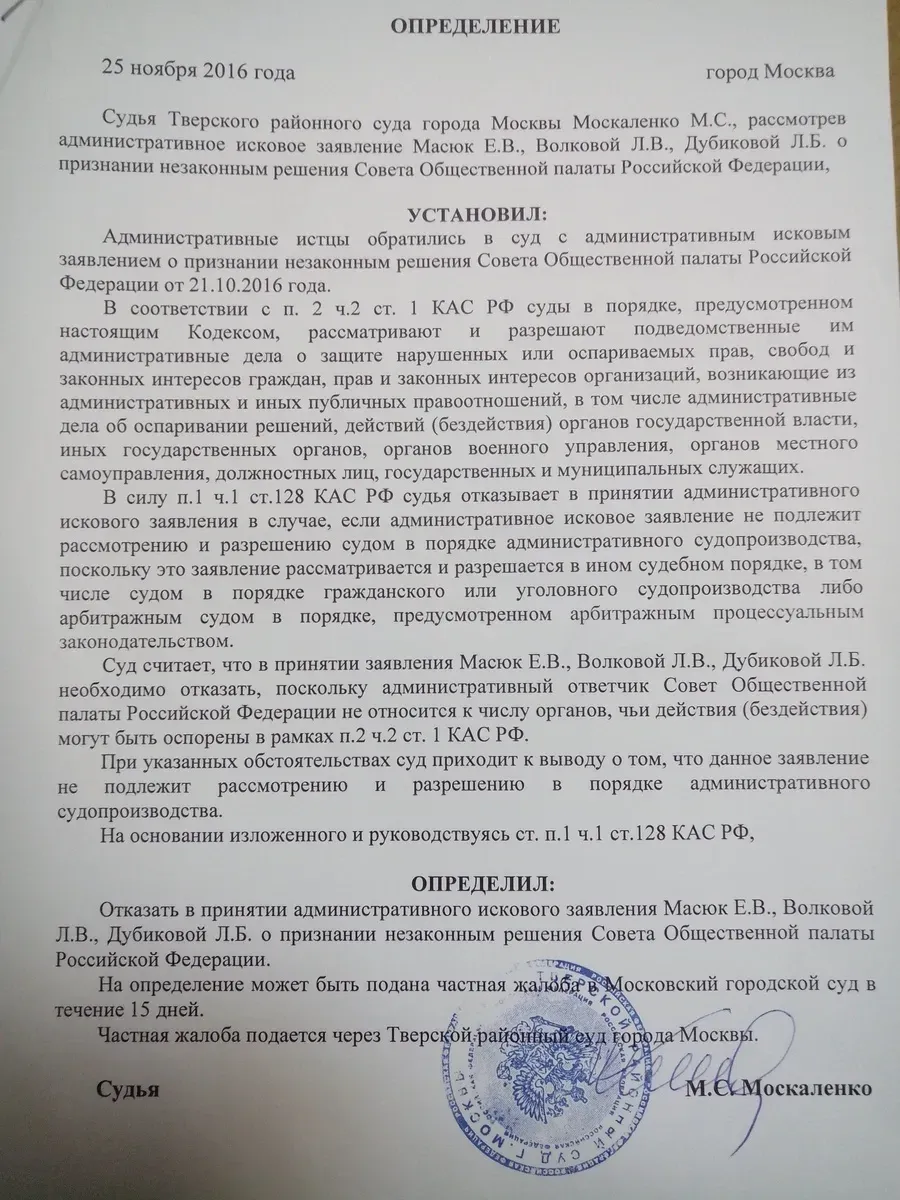
On November 25, the Judge of the Tver Court of Moscow Maria Moskalenko refused to accept the claim, citing our claims that our claims are not subject to consideration in administrative proceedings, "since this statement is considered and resolved in a different court, including the court in civil or criminal proceedings or an arbitration court." Well, besides, Judge Moskalenko decided that “the administrative defendant Council of the Public Chamber of the Russian Federation is not among the bodies whose actions can be challenged in the framework of paragraph 2 of Part 2 of Art. 1 CAS RF ".
Elena Lukyanova
Doctor of Law, Professor of the Law of the Higher School, Lawyer:
“Part 2 of Article 1 of the Code of Administrative Procedure of Russia (CAS of the Russian Federation) states:“ The courts in the manner prescribed by this Code consider and allow administrative cases subordinate to them on the protection of violated or contested rights, freedoms and legitimate interests of citizens, the rights and legitimate interests of organizations arising from administrative and other public legal relations, ”including administrative cases” ... Next is a listing of the types of disputes, one of which refers to Judge Moskalenko, refusing to consider the claim.
But “including” just means that the list of types of disputes indicated in paragraphs. 1-9 parts 2 tbsp. 1 CAS is not exhaustive. In order of CAS, the courts consider and resolve all cases of protecting the violated or disputed rights, freedoms and legitimate interests of citizens, the rights and legitimate interests of organizations arising in the process of public relations, including those indicated in paragraphs. 1-9 h. 2 tbsp. 1. This is evidenced by Article 38 of CAS, which establishes the circle of proper administrative plaintiffs and defendants, who are far from not only, as indicated in the ruling of judges Moskalenko, "state authorities, other state bodies, military governments, local authorities, officials, state and municipal employees."
According to paragraph 5 of Article 38 of the CAS of the Russian Federation, administrative defendants may be bodies and organizations endowed with individual state or other public powers. It is such a defendant that is the Council of the Public Chamber of the Russian Federation.
In accordance with the Rules of the Public Chamber (Article 26 of the Federal Law “On the Public Chamber”), 41 public powers are attributed to the powers of the Council, including the authority of the formation of the PMC.
That is, the council is carried out by the vast majority of all powers of the Public Chamber and is a proper defendant in accordance with the Code of Administrative proceedings.
All decisions of the Council of OP on the formation of the PMC (establishing regional quotas and the formation of the personal composition) affect human rights and freedom. Firstly, these are the rights of persons in places of forced content, since the PMC are the only independent control bodies for compliance with the legislation of the Federal Penitentiary Service. Secondly, these decisions affect the rights of citizens' citizens to members of the PMC, provided for in paragraph 1 of Article 32 of the Constitution of the Russian Federation.
The controversial relations are, of course, public law. They are neither property or related personal non-property, nor criminal law, and are not subject to consideration in any other way, except for administrative proceedings.
The court’s refusal to consider the claim in administrative proceedings leads to the impossibility of protecting violated rights, which contradicts Articles 45, 46 (part 1) and 47 (part 1) of the Constitution of the Russian Federation and excludes for the plaintiffs the possibility of access to justice provided for in paragraph 1 of Article 6 of the European Convention “On Protection of Human Rights”.
A judge who does not know how to separate public relations from other types of legal relations needs to verify its legal qualifications.
Already this week we will appeal the decision of Judge Moskalenko in the Moscow City Court. If the Moscow City Court considers that the lawsuit is not subject to consideration by administrative proceedings, then it will be necessary to appeal this norm in the Constitutional Court not as unconstitutional, but as appropriately appropriate. The Constitutional Court has repeatedly made such decisions, not recognizing the norms themselves unconstitutional, but recognizing unconstitutional law enforcement. ”
Well, now a few words about the federal judge Maria Moskalenko.
Moskalenko before work in the Tver court, was the justice, and then a federal judge in the Basmanny court. Among other judges in 2011, she considered the cases of participants in the protest detained on the pure ponds against the falsification of the results of the State Duma elections. In the windows of the temporary detention center, where, by decision of the court, Ilya Yashin, Pyotr Verzilov and Alexei Navalny were placed for 15 days, the banner “Judge Moskalenko serves Satan” was posted.