Date
Author
Дима Швец, Сергей Смирнов, Мария Климова
Source

Preserved copy
Translated material
"Kirovles." What it was
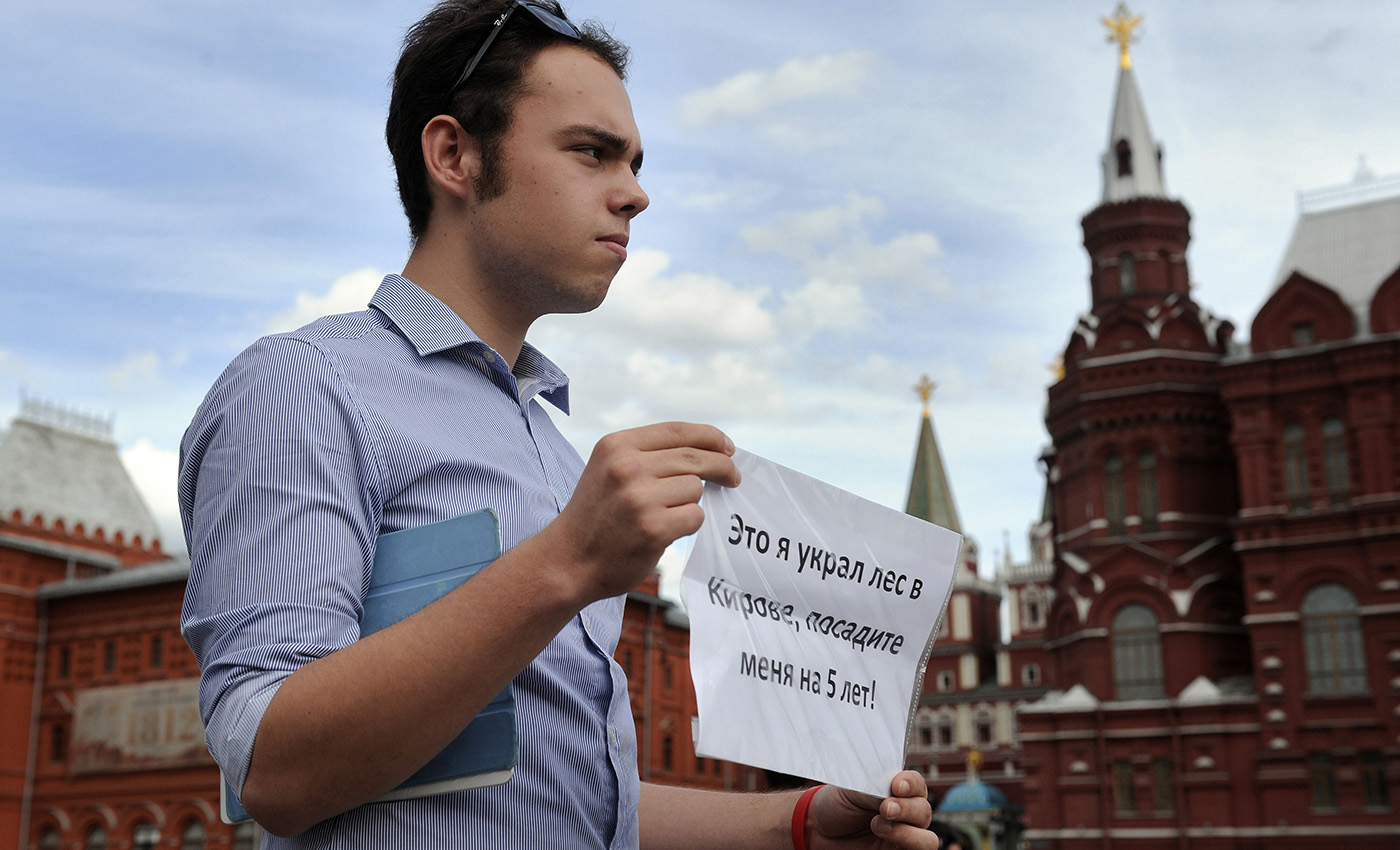
Photo: Gleb Shchelkunov / Kommersant
In Kirov, repeated hearings in the Kirovles case, aimed at a revision of the Supreme Court, begin. The Mediazone recalls what the essence of the accusations against Alexei Navalny and Pyotr Officerov, how the first process was passed in this case and how it ended.
Brows Version: 10 thousand cubic meters of forest were stolen
According to investigators, in 2009, Alexei Navalny, who at that time worked as an adviser to the governor of the Kirov region Nikita Belykh, introduced the general director of the Kirov regional state unitary enterprise Kirovles Vyacheslav Opalev with entrepreneur Peter Officer. The Vyatka Forest Company (VLK) created by the latter specialized in the sale of timber.
The indictment in the case said that Navalny and officers imposed a disadvantageous agreement with the VLK “Kirovles”. From mid -April to September, Kirovles delivered 10 thousand cubic meters of materials for 16.165 million rubles. At the same time, VLK bought forest products from Kirovles at low prices and resold it at market rates, thereby damaging the state -owned company. The investigation believes that Navalny, officers and Opalev committed the theft "in favor of third parties - accomplices of the crime" and the VLK.
Navalny insisted the investigation, was the organizer of this theft: the decision on the charges that the opposition was published , said that Navalny introduced Officer to Opalev, “gave instructions” and acted, “realizing criminal intent”.
Investigation: a new embezzlement case
The pre -investigation check began in August 2009. In May 2011, the case was opened for the first time - under an article on causing damage by abuse of trust (Article 165 of the Criminal Code). After 11 months, the investigation was terminated for the lack of corpus delicti, and in May 2012 the case was started again, under an article on embezzlement (Article 160).
Four months later, in September,it became known that Opalev gave a confession and made a deal with the investigation, and after another three months he received four years conditionally.
The process began on April 17, 2013 in the Leninsky District Court of Kirov; The case was considered by judge Sergey Blinov, about which the New Times wrote in detail. Navalny was accused of organizing embezzlement or theft committed by a group of persons on an especially large scale (in part 3 of Article 33, part 4 of Article 160 of the Criminal Code), Officer - in consideration of this predation (part 5 of Article 33, part 4 of Article 160 of the Criminal Code).
Interrogation Opilev: the main witness of the prosecution forgot everything
Vyacheslav Opalev, the main witness of the prosecution, was questioned on the second day of the trial. At the same time, contrary to the objections of the defense, the prosecutors first read out Opalev’s testimony that he gave during the investigation. Opalev himself confused in the testimony and reported that he "did not remember much." Navalny saw in this evidence that the testimony was written under the dictation of the investigator. “Three months ago there was a court. How can he not remember them, given what dramatic consequences this had in his fate? He was sentenced to four years conditionally. The testimonies were fabricated, I ask you not to read it, ”Navalny addressed Judge Navalny. Blinov ignored this request of the defendant.
In court, Opalev could not recall the important details of the case, for example, whether the price at which Kirovles sold the Forestry of the VLK was lower than the price for all other buyers, and also what was the proportion of products that the Kirovles branches (forestry) sold on their own. Opalev replied to many issues of protection: "If there is in the protocol, it means."
Process: witnesses and position of the accused
Immediately after the announcement of the indictment in court, the defense of the politician asked to return the case to the prosecutor's office, since the document, according to lawyers, "does not withstand any criticism." However, the judge Blinov rejected this petition.
Navalny himself emphasized that the case against him was initiated for political reasons, and the investigators could not explain where he or officers divided the 16 million rubles that were supposedly stolen by them. According to the defendants, Opalev illy transferred 45 million rubles to the Kirovlesproekt, where his son worked; Having given false testimonies against Navalny and Officer, the ex-head of Kirovles avoided criminal punishment for the crime.
As witnesses of the prosecution in court, former partners of the VLK wereinterrogated -ex-heads of the forestry, who were part of Kirovles in 2009. They stated that they had no complaints about the officer or Navalny. The representative of Investlandprom CJSC Mikhail Minin, as well as the ex-head of the Uninsky forestry, Sergei Panteleev, explained to the court that no one had ever forced them to cooperate with the VLC.
The ex-adviser of the governor of the Kirov region Andrei Votinov, early convicted for a bribe, alsospoke to the court. According to the former official, the case against himself, like the “Cirovles case”, was built on the testimony of one person - Vyacheslav Opalev, who was interested in misleading the Kirov Region Government regarding the financial situation of Kirovles.
Nikita Belykh himself participated in the process, who then held the post of governor. In the summer of 2016, he was taken into custody on charges of receiving a bribe; The sources of Vedomosti later claimed that the whites were offering house arrest in exchange for testimony against Navalny. Then the official told the court that Navalny was his adviser on a voluntary basis - he could not make decisions, but could give recommendations and speak out at meetings. According to the head of the region, the activities of Navalny did not harm the Kirov region in any way, and Kirovles in 2009 could no longer continue its activities due to debts that reached 150-200 million rubles.
“The model of work of Kirovles was vicious. In the association of commerce and state tasks there are corruption prerequisites, ”concluded during the interrogation of the whites.
Verdict: replacing the real term with conditional
Prosecutor Sergei Bogdanov asked to appoint six years to Navalny and five - an officer and fined everyone for 1 million rubles; The defense required the excuse of the defendants. On July 18, 2013, Judge Blinov sentenced Navalny and Officer to five and four years of the colony, respectively and 500 thousand rubles of a fine. This happened the day after Navalny registered the candidate for the post of mayor of Moscow.
The verdict stated that “Navalny, acting from selfish motives as the organizer of the crime, simultaneously planned to manage his performance together with his acquaintance officer, attracted as an accomplice, developed a criminal plan to commit the theft of Kirovles property through his embezzlement in favor of the organization newly created and headed by officers.”
The accused was detained, they spent the night in the Kirov pre -trial detention center No. 2; In the center of Moscow, a large -scale inconsistent protest rally was held. The next day, according to the appeal of the prosecutor Bogdanov, the Kirov Regional Court released Navalny and Officer on a recognizance not to leave. The prosecutor's office motivated the participation of a politician in the election campaign.
The founder of the project “1917, wrote about how and by whom the decision was made to free Navalny, in his book“ All the Kremlin A army ”. Free story ”Mikhail Zygar, who at that time worked as the chief of the channel“ Rain ”. According to the journalist, as soon as the verdict was announced in Kirov, Vladimir Putin gathered a meeting with the participation of the current speaker of the State Duma Vyacheslav Volodin, who was then the deputy head of the presidential administration and oversaw domestic policy. “Putin said that to plant Navalny means to make a hero out of him, as this happened to Khodorkovsky. It is much more efficient to make it out of outcast and marginal. He needs to be released and allow him to make all the mistakes himself, ”Zygar, who sounded at a meeting, retells.
Soon, the lawyer Henry Reznik contacted Navalny, who urgently advised not only to appeal to the sentence, but also to appeal the preventive measure to the decision of the highest instance. The lawyers reasoned that it was useless: there was no precedent in the history of Russian justice. Then the verdict was appealed by the prosecutor’s office itself, using as an occasion to register Navalny in the elections.
On September 8, 2013, he gained 27% of the vote and lost to the current mayor of Moscow Sergei Sobyanin, who received 51%. Navalny tried to appeal the results of the vote in court.
After the sentence: ECHR and revision
On October 16, 2013, the Kirov Regional Court replaced the real deadlines to Navalny and the officer with conditional, a month later the opposition lawyer Olga Mikhailova said that he had paid a fine.
Two years later, KOGUP Kirovles filed a lawsuit in the amount of 16 million rubles to Navalny, Opaleva and Officer; Judge of the Nikulinsky District Court of Moscow Yevgeny Borisov satisfied this lawsuit.
The European Court of Human Rights recognized the trial of Navalny and Officer unfair and awarded them compensation; Russia unsuccessfully tried to appeal this decision of Strasbourg.
In November 2016 - four months after the ECHR refused the complaint of his decision - the Supreme Court of Russia canceled the verdict in the Kirovles case and sent the case for a new consideration.