
Translated material
True with names and faces
There are books that you dream about all your life, but as if already existing. They stand somewhere on the invisible shelf, and it seems-only stretch your hand. Years pass, but they are still not and not. And now you no longer know how to be, and you think, and you were going to make them yourself, but your hands still do not reach, and there is still no image of the intelligible and no. And take the book and go out. And this is a holiday.
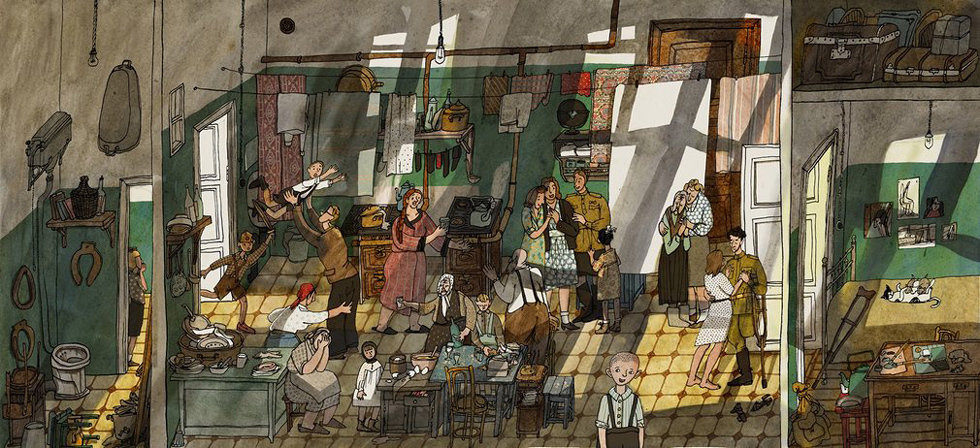
“History of the Old Apartment” (artist Anya Desnitskaya, author of the text of Alexander Litvin, Self -Cat Apocate) - just such a book. The encyclopedia of the Russian life of one family in one apartment throughout the century, drawn in the smallest details, where each turn is an era, a generation of residents, their conversations, utensils, clothes. The word and the image are inseparable here. Unlike their Western prototypes (mainly illustrated books for children of publishing houses such as USBORNE or Dorling Kindersley ), this is not only an encyclopedia, but also a kind of novel, family saga, a family portrait in the interior. The impeccable verbal and visual stylistic verification of this book puts it in a number of great literature, despite the fact that it is not easy to determine its genre.
Drawn novel? Time guide?
So far, the first pages do not suspect the sessions and Nikolka that they are waiting for them in the house, the servant screams in the house and the stove is drowning, Elena Nikolaevna's gloves are adjacent to the hat of Maria Nikolaevna and with Pince -Persean Ilya Stepanovich, we, as readers of the Bulgakov “White Guard”, are involuntarily transferred there, we will rush to this comfort, although we are in a hast It is already sadly known what will be with us (about us) on the next pages.
The visual decision of the book-huge wrappers-cutting of the inner life of the apartment-this is primarily the effect of presence. Detailing detailed, thorough and at the same time alive, in some ways almost children in the manner (the narrator is a child, and everything is given to him with his eyes), these historical, replacing each other in the years of the life of one apartment and the characters inhabiting it immediately place the reader-prostate inward. Such a manner of image and a first -person narrative do not allow us to consider what is happening with the cold curiosity of the entomologist. Only light on the walls makes the removal impossible.
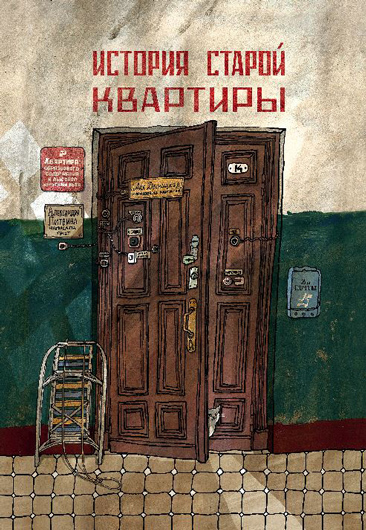 © Scooter
The combination of the visibility of the course of time and each time a new childhood look at him with the effect of reader immersion informs the book about the history of one intelligent Moscow apartment. The huge mass potential of the identification of the reader-spectator, if not directly with the heroes, then with the things surrounding them and signs of the era. Ulitskaya does something similar in his novels, carefully recreating the characters and the micromy of his narrow circle, which is eventually interesting to the mass reader and is in demand by them.
As you know, the heroes of great novels begin to live their life, separate from the author. Says Anya Desnitskaya, an artist and a kind of director of this project:
“For me, these were partly memories of family history, and partly-a little game in the puppet theater, where you arrange characters on the stage. It is amazing how the characters have healed a separate life - probably this always happens, but for me this is the first experience. <...>
It seems to me that this book eventually is an occasion to talk with the child. I had a very interesting experience in the summer in the summer: I sat and painted an illustration about the 70s, and my eight-year-old nephew was sitting nearby and asked questions about what I was drawing. What we just did not talk about! And about the demonstration of 1968, and about the “voices”, and about samizdat, and about emigration. It was precisely the conversation that flowed from the drawn: what is this? How? Why? At the same time, we leave space for the reader: it is not necessary to talk about it at all-it seems to me that readers can catch on something completely different, for example: and we also had such a sideboard! And my grandmother had such a briefcase! And, it seems to me, this is good - that perhaps the book will make people tell their family stories - maybe those that no one has ever told. ”
In one of the main scenes of the Kutelevsky film “Double Life of Veronika”, the heroine, who finally met a stranger, whom she had been looking for so long, not knowing where to start this main conversation, shakes the contents of her handbag on the bed, and then takes the object behind the object and talks about each of them. The authors of the History of the Old Apartment do something similar. Instead of large -scale paintings, they begin with detailed transfer cardboard, kefir caps, primuses and Christmas toys, and from this a large -scale canvas not only the life of one family, but also of the twentieth century of a huge country, is born.
“I hope that this book will help parents and children talk to each other about the history of the family, and for me it was an occasion to think about why we tell children and what. <...> We tried very hard to reliably reproduce everyday life, and here many thanks to the historian who became for me directly the second home, various scientific works, memories, consultants, and so on. All the mistakes are exclusively ours, alas, cannot do without them, but, it seems to me, we managed to convey the spirit of time.
The fact that the story does not happen somewhere there, but with you and your family right in your apartment is, it seems to me, the main idea of the book. <...> For us, if possible, accurate reproduction of the past - both in the figure and in the word - was a task from the very beginning, which, on the one hand, is impossible, on the other hand - the main one. Therefore, at some point we came to the idea of artistic pieces with a realmous storyteller. No one lies like an eyewitness, it is not for nothing that historians do not like memoirists. Here we used the reception of an unreliable storyteller, because the child notices more than adults, but not everything is clear to him, and most often adults try to hide something from him. The child is easily influenced by propaganda, it was also important to us that the look is not critical in many ways ... ”(Alexander Litvin, author).
I would like to say separately about the choice of names (and here the peaks come to mind: the Nabokov list of classmates of Lolita) and the accuracy of replicas:
“ - Nikiforovna went to open and only gasped loudly, and from the hallway right into the living room - in the burck, dad entered in overcoat! (1914)
- Nikolka is coughing everything, the third day he has a fever. Mom ran to a dump truck, call the doctor - did not find a cabman, trams do not go. Dr. Ignatov came, old daddy comrade. He shook his head: “Pneumonia. But I can’t recommend our hospital - chaos and confusion. In the wards - a rash. And at the carers every day, whether to see, then meetings, then rallies.” (1919)
- Well, Buza was today! I went to the kitchen, to see if there was something to go. And my mother washed there, she swore: “Why are you hanging around? Sit down with a tonka problem to solve!” Only here Madame commissars swim in the kitchen and come on to the doctor, Lennicolavna, yell: they say that her new silk stockings burned her primary. And do not hang your stockings over other people's primuses! (1927)
- Several pairs of boots passed along the corridor. No, it's not a telegram all the same. Probably, work comrades? Fedya cried louder, finally Aunt Maroussia took him in his arms, and he calmed down. Behind the wall, the eagles, something fell and crashed. And then I fell asleep. The morning was the most common, but all for some reason fell silent. At breakfast, I did not finish the porridge, but my mother did not tell me anything. Grandpa and dad did not argue who would be the first to read the newspaper. (1937) "
Years go. The numbers change places. Now the children's diary of 1973:
“Half of their course came for the wedding, and the whole Tanin of relatives arrived from the village of an atheist. The table was placed through two rooms, the stools from the kitchen were brought, they asked for chairs and plates at the neighbors. From one edge of the table, the harmonist enjoys, from the other - Elvis Presley “on the bones”! And Uncle Friedrich and his friends went to smoke on the stairs. And I’m behind them slowly, because if they notice it, they will drive away: “Not for your ears.” Friedrich still lives with us because he wants to leave. For good. Abroad. And they are not released. Only this cannot be talked about. And about the fact that he is printing a car under a car under a carbon carrier either ... "
On the sidelines, drawings: Erica machine, plate of pilaf, plastic navels, portraits of Sakharov and Solzhenitsyn, Taganka tickets, the Saturn and 17 Moments of Spring on TV.
And in a long time already a communal apartment, life goes further on its turn. Gena and Tanya returned from Jurmala, the neighbor rests after the night shift, and Gulya and Ravil jump on the beds ...
“This is an unprecedented“ fucker ”on the audience and meanings: to tell the history of Russia over the past hundred years so that it is understandable to adults and children, is not distorted, not rewritten“ under power ”, as neutral as possible-but only one can talk about history-at the same time humanly touching. This is a story through the eyes of children who are still small and can only be its witnesses, and often become its main victims, but the naivety and lack of fear (out of ignorance) help them survive and maintain faith in the best where adults break. This is an excellent example of how to truthfully and consistently tell children who should prepare the creators, the tops of history, about the past - tactfully, evidence, so that they certainly understand that there is no absolute truth in history, but there is a law and the highest value that should remain the measure of all actions - the life and dignity of a person ”(Irina Balakhonova, the chief editor of the Samokat publishing house).
Today, the request for historical reliability is extremely aggravated. But it should be true with names and persons. No wonder right now we are witnesses of the incredible story of Denis Karagodin, whose efforts the Akhmatovskoye “I would like to name everyone” suddenly gets a different sound. This is not only the “return of the names”, where the cook is posthumously adjacent to Marshal. These are the names of those whose hands this neighborhood was provided. The state for the first time turns out to be an inanimate machine, but people who made the impossible with other people. The very lexical set that describes this is outdated: the word “repression” already means nothing, while the list of names as a fact and genre means a lot.
Many years ago, when our family moved to the old apartment on Bolshaya Sadovaya, our parents started repairs and began to tear off old wallpaper. Under them, newspapers were soon discovered, with which the whole room was glued, with reports from the fronts of the First World War. (The house was just in 1914.) This is a painful and at the same time exciting feeling of sensation of himself to a contemporary as they ripped off firmly glued over the years of silence, manipulation and simply oblivion of the layers of historical memory and is the main internal engine of this book. “History of the old apartment”, I am sure, is an important event of not only the non / fiction fairs. This children's book is promised a great future.
And if so, maybe her readers?
Alexandra Litvina, Anna Desnitskaya. The story of an old apartment. - M.: Scooter, 2017. 56 p., Ill.