
Translated material
Colta.ru
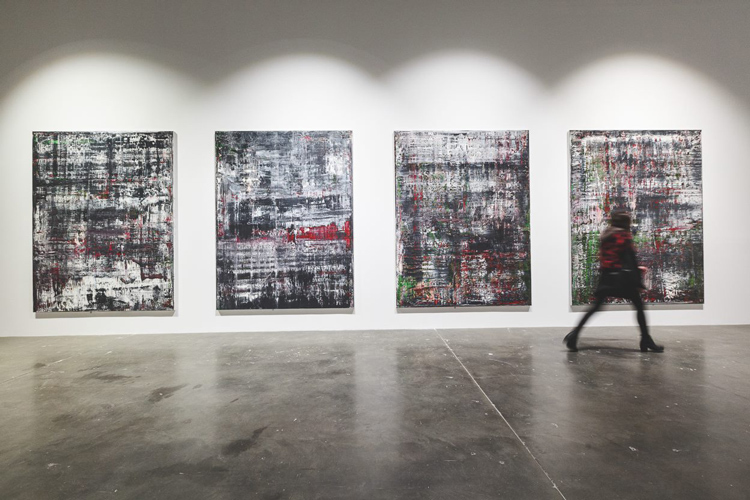
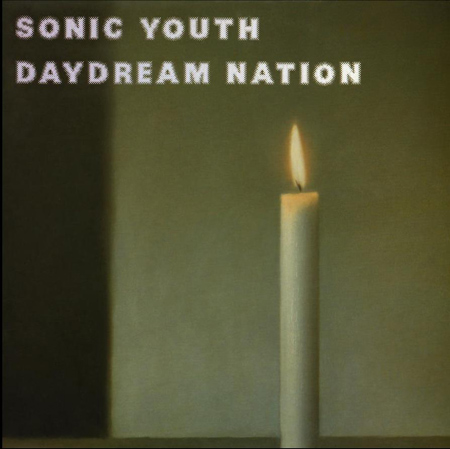
It is difficult to write about Gerhard Richter: then his figure seems too invulnerable , then, on the contrary, he becomes too light target . Nature, according to him, is a stupid and bad thing [I] , and, for example, the church is good, because it helped to separate good from evil [II] . Above all, Richter seems to appreciate the order, and with him Bach, Palladio and Cage. His name, on the other hand, firmly entered the mass culture. Not only the fact that one of his works at one time adorned the cover of the American group Sonic YouTH . Songs are dedicated to him - not the most famous performers, but you can find such (the artist himself at that time collaborates with Arvo Pyart). And on the site The Question , for example, you can find the ironic question "How many shades of gray Herhard Richter found?" . Apparently, it was published in connection with the exhibition at the Jewish Museum and the Center for Tolerance .
The explication explains that the exhibition is devoted to the artist’s search for a picturesque image - that is, that in the post -war years it was customary to be considered dead. The problem of the image for Richter is really strongly acute - however, perhaps not so much in his opposition abstract work: after all, the depth of distinction and the gap between photorealism and the abstract canvas is in doubt, including the artist himself. Rather, his experience with photography influenced the specifics of the special plasticity of his abstract language, balancing between mechanical expressiveness and multi -layer, imitating its own parallel space. The problem with the “search for the image” is laid down in the very attitude of the artist to him - in deep, irreconcilable distrust of him as a carrier, an agent of ideology (it is difficult to choose a word more hated by Richter; his beloved, on the other hand, is a “case”), which has been read more than once by researchers through the artist who managed to find the third Reich who had grown up in the GDR and at the age of 29 years emigrated to the west.
The problem with the “search for the image” is laid down in the very attitude of the artist to him - in deep, irreconcilable distrust of him as a carrier, an agent of ideology.
Richter arrived in Germany in 1961, being there at that time of history, when discussions about the recent past, in particular, about the process over Adolf Eichmann, who were then passed the death sentence, were noisy throughout the country. Six months later, Eichmann is executed. Then, in Munich, with a great noise, the reconstruction of the sadly famous exhibition “Degenerative Art” will open; She will show the surviving work, not destroyed in fire after the 1937 exhibition. Then Richter will burn all his early work and begin to write gray paintings from photographs, which are probably more intently than any others, explore and analyze the “banality of evil”, later described by the Hannoma. “I have nothing to say, and I'm talking about it,” repeated Richter for Cage.
The “death” of the image (as well as the dematerialization of art) in Richter’s paintings steadily transformed into the motive of death, which, in fact, took shape in the central and fundamental object of his artistic practice. If we limit ourselves to only more or less obvious ties and not take into account, for example, “deer” (1963) or “roll of toilet paper” (1965), the semantics of which may seem menacingly slippery, then at least the work “bearing the coffin” (1962) or “dead” (1963) can recall (1963) (the illustration of the news of a person about the death of a person, accidentally given out of an ice block), as well as numerous paintings depicting bombers, or schematic, from a bird's -eye view of city landscapes. But after all, the Aura herself, which, as is commonly believed, managed to recreate, suggests the presence of the aura of death [III] (it is difficult to avoid at the Atlas (1962-2013) acquaintance with the famous text of Jacques Derrida about the “archival fever” and its interpretation through Freud’s concept about the attraction to death).
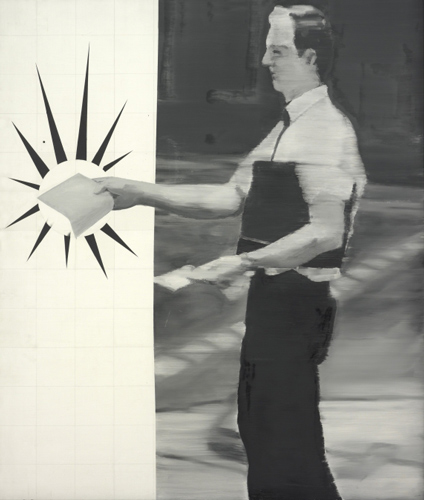 Gerhard Richter. Oswald, 1964
In this context, it is really difficult to avoid Richter's comparison with Andy Warhol - the plots of many of their works have obvious similarities up to literal coincidences (for example, the images of Jackie Kennedy or Mao Zedong appear almost synchronously). Sometimes it is noticeable, although barely perceptible, in separate theses: so, “ I Think EVERYBODY Shoup Like EVERYBODY [IV] ( “In my opinion, everyone should like everything”) not so far from “Ich Verwische, um alles gleich zu machen, alles gleich wichtig unwichtig” [V] (“I wash out to make everything equally important and the same unimportant "). The works of both today are often considered through the rhetoric of the Cold War [VI] with its conspiracy, spyomania and militant media images. Richter in the GDR (here it is worth recalling his fresco that has survived only in the reproductions in the Hygiene Museum in Dresden; outside the official order, he draws still lifes with skulls in the spirit of Picasso [VII] ), and in Germany turns to the images of happiness, equally artificial and on the other side of the Berlin wall. And Lee Harvey Oswald (Oswald, 1964) clearly interprets the visual code of the poster language of the socialist block. But the main conflict - laid down in actual methods - is allowed in the facility and, probably, the addressee can be said: if Warhol is interested in the media as such, in what happens on the TV screen, then Richter's attention is more focused on the family that watches it (it is not difficult to recall the “formalism and historicism” of Benjamin Bell). In the most famous - and the only one - the campaign of 1964, which indicated the birth of a short -lived capitalist realism , in the furniture store Richter, sitting on the sofa in the living room near the TV, periodically read excerpts from detective novels. You can recall the short essay "Luxuriously furnished ten -room apartment" Walter Benjamin, in which he, although turning to the 19th century, describes how the focus of detective novels (E.A. Poe, A. Conan Doyle and G. Lero) became “horror inspired by the apartment” [VIII] . So, for the artist, the image of the Flemish chandelier (1965) was the most terrible monster (the embodiment of evil): “The chandelier is a monster. I do not need to draw a monster; It is enough to write this thing, this shitty little vulgar chandelier ... ” [IX] .
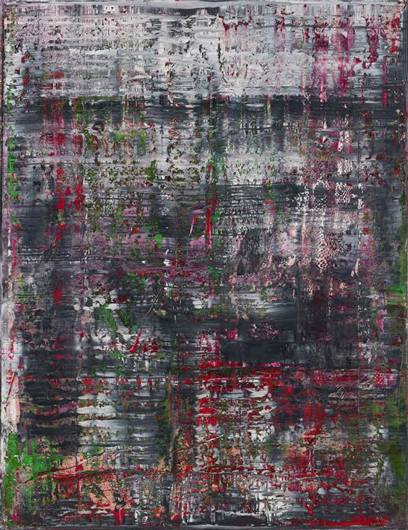 Gerhard Richter. Birkenau 3, 2014
However, if you recall Warhol, one cannot help but recall Joseph Boyce-the artist with whom Warhol was compared in the 1970-1980s. It is at least difficult to talk about his influence on Richter-there are simply no traces (with the exception of the moment when Richter first got acquainted with the concept of Radi-Mada through the work of his senior colleague). Zeige Deine Wunde - largely due to the active practice of Boyce, the artistic discourse includes topics and questions that problematizing the "overcoming of the past" in Germany - "show your wounds." It is difficult to exclude the influence of this background on the addition of Richter’s plots, which today is almost the official representative of modern historical painting. Portraits taken from family photographs are still attracted in this connection. Richter, as a rule, reproduces the simplest iconography of amateur photography. Pierre Burdier wrote that the figure in the center in such pictures demonstrates a look in eternity. In the portrait of the daughter of the Betty artist (1988), researchers often recognize the “Angel of History” (the special attractiveness of the interpretation is that the girl, turning around, turned away from the viewer). However, it seems that no one has yet decided to distinguish him in the friendly image of “Uncle Rudy” (1965).
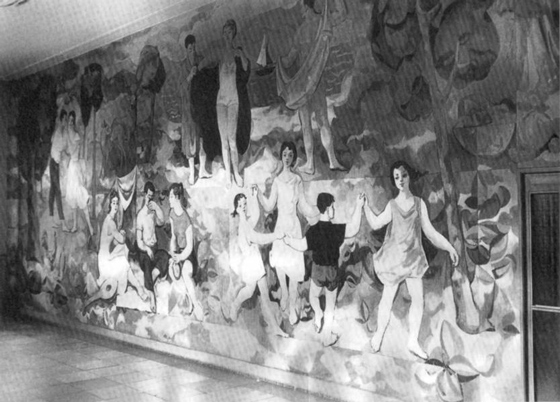 Gerhard Richter. Lebensfreude, 1956
The family in Richter's work occupies a key place (and at a later time, as you know, the plots of his work are closely connected with it). At the early stage, it is the family that becomes a kind of path for him, a metaphor for understanding the post -war situation in Germany. In addition to the already mentioned, there is a well -known plot related to the figure of Aunt Marianne in the work of the same name (1965) - she was diagnosed with schizophrenia, sterilized it and later killed it as part of the Nazi euthanasia program. But it is not so widely known that the man, the head of the family and father-in-law of the artist, smiling from the painting “Family on the Sea”, is a member of the NSDAP and director of the female gynecological clinic, although not directly related to the death of Aunt Marianne, but still supporting the current racial policy [X] . The work of Richter with a document is largely at the founding of today's historiographic methods of a large number of art produced. At that moment, when Foucault in the “Archeology of Knowledge” removes the gap between the document and the monument, Richter does the same operation within artistic practice. So, an anonymous image of an unknown family becomes a pattern in which it is possible to identify the social situation of a separate post -war country. But this anonymity embodied in half -erased figures and faces - the backstage story of which may be unfamiliar to us - is anxiety, suspicion, sappress, tension before the banal, before that in this banal one is hidden (it is difficult to avoid comparison with the famous film by Michael Haneke, which analyzes similar problems and close plots with the help of cinema -language tools).
The family in Richter's work occupies a key place.
As a monument, almost from the very moment of appearance, its cycle “October 18, 1977” began to be considered, dedicated to the death of several main members of the RAF group. These paintings are a logical continuation and completion of the searches of the 1960s. He writes portraits from photographs from newspapers and police reports - on the basis of materials provided by the state - but at the same time gives them the same strange sentimental character, which was characteristic of his early works. So, portraits acquire a quality that we have already met before - innocence that makes it difficult to draw a strict border between the victim and the criminal.
Susan Umbrella wrote in her text “On Photography” in 1977 that one of the main characteristics of the photographer is that he is not able to intervene in what is happening while he is busy photographing. Richter, in fact, artificially reproduces this distance. Of course, its method itself is designed on the basis of the illusion of a distance - it begins with the fact that the photograph is forever released by brackets when the picture appears; If he appears later, then only as a document. The right to revelation and authenticity of the certificate remains only in the paintings. The illusion and problem of the distance that Richter called the theme of his life reveals itself as an integral quality of a formal language. It manifests itself not only in his figurative works, but also in the images that show and, one might say, describe the three -dimensionality of the abstract world, and in those works where the image reproduced from the photograph is hidden behind many layers of paint. It is these operations that localize the position of the artist himself, who distances from any biased - political, illustrative - artistic statement, masterfully creating objective works of art. Perhaps the distance and non -interference is the prerequisites necessary for the identification of historical objectivity with the face of the museum (not without reason the rare case when Richter showed civil indignation was associated with the scandal around the possible closure of the Morsbroch museum in Leverkuzen ).
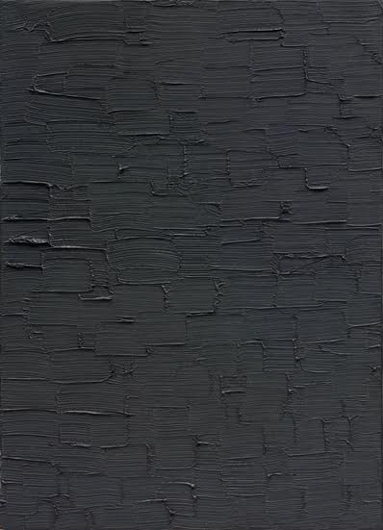 Gerhard Richter. "Gray", 1973
 The trivial vulgarity of the question voiced at the beginning of the text (by the way, she migrated from jokes about the Jewish museum, which, alas, did not have to look for a long time), remarkably resonates with what can be called the problem of the art of Richter, who carefully explores the relationship between the obscene and the exudity (most clearly was reflected in his unrequited project, but well -known project, in the well -known project, in the well -known project. which he planned to combine paintings made from photographs from concentration camps and from pornographic products). Events in his works unfold in the gray zone between expressed and impossible, obvious and invisible, history and death, banal and mysterious (he, for example, considers abstract art) - that is, in the only space that survived after the twilight of the gods.
[I] Itv The South Bank Show: Gerhard Richter (2006).
[II] Gerhard Richter. Panorama. Tate , 2011, s. 25.
[III] Roland Bart. Death and photography // Camera Lucida . Commentary on the photo. Hell Margin, 2011.
[IV] What is pop art? Answers from 8 Painters. Art News 62, November 1963.
[v] Gerhard richter. Text 1961 Bis 2007. Schriften, Interviews, Briefe. Verlag Der Buchhandlung Walther Koenig, Koeln , 2008, S. 33.
[VI] Jon J. Curley. A conspiracy of images. Andy Warhol, Gerhard Richter and the Art of the Cold War. 2013.
[VII] Robert Storr. Gerhard Richer: Doubt and Belief in Painting. MOMA , 2003.
[VIII] Walter Benjamin. One -way street. AD Margin Press, 2012, p. 17.
[IX] Richter . Moma Interview with Robert Storr, In Elger and Obrist, Richter: Writings , 407.
[X] However, there is a chance that these details were not known to Richter himself. Erik Verhagen. Gerhard Richters Familienbilder: Eine Ausnahme in Medieneld // Gerhard Richter: Fotografie und Malerei - Malerei Als Fotografie. Verlag Der Buchhandlung Walther Koenig , 2011, S. 9-37.
The heading "prints" is supported by the Fund for Assistance to the Study of Russian Fine Arts "Russian Art The World".