
Translated material
Souvenir shop
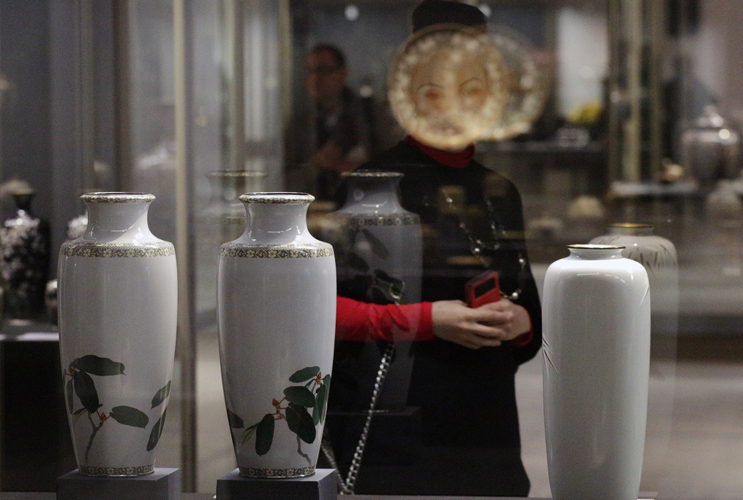
“Perfection in details. The art of Japan of the Meiji era ” is the name of the exhibition in the Manble of the Small Hermitage. Ceramics, enamel, varnishes, metal - expensive exotic, a century and a half ago conquering two fracture generations of artists, impressionists and post -impressionists, and allowed thousands of Chinese craftsmen who stamped fakes. The world was fascinated by Japanese aesthetics, but the Japanese could not fully take advantage of their victory. They began to adapt to the buyer - capricious old light - or copy his achievements. An island state with a flowering bouquet of national complexes. Look, for example, at the products of Japanese artists who learned about the existence of prospects in our understanding. They play with her like small children in their first designer, building illogical, terrible sakes of houses for their gear dolls.
The Hermitage Exhibition is luxurious - these are the best examples of applied art. Such high -quality and sophisticated that I want to immediately take them to my non -existent apartments. Late visitors of the exhibition, looking at a round table with inserts of color enamel, seriously reason how they would clean it if he stood at their house. It is generally accepted that, for example, Russian culture is literary, and Japanese seems to be spinning around expensive souvenir trinkets, monumental vases, kimono. In the most replicated work of medieval Japanese literature - “Tales of Genji” - the colors and number of layers of sleeves, in which the heroes love to cry, which is easy to believe in this, are described in detail. However, the applied art under the emperor Mutsuhito (the posthumous name of Meiji - “Enlightened Board”) has become an element of the state export program. It came into fashion in Europe, and the workshops required stylistically verified products. Instead of the samurai estate, which was piecely ordered ritual items for internal use, the customer became a huge external market. The old light needed recognizable exotic, over which the Japanese patiently corpsed. The Hermitage represent the best, masterpieces, but there were much more crafts and fakes. To understand the Japanese culture of this ambiguous era, you should turn to literature. There were more than enough writers in Europe and their own, so the Japanese in this regard were left to themselves.
Geopolitically, Japan on the eve of the restoration of imperial power can be compared with today's North Korea.
Then Mori Ogai, Natsum Soeski, Dzyuniitiro Tanidzaki, Ryunoske Akutagawa, Yasunari Kavabata, Syoi Ook, and then Cobo Abe and Kenzaburo OE - several generations of writers who, in the field of psychological realism, will plug up behind the belt of multi -stringing Zola and Balzac. It’s just that the Japanese had enough time for self -digging: while France was amused by scandals, intrigues and revolutions, the Japanese sat quieter of water, below the grass, eating about the same - water and grass. Geopolitically, Japan on the eve of the restoration of imperial power can be compared with today's North Korea. An isolated poor state with a monstrous bureaucracy, decrepit shipbuilding (on the islands!), Outdated by defense. And the quality of applied art - those very varnishes, drawers, tubes - depended on who they were going to give them. To some extent, these gifts became the Japanese “defense” from the uninvited guests of their ports.
Ivan Goncharov, who swimming in the military frigate Pallas, wrote in 1852-1855, wrote as a result of the book of the same name, more acute and modern in places than his artistic prose. The frigate, however, spent most of the trip off the coast of Japan. The mission of the Pallas was to become the “opening” of Japan - it was on the eve of the restoration of Maji 1868, and the most perspicacious governments hoped to be the first to conclude trading agreements. Goncharov notes that at the time of the arrival of Pallas in Nagasaki, the only officially open port of Japan for foreigners - the Americans have already entered the capital's port of Edo. Long before the Cold War became the mainstream, the Russian Vice Admiral Putyatin did everything possible to get ahead of the United States.
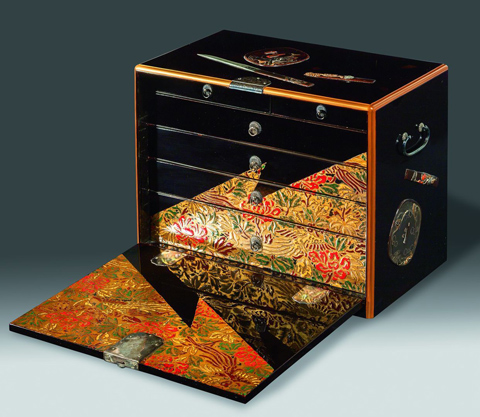 © State Hermitage Cabinet Sagedans. Master Sibata Zasin. 1890s
So, Goncharov writes what high -class things the Japanese gave to the admiral and what simple ones - for example, to him. “At 11 hours, Banios arrived with gifts from plenipotentiary to the admiral. <...> But what kind of things they sent - a sight for sore eyes! One sent a casket, black, varnished, with golden reliefs of temples, arbors, mountains, trees. The varnish is unusually gust, black, does not go away, they say, for decades and clean like a mirror. There are no such varnished things anywhere. Another box is dotted with red-gold, drowning in varnish, sparks. There were different trinkets with the box: a smoker for powders ... But the most wonderful and expensive gift was a saber - for its dignity and for its intended purpose ” [1] .
The discovery of Japan coincides with the heyday of the Russian realistic novel, and here you can proudly trace influences and family ties. They are especially clearly visible among Akutagava. Arkady Strugatsky, translating from Japanese, called Akutagawa the father of modern Japanese literature [2] . The first collection of his stories was to be published during the life of the writer. Akutagawa even wrote to him a touching preface, in which he called Natasha (Rostov) and Sonya (Marmeladov) his sisters. The Japanese got to our classics closer than many Europeans: he wrote stories with obvious references to Gogol (“nose”) and Chekhov (“garden”), and “woodcock” begins like this: “It was in the evening, in May 1880. Ivan Turgenev, who visited Yasnaya Polyana two years after he was the last time there, and Count Tolstoy, the owner of the estate, went to the forest to hunt for the woodcocks ” [3] . It would be just a paragraph of praise of the Russian school, if it weren’t so that Akutagawa, who admitted that Russian literature had influenced him more than others, was the first of the Japanese to go to the global level, equally enriching the national and world literature. He broadcast Japanese self -awareness - something, unlike exported expensive gizmos, intangible.
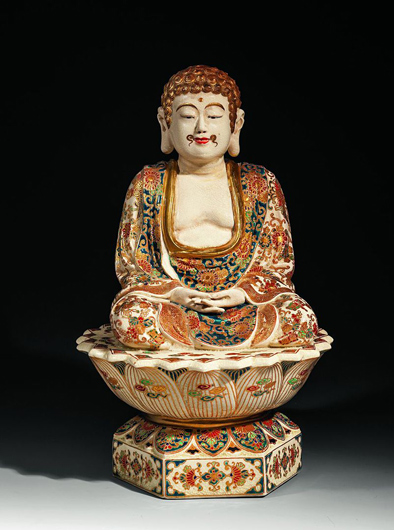 © State Hermitage Buddha Shakyamuni. Mark "Maybido". Middle of the XIX century.
The Japanese for a long time remained alone with their island and powerful Chinese literature, but created a number of strong independent works, especially distinguishing themselves in the early Middle Ages, when the court ladies wrote a diary-type novels (and Gandzy-Monogatari Murasaki Sikibu for a long time became a sample of sophistication and a source of images). A separate bright chord can be considered the discovery in 1940 of the “uninvited story” of Nidzo - the court lady of the line of the XIII -XIV centuries. In addition to lyrical experiences, she suddenly subtly feels the surrounding realities, whether it be palace intrigues or geopolitics. This is a national genre, very intimate and unexpectedly close to modern realism - unlike a chronicle, where the Japanese borrowed a lot from China.
Chinese art has been penetrated for centuries for centuries by the right of a large and strong neighbor, despite the fact that mentally Japanese culture has been serious. Traces of Chinese influence are in bright colors, the cutting eye of the variety of enamels, while the Japanese themselves are more prone to discreet delicate or noble dark colors. “I also liked silk robes, skirts and mantiles in this collection of bright and sharp colors,” Goncharov writes. - Not a single whole color, red, yellow, green: all the mixture, delicate, softened tones of one, another or third. Do not believe the pictures in which the Japanese are represented by some parrots. <...> I forgot where I was sitting: instead of the extreme East, as if in the extreme West: colors in the toilet - like European women ” [4] . The white -sided ceramics of Satsuma, which regularly receives specialized exhibitions, appeared thanks to the group of Korean potter who moved to the country of the rising sun. Technical features and vivid style made it a bestseller of international exhibitions, but what's next? Modern porcelain artists sometimes criticize the imperial porcelain factory - the flagship of Russian porcelain production - for conservatism. But tourists, with boxes of the buying products of IFZ, want a “cobalt mesh”, remarks of dishes of the heyday of avant -garde and painting in the style of Vorobyevsky. These are stylistically frozen things that are doomed to stable demand. So it happened with Japanese applied art.
As we know, the Japanese hieroglyphs still took revenge on the West Fashion on dubious tattoos.
You can admire for a long time the quality of the performance and the originality of the best enamels, porcelain and ceramics, metal products of the Meiji era. But, finding such an attractive style, the Japanese masters almost lost themselves. Dzyuniitiro Tanizaki in the program “Praise of the Shadow” (1934) writes: “It is possible that to say how I mean to dream of the impossible, to grumble about the impossible. Let it be so, but let us think about what damage we carry out in comparison with Europeans. After all, the fact is that European civilization has reached a modern level, developing a normal way, while we, having faced a more developed civilization and accepting it, were forced to deviate from the way that several millennia went ” [5] .
He dreams of a “original technical culture” that would have appeared if it were not for the revolution, that Japanese would never occur to the new generations of the Japanese to “Latinize” Japanese writing. But the loss of the alphabet, the symbols of the language, is an almost fatal outcome for national literature. As we know, the Japanese hieroglyphs still took revenge on the West Fashion on dubious tattoos.
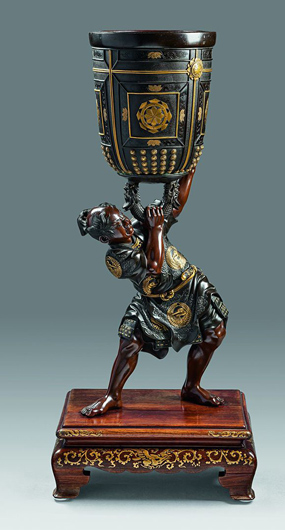 © State Hermitage Bankei holding the bell. Workshop Miyao Esuke. OK. 1890
 Tanizaki belongs to a turning point in an open country. He passed the period of charm by the West and returned to the national principle, already in adulthood, creating the best works. I do not want to downplay the influence of Japanese art on the European one - Modern borrowed many motives - but still it was redevelopment. In the Meiji era, a still life was in fashion (the “Flowers and Poultry” genre, which was divided into sucks like “aquatic plants and fish”), combined with the aesthetics of the pre -Raphaelites, which gave the modernity an accurately recognizable stylistic alloy. But modern (and in some countries and to a greater) was “nationalized”, the development of local heritage was underway. For Japanese art, the Golden Age has come to naught, and the matter is not at all in the First World War. And not even in the second. Before the time, the wars and, most importantly, the Japanese national identity was defended by the literature - in 1968, Yasunari Kawabata, a writer, rooted in the Japanese tradition, stronger than a number of European predecessors, received the Nobel Prize "For Writing Mastery, which transfers the essence of the Japanese consciousness." The Western world seemed to be not the Japanese “souvenirs” for the first time, but the Japanese consciousness.
[1] I.A. Goncharov. Frigate "Pallas". - M., Drofa, 2009.
[2] Akutagawa Ryunoske. Novels. - M., Fiction, 1974.
[3] Akutagawa Ryunoske. Gate Rasomon. Novels. Translation from Japanese N. Feldman. - M., Eksmo, 2008.
[4] I.A. Goncharov. Frigate "Pallas". - M., Drofa, 2009.
[5] Tanizaki D. Praise the Shadow. Translation from Japanese M. Grigoryev. -St. Petersburg, ABC-classic, 2006.