
Translated material
Why will we never remember the same?
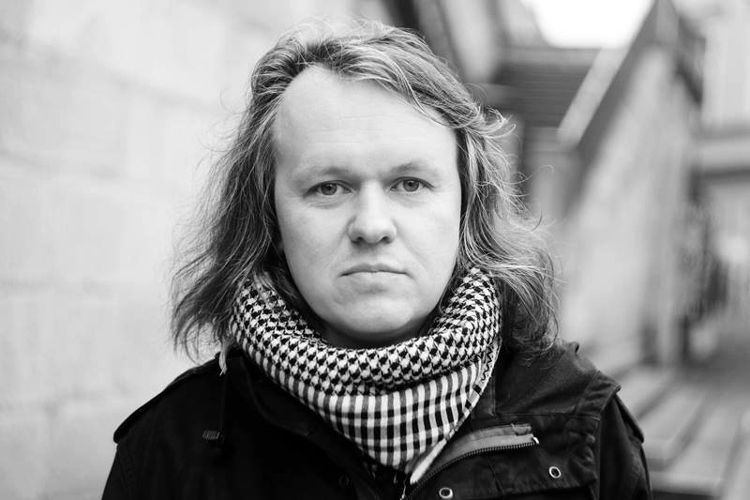
Historical memory in today's Russia is the space of conscious and unconscious deficits, rewritten narratives, the struggle of different forces for this past. Today on colta.ru - two texts that look at these processes from completely different positions, but make similar diagnoses. This is the column of Andrei Arkhangelsky and the text of the speech of Alexei Tsvetkov on October 7, 2016 at the Prague Conference “History inside us” in the library of Vaclav Gavel.
1.
Twenty years ago, in Russia, bills of 500 rubles began to print bills. They depict a Solovetsky monastery, one of the symbols of the country. But, if you look closely, this is not a Solovetsky monastery, there are no domes and crosses on the roofs. This is a Solovetsky camp with one of the Soviet photographs. Three years ago, the picture was replaced and the domes were made. But for 16 years no one noticed this. I must admit, and I would never have noticed this, if it were not for the book of Alexander Etkind, Krivoy Woe, which is precisely from this.
It pursues us like a ghost. You can recall Sigmund Freud with his “obsessive repetition” and the “return of the crowded out”. Although another explanation of the mechanics of collective memory is closer to me: the theory of sociologist Immanuel Vallestain that each country has its own specific place in one of the three belts of the world capitalist system. This place is set by the type of elite and the rules of the game within the country. And this type and rules form collective memory and national mentality. Hence the inevitable difference in the way to remember and forget.
Did justice restore when the dome was returned to the bill? I do not think that the differences between the camp and the monastery gradually disappear in the new imperial optics. Monasteries were the first prisons of the ancient Empire.
This is written by Zakhar Prilepin in his last novel "The Abode". The Solovetsky camp there is a model of the Russian universe, in which the punishment is always fair, because there are no innocent ones. Solovki as the necessary Calvary, from which an inexpressible national spirit is born.
2.
Any nation is an imaginary community. However, any community that is more than the family is imaginary. An imaginary community needs a story to build yourself. For such construction, it is necessary not only to remember a lot, but also to conscientiously forget a lot, exclude, attribute to the periphery, and encrypt. And the fact that it still remains will have to be deciphered in favor of the community that we need, the constructed community.
It is popular that if a court took place over the CPSU and lustration, then we would live in another country. I have always been skeptical about the idea of such a court. It would inevitably be a trial of Marxism.
In the center of Moscow, opposite the main office of the KGB, there is a stone from the Solovetsky monastery. Once a year, the metropolitan intelligentsia gathers around this stone and simply reads aloud the name of the repressed. There are thousands of them. Anyone can do this, but passers -by, which go by, as a rule, do not join. On the contrary, they usually bypass this meeting as far as possible. After all, suspicious people gathered here, who "remember the wrong." The majority loyal to power perceives this not as a memorial ritual, but as an opposition rally against the current government, it is dangerous to participate in which.
"The intelligentsia of large cities looks into the past through the eyes of our enemies, national traitors." This is an important installation of mass propaganda in modern Russia. However, the metropolitan intelligentsia does not remain in debt, it calls the loyal majority "quilted jackets." Vatnik is the clothes that were worn in the camps. Now this word means: you agree to be potential prisoners.
The opposition version of our history is not much more difficult than the official one: everything Soviet is considered in it as a deviation from the norm, and one day you need to just return to the main road.
In opposition circles, the opinion is popular that if a trial of the CPSU took place on time, “decommunization” passed and lustrations were introduced, then we would now live in a completely different country. I have always been skeptical about the idea of such a court. In specific political conditions, it would inevitably be a trial of Marxism, and Marxism for me was and remains an important part of European culture, which involves a unclass horizon of society and universal ethics, without which any social criticism of lack of freedom hangs in the air.
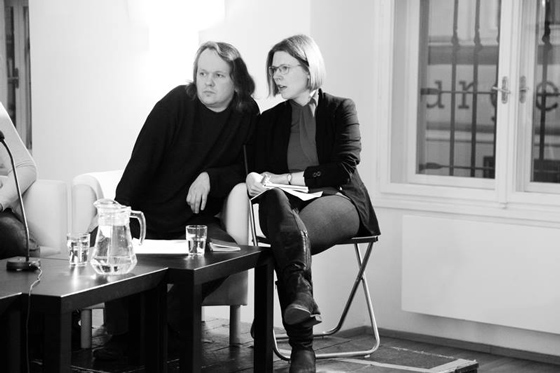 © Petr Horčička Conference "History within us" in the library of Vaclav Gavel
It seems to me that the true meaning of criticism of repressions, the authoritarian system and the authoritarian type of personality should send us to ethical utopia, which is simultaneously social utopia.
A well -known list of claims can always be made to real capitalism: colonialism, imperialism, social racism, witch hunt, daily alienation. Or at a more subtal level: the society of the performance, the triumph of the absolutely false consciousness necessary in order to accept the irrational class system. Of course, we can say that capitalism is one thing, and democracy is another and it is much older. This is true. But in the same way it can be said that socialism is one thing, and the Soviet period is only a segment in its history. For me, socialism is a democracy that has stepped from the field of politics to the economy.
3.
The main question of mass memory: in which of the characters of the historical narrative do we now recognize ourselves?
How has the national memory of memory changed over the past thirty years? Since the late 1980s, it has become fashionable to look into the past through the eyes of those who were repressed. "We are the heirs of those who were sitting." The executioners were expected from the heirs and demanded repentance.
By the end of the 1990s, the scenario of mass memory has changed a lot. “We are the heirs of those who have not touched the repression, we do not want to remember this, no one should repent of anything. And those who recently demanded repentance were deceived, destroyed the country, our life has become worse, and not better. ”
And, finally, after another 10 years, in the zero, the mass model of the past has changed again: "We are the heirs of not those who were sitting, but those who guarded them, and we have nothing to repent of." Such optics dominates, regardless of specific family experience. Increasingly, executioners are recognized as their own, and victims are alien.
In the zero, the mass model of the past has changed: "We are not the heirs of those who were sitting, but those who guarded them, and we have nothing to repent of."
On Russian television, a competition was held on the topic: Which of the characters of our history is the most popular? With a large margin, Stalin turned out to be, and it was worth a considerable effort to save the image of the state, moving Stalin at least to third place. One of the first statements of our new Minister of Education: "The scale of the victims of the Stalinist repressions is too exaggerated."
Recently, Putin equated the guards of the Stalinist camps with war veterans, now he and their families are relied by all the same benefits and privileges. The only preserved Stalin camp in the taiga, Perm-36, until recently was the Museum of Repression, and there the human rights festival "Pylorama" was held there. But by decision of the authorities, the festival is no longer held, and the camp itself is turned into another museum - the NKVD Museum, that is, the secret of the Soviet political police, which had very difficult and dangerous work. Now it is a museum of those who guarded, and not those who were sitting.
One by one, new monuments to Stalin appear. This began in the smallest provincial towns, but gradually moves to the centers. Stalin is perceived as a great king who created a huge empire. The version that he was going to get married to the kingdom on the Orthodox rite was popular, but did not manage to do it.
The lower the standard of living and education, the higher the demand for imperial memory. One who is poor, powerless, is not enlightened, remains one thing: to dream of former greatness. People like to remember how, under the leadership of Stalin, we saved the whole world from fascism. And later we have repeatedly saved the world from the Third World War, sending the army where necessary.
Any alternative and tragic memories come across a popular folk phrase: “But everyone was afraid of us!” They want them to be afraid. They are sure that this is the best that can happen to them. They do not expect anything else, because the main historical lesson that they carried out of their lives - "the Western world seduced us and deceived us."
Most of the current Stalin fans are indifferent to communism. We are building capitalist Stalinism. This is very Asian.
The state cynically, with pleasure uses this mass demand for greatness. In the Russian television series about the 1930s, a completely impossible phrase sounds: “Our Stalin is building a new empire!”
This is the Stalinist optics, but without a socialist horizon, which in the language of Stalinism remained at least rhetorically, like a useful chimera for mobilization of the masses. Now the Soviet experience is being built into the right, imperial model of history. Communism has nothing to do with it. Most of the current Stalin fans are indifferent to communism. We are building capitalist Stalinism. This is very Asian.
4.
The official version of national memory is now insultingly simple and flat. This is a story without gaps. We always had the same state, power, empire, and this has been going on for a thousand years. Our story all this time moved from good to better, and all the problems that arose inside were the machinations of external enemies, abroad agents. There were no internal contradictions, insoluble antagonisms in this system.
So new school textbooks were written. And in the form of a dance show, this version could be seen at the opening of the Olympics in Sochi, where, by the way, the Russian team entered the "quilted jackets". Recently, the Minister of Culture Medinsky said that in the Civil War of the Reds and White, the same and not the other won, but a certain “historical Russia” won, which has always existed and always wins. She is an inexpressible sovereign spirit.
Nevertheless, two traumatic ruptures remain in this through narrative, two abysses: 1917 and 1991. If everything went right, then why did the Romanov Empire collapsed, and then the Soviet Union? There were no these two revolutions, but they were.
It’s easier to do from 1917. Of course, it was arranged by foreign agents who created internal enemies within our civilization. Now this is a generally accepted opinion. Increasingly, these “internal enemies” are simply understood as “Jews”. Putin publicly drew attention to the fact that most of the posts in the first Soviet government were occupied by Jews. It is unlikely that at least one professional historian would agree with this, but most historians chose not to comment on the president’s statement.
Two traumatic ruptures remain in the through narrative, two abysses: 1917 and 1991.
Until recently, a stone stele stood near the Kremlin. This was the first monument erected by the Soviet government in 1918. The names of the left thinkers - socialists, Marxists, anarchists, and the Narodniks who inspired the Russian revolution were carved on it. But a couple of years ago, Putin ordered to knock down all these names and restore the lush decor on the stele that was there until 1918. These are the festive emblems of the royal family. Then one of the leading Russian newspapers wrote: "The connection of the times closed."
It seems to me that only the horizon that the revolution has strove for, and allows you to truly condemn the suppression of freedom. It is always important what we compare with. The most crushing and useful criticism of real socialism was its comparison with its own ideological attitudes, the discovery of an obscene gap between the socialist declaration and Soviet practice.
For me personally, this is the most important loss in the common memory. I would like to look into the past, and in the future through the eyes of those who planned and made a revolution in 1917, and not through the eyes of the overthrown imperial elite of the old world or the western capitalist. I would like to remain faithful to this event.
Yes, this is a little reminiscent of a humanistic dream of “socialism with a human face”, in which the leaders of the “Prague Spring” believed. It is somewhat strange that I am talking about this in the city, where this dream was crushed by steel caterpillars of tanks of real socialism and has not returned since then. However, I do not get used to looking stupid, this is not the worst. I continue to seriously relate to what Lev Kopelev wrote in his famous protest letter about the Czechoslovak events.
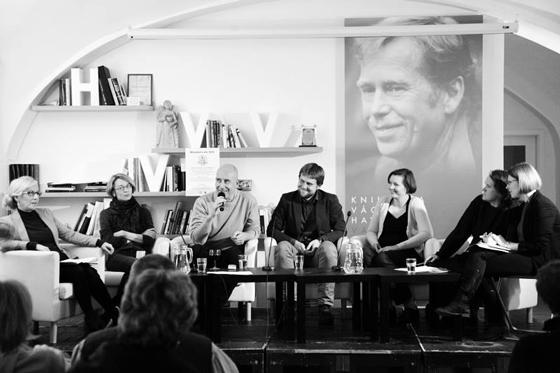 © Petr Horčička Conference "History within us" in the library of Vaclav Gavel
Much more difficult with the second break: 1991, an anti-Soviet uprising in Moscow, which buried the USSR. The official memory policy here is this: we simply do not talk about it, ignore this date. Because a simple version of the external forces and internal enemies will not get off here. There is one line in a school textbook, from which nothing can be understood.
1991 is the main “skeleton in the closet” of the current Russian elite. They all received power, property, connections, all the main resources and assets then, at the time of the collapse of the Soviet state. Our whole elite comes from there, but never mentions this and even prohibits a memorable requiem of the dead at the place of events. This is a real "blind spot" of collective memory. It does not fit into the version of history proposed to us, where the empire always went its own way, the essence of which is inexpressible and sacred.
Thus, the formula of our national memory is now this: you need to well recall Stalin and Russian kings and we must firmly forget 1991 and 1917.
5.
And yet why people will never remember the same?
I am an economist. Offering and production relationships determine even the thinnest game of the most complex cultural mechanisms. We encrypt our experience using symbols of culture and, conversely, decipher the alien. This is the basis of cultural mechanics. But encryption and decoding are predominantly determined by the measurement-production matrix of a particular society.
Our mental situation depends on our situation in the economic system and, more importantly, on the position of the country within the world system.
The historical optics that won in today's Russia is adequate to the role that the country in the world -system. If we want to remember differently, we need to change the position of people within the country and the position of the country on the global economic map. This was based on the weak faith of the opposition in the reformist capabilities of President Medvedev, in the fact that he will help create a new sector of the economy, and it would allow another cultural optics.
Left optics is the most effective antidote from a repressive, authoritarian way to understand and remember themselves.
I really believe that the socialist horizon and the way to remember our history will return in the new post -industrial conditions of the information economy. Technologies will again change the social alignment, and it is a dominant method of memory.
I think that the left optics is the most effective antidote from the repressive, authoritarian and reactionary way to understand and remember themselves. Modern Marxism sets us that ethical horizon, looking from which we can only make convincing claims to real capitalism and real socialism. In Marxism, this ethical horizon is not just a moral preaching, it is dictated by the very logic of social and technological evolution. And this favorably distinguishes Marxism from other ethical alternatives to the dominant system.
I understand history as a struggle, all important fronts of which are not between us, but inside us. We are internally divided, and it will always be so.
It is possible only when implacable class contradictions, the difference in interests and reasons for mutual submission disappears inside the society, we all finally have one common historical memory, common and equivalent to all ethical conclusions from this memory. And according to the laws of dialectics, it is the commonality of this memory and ethics that will allow each of us to have their own, truly individual, view of history. A look that requires not only personal interpretation, but also conscious personal participation. Then the reason for the mental difference between people will be a different look from the window, not class interest.
After all, any “never”, like any “always”, once ends.