
Translated material
The barrel was half sold
Who wins and who loses from the privatization of Rosneft
Whenever we believe that everything has already been decided and it remains only to wait for the denouement, what we always forget in business - the market element.
Behind the scenes
A week ago, most analysts almost openly said that, apparently, after the scandal with the Minister of Economics, Alexei Ulyukaev, there will be no privatization of the package in 19.5% of Rosneft shares.
On December 5, when Rosneft quite unexpectedly took on the market in half an hour (that is, she actually pretended to be) 600 billion rubles, were still sure that Rosneft, as everyone expected, would buy a package from the mother's company - and thus the Rosneft management, led by Igor Sechin, will retain absolute control over the state -owned company, having rejected the state -owned region. From the budget - taking into account the payment for "Bashneft" - a round amount of trillion rubles.
On December 6, everyone was also sure that everything was not clear with this deal, since no one is in a hurry to collect the board of the Rosneft directors for its approval.
However, on December 7, skeptics were shameful, and the optimists were puzzled. Rosneft was really sold, and even for a round amount of € 10.5 billion, that is, at a market price, not at all Igor Sechin and the company, but real investors - Glencore and the sovereign fund of QIA QAIA.
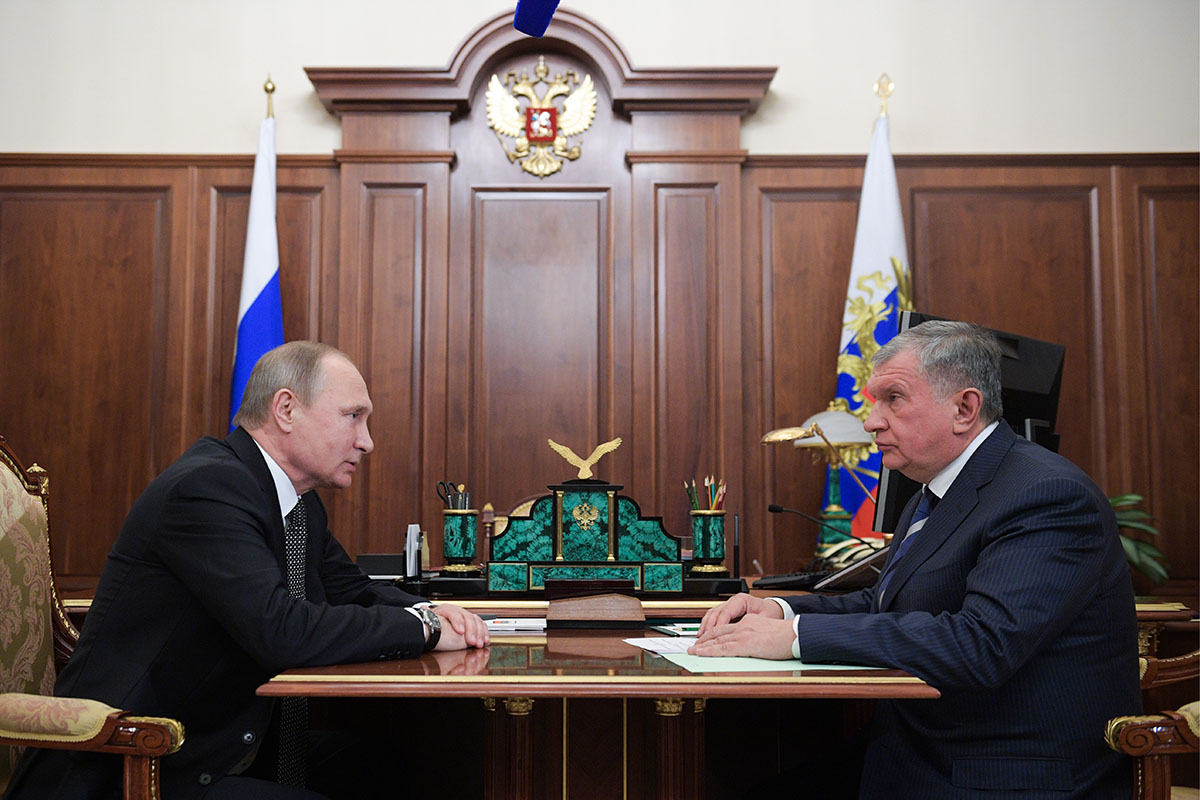
At a meeting in the Kremlin, Vladimir Putin congratulated the unperturbed Igor Sechin with the kind with which the trainer usually praises the tiger, after long clicks of scourge and persuasion still jumping from the cabinet to the cabinet, although he did not want it at all.
Who and how much
The fact that the sale of Rosneft is real to private foreign investors was not even shaken by Glencore explanations on December 8 that she actually hadn’t bought anything yet, she only looked closely, and in general, her share in these € 10.5 billion is 300 million. The rest of the Glencore share, as it turns out, presented a certain European bank (by universal conviction - Intesa Sanpaolo).
The share of Glencore is only looking closely, and indeed its share in these € 10.5 billion is 300 million. The rest is from the share of Glencore - the Italian Intesa Sanpaolo. The share of Qatar Qia in the transaction is the second half
The share of Qatar Qia in the transaction is the second half, and although the fact that the young Qatarian emir bin Caliph has authorized investments in Russian oil is easily believed, QIA, just in case, does not confirm and does not refute anything. However, there is also secret information in the world, and they fly away faster than official versions: the underground bureaucratic telegraph from December 7 sent the messages everywhere: the real deal, Igor Ivanovich Sechin - well done, everything did, although not as he wanted. And the deal is beneficial to him. Or not profitable? Here, messages of the underground telegraph diverge - it seems to have won Sichin and lost at the same time.
How can this be? Let's try to explain how, from our point of view, the party itself looks and what does the free market have to do with it.
Knight
It is perhaps worth starting with the asset sold - why is the sale of 19.5% of Rosneft shares so important if the state still leaves 51% that Rosneftegaz owns through the company and runs, in essence, through Igor Sechin?
After the absorption of TNK-BP in Rosneft, the British company BP owns 19.75% of the shares. The presence of such a shareholder limits the possibilities of Rosneft management, forcing it to meet at least formally the standards of a large global oil company - what happens to oil state -owned companies that do not have such a limiter can be seen using the example of Venezuelan PDVSA. But, in essence, the foreign spirit in Rosneft is not too strong: BP can claim respect, dividends, places in the Council of Directors, but nothing more. The sale of 5–7% over the limits changes the situation radically - a blocking package of 25% in the hands of foreigners allows you to reliably ruin the life of the Igor Sechin team, since at a meeting of shareholders such a package can be quite simply blocked by any solution.
Therefore, when in January 2016 a subject conversation came to privatize 19.5% of Rosneft shares, it was not even about the fact that it was urgent to close the budget deficit (700 billion rubles-a large amount that, however, would solve the problems of the Russian government with a shortage of budget for about three months of 2017 and no more), and that it would be nice to find the main state oil company of Russia of some kind shorter. The paradox of the situation is that the Board of Directors of Rosneft consists entirely of prominent statesmen of Russia, who, in theory, and without any privatization, should serve as a limiter for Igor Sechin. But for known reasons, they are not such. Make sure that Rosneft’s management is limited to the interests of Western companies - the government is considered a more reliable decision. In about January, Vladimir Putin, in general, was not alien to the ideas of regular corporate governance, when they do not interfere with more serious matters. And the money, in fact, is needed-funds from the privatization of Rosneft will allow the budget to close, for example, problems with past loans to the military-industrial complex, due to which the budget deficit in 2016 had to be increased from 3.4% to 3.7%.
Rosneft VS Government
Rosneft did not like the idea of privatization at all - it was never hidden. In August, when the government intended to sell Rosneft first and only then “Bashneft”, Igor Sechin easily achieved the order of sales from Vladimir Putin first - first “Bashneft”, and then Rosneft, after which he was no less easily pushed by the non -specific purchase of “Bashneft”, previously selected from Vladimir Evtushenkov. Immediately following this October “transaction”, the likelihood that Rosneft will not have any privatization has grown many times. Then, in October, as the main version, the idea arose of the future “Self -Production” Rosneft - the company occupies about 600 billion rubles in the market. (about 200 billion rubles. It seems to be already on the balance of Rosneftegaz), receives his own shares at the disposal and will slowly look for how to transfer them to the benefit of some new owner. That is why, after the scandal that was clearly spinned by the Rosneft with the removal of the Minister of Economy Ulyukaev, the version that the Rosneft shares may receive, but there will be no money from a self-removal under some pretext to pay the budget, became predominant.
And even when Rosneft on December 5 took 600 billion rubles on the market, they immediately recalled that exactly two years ago the Central Bank under the Kremlin’s pressure under a fairly simple scheme had already helped Rosneft with debts - and, most likely, the calmness of the Igor Sechin team would be paid, experts suggested, in December 2016, in December 2016, in the issue of the public issue for the round amount.
From the world to a billion
But everything went wrong. Since mid -November, according to our information, Rosneft’s management began to be found at various points of the planet. What and with whom the Sechin team negotiated - the most fantastic rumors went. For example, about a peaceful agreement with Japan in exchange for the acquisition of a large share in Rosneft by Japanese Mitsui and Mitsubishi, shareholders of the Sakhalin Gazprom Sakhalin projects. Or about the exchange of shares with Indian ONGC. Or about the new contract with the Chinese CNPC. It was not said only about transactions with EU and the USA companies-of course, due to sanctions that do not directly prohibit in the case of, for example, with European companies, the acquisition of a share in Rosneft’s capital, but create big problems with such purchases that the Japanese, Indians, Chinese do not have-and, as it turned out, Qatar also has. The fact that the QIA Gosinvestfond is ready to invest billions of dollars in Russia for quite some time-Qatar, a sworn friend and an eternal opponent of Russia in the global gas market in the 2000s have long been interested in diversification of assets. But in the Bin Caliph family, they can consider risks - without special agreements and a good partner, QIA would not invest anything in Russia. But where to get such a partner?
Flights of the management of world financial centers began after Vladimir Putin unequivocally informed Rosneft’s management that it was still to sell her package, and for sure, it will still be necessary
Meanwhile, according to the information of the same underground administrative telegraph, managing the world financial centers began after Vladimir Putin unequivocally informed Rosneft’s management that it would still have to sell its package, and this is not being discussed. Most likely, the reason for this decision was, oddly enough, Alexei Ulyukaev. Alas, the cunning combination of the SK, the FSB and the Rosneft security service, although it forced the president to lose confidence in the minister, but that’s all. In the White House and the Kremlin, we could not find a person who would seriously believe that Ulyukaev was caught on a bribe. But the number of top managers of the government, confident that in this way Rosneft is trying to upset its own privatization, apparently, is at least an arithmetic majority. Vladimir Putin had no choice but to force Rosneft to prepare the sale of himself-but not to himself, but to someone else. That is, to enter the market.
And in the market, the forces were immediately discovered that you will have to play according to the rules that do not really like in Russia. The Qatar Qia appeared instantly, as if he had been waiting for this moment for many years, the head of Glencore Ivan Gloisenberg appeared on the horizon, and a certain European bank, terribly similar to Intesa, immediately appeared. And in a record time they made a team of Igor Sechin a proposal, which he not only could not refuse - but did not have the right to refuse in the circumstances.
In general, there is something mystical in how much the history of Russia is connected with the world of large raw material trading. No, of course, in itself this is understandable: Russia is interesting to the world with oil, and where there is oil, there is an oil floor. But the fact that the entire commercial history of the country can be explained as an episode in the long history of oil oil industry Mark Rich, who in the 1980s tried to displace the world leader, American trader, is amazing from the world market markets. The Rich empire broke up in the 1990s, it was inherited by people who built Trafigura and Glencore on its ruins. Now this is the third and second raw materials traders in the world - and it was with the head of Glencore, who flew to Moscow not in his first career, not for the fifth or even for the twentieth time, Sichin still had to decide his fate.
However, two other transaction partners are not sugar. QIA and its owners from Qatar already clicked on Gazprom’s nose, in 2008 elegantly intercepting the control over the gas OPEC project (there was nothing to be offended, Gazprom intercepted the idea from Iran). If the European Bank, the crediting transaction, is really intesa, then Rosneft cannot but take into account that the Italian banking group has long been over the ears in the Russian oil and gas business, it is actively lending not only Gazprom, but also Novatek and Yamal LNG.
The new partners of Sechin have their own game. And even if we assume that the consortium of three new shareholders of Rosneft has its own agreements with the management of the Russian state -owned company, then these are purely market agreements. They will change the meaning at the moment when it ceases to be profitable.
Sechin: Pros and cons
As a manager of Rosneft, one of the world's largest companies, Igor Sechin objectively won. Rosneft got rid of the need to reduce its capitalization with a “self -removal” with subsequent uncertain outcome, received new, quite interesting shareholders from the point of view of business, and finally helped the Russian budget. But Sechin, the top manager of Rosneft, the bastion of Russian hospitalism, is not very good. For a whole year and an incredible amount of effort was spent on leaving everything as it is and not to change anything - everything suits for many years.
There is everything on this chessboard: Donald Trump’s figure, and Snowden’s horse, and the locked elephant Viktor Bout, and Queen of Angel Merkel, and Ukrainian pawns, and Arabic rooks, and Venezuela, and the deceased Castro, and the ideas of Chuchhe, and Rothschilds, and Rockefellers, and, perhaps, even foreigners.
However, there is a third sechin, about which we know quite little. This is the head of Rosneft, the leader of that group of comrades who have been in the same team with Vladimir Putin for many years the most difficult geopolitical game with the whole world on the Great Chessboard, invented by Zbigneev Brzezinsky for the convenience of exposing his own thoughts and literally understood in Russia. In this imaginary space there is everything - and the figure of Donald Trump, and the horse of Snowden, and the locked elephant Viktor Bout, the Queen of the Angel Merkel, and the Ukrainian pawns, and the Arab boats, the Venezuelans, and the deceased Castro, the ideas of Chuchhe, and the Rothschilds, and the Rockfeller, and, perhaps, even alien, all kinds of alien. In case, the development of Mars is definitely there. It’s scary to even think about what significance the players in this game give the ongoing privatization of Rosneft. It seems to us that the whole thing is in the corporate governance of the state -owned company and in the general rules of the game. And what does it seem to them - how do we know?
And that is why we will definitely not be able to predict what will come out of the privatization of Rosneft. We do not play this game. The state of the state in Rosneft decreased to 50%, foreigners - increased at least above 40%, the budget will receive 700 billion rubles from this, Rosneft will become a little more transparent and predictable. Is it good for Igor Sechin - no one but himself can know about this.