
Translated material
It is impossible to be silent to Poland
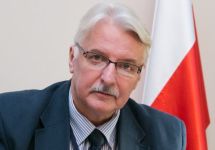
Today, Putin's Russia violates international norms to a greater extent than the Soviet Union did at one time. This was stated by the Minister of Foreign Affairs of Poland Vitold Vashchikovsky, according to the website of the Polish Foreign Ministry.
"In the 90s, we were inclined to think that the new Russia would pursue its foreign policy in accordance with international norms and values. But in the last years that Russia has come in violation of the OSCE principles, the UN Charter and international standards further than the USSR, we proved that we were very mistaken," Vashchikovsky said.
The Minister noted that Warsaw’s critical attitude towards Moscow is caused not only by a difficult history of relations, but by a “sober assessment of the revisionist inclinations” of Russia.
“We believed that there is no longer any need to maintain our troops in constant readiness to the extent, as it was during the Cold War,” said Vashchikovsky. “Unfortunately, European, as well as global security architecture, created after the Cold War, is currently increasingly questioning and destruction.”
The minister emphasized the importance of the Union of the EU and the USA. “It is thanks to American guarantees of European security that can develop peacefully we believe that Europe still needs America, and our role should also remind the Americans, that they still need Europe,” Veschikovsky said.
Speaking about the relations of the European Union with the closest neighbors, the head of Polish diplomacy noted that "the prospect of membership or a close association with the European Union remains one of the most effective tools of influence." At the same time, he recalled that the European aspirations of Ukraine were faced with the "brutal resistance of Russia."
In July, at the NATO summit in Warsaw, the heads of 28 states decided to strengthen the military presence in the eastern part of the alliance . In Poland, Estonia, Latvia and Lithuania, four multinational battalions will be placed on a rotational basis.
The summit participants also confirmed the readiness to spend more funds on defense. NATO Secretary General Jens Stoltenberg welcomed that in 2015 for the first time in many years, it took place a slight increase in defense costs. According to estimates for 2016, NATO will spend more on military programs by 3 percent, which is about $ 8 billion. “We still have to go a long way, but I believe that we took the first step,” the Secretary General said.
Stoltenberg at the same time emphasized that "NATO does not pose any threat to any country" and continues to look for ways of constructive dialogue with Russia.