
Translated material
New McLaren's report
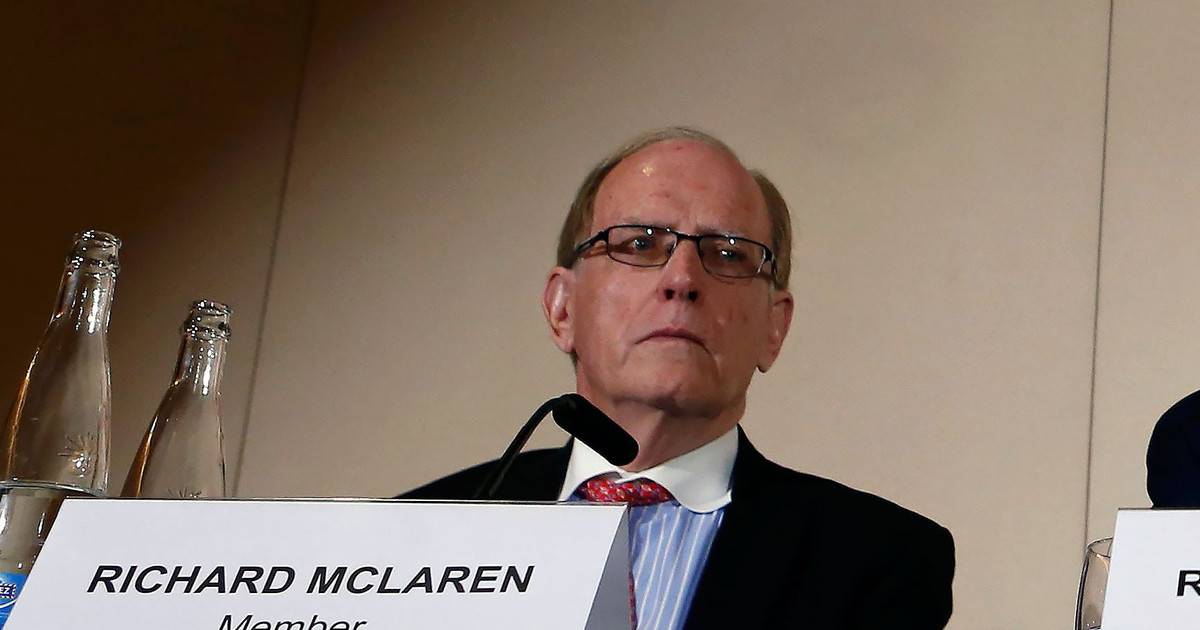
An independent expert of the World Anti -Doping Agency ( WADA ), Professor of the Law of Canadian University of Western Ontario Richard McLaren on Friday presented the second part of his report on the state doping system in Russia. The first part of the report was published in the summer, on the eve of the Olympics in Rio and almost led to the removal of the Russian team from participation in competitions. The IOC agreed to allow the national team to competition in Brazil, not becoming the principle of collective responsibility, but some athletes were not allowed to competition. The new report says that all conclusions made in the first part are confirmed, and this will surely lead to sad consequences for Russian sports.
The second part of the McLaren report not only repeats the main accusations contained in the previous one, but also indicates new details. The investigation, headed by the Canadian lawyer, came to the conclusion that the scale of the Russian doping system is much wider than expected. The number of athletes suspects of involvement in the system increased almost twice. If in the summer McLaren justified that about 600 athletes are involved in the use of doping, then the new version detects over a thousand athletes representing about 30 year and winter sports that could benefit from the doping system.
The report is about a period of time from 2011 to 2015. The authors of the report believe that the sampling system began to be developed after the unsuccessful performance of Russians at the Olympics in Vancouver. During this time, it was possible to apply it at the Olympic Games in London (2012), at the Universiade (2012), at the World Athletics Championship in Moscow (2013) and at the Winter Olympiad in Sochi (2014).
The main defendants in the investigation are the same. The sampling system, as stated, was created under the supervision of Russian officials with the support of the FSB. The key role, according to the authors of the report, is occupied by the Ministry of Sports of Russia and the associated Russian anti -doping agency (RUSADA), the Center for Sports Training and the Moscow Anti -Doping Laboratory.
The most important element of this system was the director of the Moscow laboratory Grigory Rodchenkov, who became an informant of McLaren after he moved to the United States. At the same time, it is not quite clear what place in the system was occupied by the then Minister of Sports Vitaly Mutko, in October of this year, appointed Deputy Prime Minister. According to McLaren, Mutko could know about the doping system, but the process was led by his deputy Yuri Nagornaya, already dismissed. WADA has no evidence of Mutko’s direct involvement in the organization and management of the system.
A person in the report is occupied by the Sochi Olympics, in which Russia took first place. McLaren continues to insist on the existence of the practice of replacing “dirty” samples with “clean” right during the competition. According to him, the Ministry of Sports, together with Rodchenkov, developed a technique that would be a perfect and safe mechanism that guaranteed the impossibility of sniffing in the use of doping, and specialists in laboratories achieved even the external similarity of “pure” and “dirty” samples.
The investigation showed that at the Olympics in Sochi, 12 medalists opened samples in urine. On containers with samples, scratches and damage were found, indicating manipulations with the contents of these containers. In the samples of some athletes, the salt level exceeded the "physiologically acceptable." Two women from the hockey team, in the samples they found male DNA. Manipulations with samples of six medalists of the Paralympics in Sochi were also revealed. To make the forged samples of samples similar to real ones, water or soluble Nescafe coffee was used, the report said.
All conclusions made in the report are based on examinations and laboratory research. In total, it refers to 500 fake reports on the samples transmitted by the Moscow laboratory to WADA . In the published report, the names of athletes are not indicated, but they are in full versions of reports sent to sports federations. To confirm the applications made, WADA has launched a site with the database of documents used in the investigation.
The head of WADA Craig Reidy called the new report “anxious” evidence demonstrating the “scale of subversive activity”. Russian officials in personal comments mainly spoke about the lack of evidence and purity of Russian athletes, but there is no official position on the presented report yet. The Ministry of Sports promised to carefully study the presented information "in order to form a constructive position." At the same time, the ministry claims that there were no doping support programs in Russia.
The Minister of Sports Pavel Kolobkov, in turn, stated that the term “state conspiracy” used by McLaren is erroneous. “There was no conspiracy and could not be. With individual violations and even, in my opinion, crimes committed, in particular, Mr. Rodchenkov and his likely associates, Russian law enforcement agencies are being understood, ”Kolobkov said.
The Kremlin promised to carefully read McLaren's report, noting that "some hypothetical reasoning is inappropriate here." The President of the International Olympic Committee (IOC) Thomas Bach suggested that everyone who is involved in the doping system be taken from participating in the Olympiads. In the near future, the IOC will double -top urine samples of all 254 Russian athletes participating at the Sochi Olympics.