
Translated material
Robert Bruce's face
The national hero of Scotland, the brave warrior, King Robert Bruce died in June 1329 at the Cardoss estate, near the city of Dambarton. Messages about the causes of the king’s early death (he was only 54 years old) are contradictory. English historians write that Robert suffered from leprosy. As it seems, their words are confirmed by Jean Fruissar from the Valloon County Eno. The “Chronicle of Fruassar” says: “King Robert Scottish, who was a very valiant knight, was covered with wax and fell ill with such a serious illness that he saw the approach of his end” (the translation hereinafter D. N. Rakov).
But in none of the Scottish sources there is no hint of Robert Bruce's leprosy. A number of modern historians also doubt such a diagnosis. The king suffering from such a severe illness, in their opinion, could not have to fight relatively shortly before his death, devote his associates to knights, attend the council and perform the court, travel a lot and, finally, become the father of more than a dozen children, both legal and illegitimate. They offer their hypotheses about Robert's disease, calling eczema, cancer, tuberculosis, stroke and even syphilis and lateral amyotrophic sclerosis. The personal doctor of the king Milanets Mario de Maineri is generally blamed in his ailments of eels, whom he considered inappropriate food at this age. There is still no final answer to the question of the causes of Robert Bruce's death.
Robert Bruce
One way or another, the death of the king was approaching. He turned to the most brave of his associates, Sir James Douglas. That's how his words sounded, according to Fruissar:
“My dear friend, Lord James Douglas. You know that I worked hard and experienced a lot during my life to support my rights to the crown. At the time when I was most busy with this, I gave a vow, the failure of which is very upsetting me. Namely, I vowed that if I could complete my wars in such a way that I could calmly rule in the world, then I would go to war with the enemies of the Lord Jesus Christ and the opponents of the Christian faith. My heart was always inclined to this goal, but our Lord did not want this, and although he gave me so much in my life, but this last campaign lasted so long, and this serious illness followed him. Therefore, since my body cannot meet the desires of my heart, then to fulfill my vow, I will send my heart instead of the body. And since I don’t know any more knight, just as bravely and entrepreneurial, and it is better to fulfill my desires than you, then I, urgently, as I can, pray you, my dear and exceptional friend, so that you show generosity and, for the sake of love for me, would do the duty of my soul to our Lord and the Savior. After all, I am so high about your nobility and fidelity, which I think, since you will take up this matter, it cannot fail, and I will die more satisfied, but you will have to fulfill the following. I wish that as soon as I die, you would take my heart out of my body, and would embalm it. You will also take as much money from my treasury as it will seem suitable for you to make your journey, as well as for all those whom you will fail to take with you. Then you will put your cargo in the holy tomb of our Lord, in which he should be buried, since my body cannot reach there. You will not save on expenses and take with you such a detachment and things that you consider to be appropriate for your rank. And wherever you come, you will let everyone know that you are carrying the heart of King Robert Scottish, which you take for the seas by my order, because my body cannot go there. ”
Sir James Douglas promised the dying that he would fulfill his will. On June 7, 1329, Robert Bruce died. The king’s body was embalmed, his chest was opened, his heart was removed from there and Sir James Douglas placed him in a silver casket. The inside of the king were buried in the wall of the chapel of St. Serf in Card "(now its ruins are located in the Lovenshgrav Park on the territory of Dambarton). And Robert’s body was sent for burial to Dunnam's abbey, since it was in Dunfermin that the residence of the Scottish kings was located.
The funeral of Robert Bruce was grandiose. Only the wax for candles, according to the references that have reached us, was spent 478 Stone (3040 kilograms). The king’s body was laid in an oak coffin, and he was placed in a stone tomb under the floor near the altar. At the top there was a marble plate specially bought in France a year before Robert’s death, above it was an elevation of black limestone, on which Robert Bruce's sculptural image from a painted and gilded alabaster rested.
After the body of Robert Bruce received a worthy burial, Sir James Douglas began to fulfill the promise given to the king. He gathered a detachment of the eight most valiant knights of Scotland and 26 squires and went to Flanders, hoping to find fellow travelers there and get to Jerusalem. In Flanders, he learned that the king of Castile and Leon Alfonso XI was waging a war with the Moors of the Granadsky Emirate. Sir James found that this war was quite suitable for turning the exploits for faith, and to Spain closer than before Jerusalem, so he went there. His detachment arrived in Valencia and soon joined the royal troops.
In August 1330, Scottish knights took part in the battle with the Moors at the Teba fortress, in the territory of the current Spanish province of Malag. They say that Sir James Douglas threw the casket with his king’s heart into the crowd of the enemy during the battle, shouting that faithful associates would follow the king forward. The Scots rushed to the attack and turned the Moors to flight. But the continuation of the battle ended with a disastrous Douglas.
Jean Fruissar writes: “Lord James set himself and his detachment on one of the flanks so that he gets the best work, and he could better do his job. When he saw that the military ranks of each of the parties were completely built, and that the king of Spain was in motion, he imagined that they would immediately begin the attack. And since, in such cases, he always wanted to be more among the first than among the latter, he and his entire detachment spurred his horses, and galloped until they were in front of the army of the Grandan king, and fiercely attacked Saracens. He thought that the Spaniards should support him, but that was a mistake, since no one followed his example that day. The glorious knight and his entire detachment was surrounded by an enemy. They showed miracles of valor, but all to no avail, since they were all killed. ”
After the battle, the body of Sir James Douglas and a casket with the heart of Robert Bruce were found on the battlefield and returned to Scotland. There, the casket was buried in the abbey of Malroose in Roxburghr, the burial place was lost over time, and only in 1920 was the casket found archaeologists and reburied. He was found again in 1998 during construction work. This time the burial place was marked with a memorable sign.
A memorable sign at the scene of the heart of the heart of Robert Bruce in the abbey of Malrose. The inscription is a quote from the Scottish poet John Barbor (1320 - 1395): A Noble Hart May Have Nane GIF Freedom Failye "The noble heart will not know peace without freedom."
The fate of Robert Bruce's body was also not easy. In the 16th century, the Reformation came to Scotland, and in 1560 the Danfermlin abbey was closed and destroyed. The tomb of the king was lost. Only the central oil of the cathedral was used as a parish church. At the beginning of the 19th century, it was decided to build a new church on the site of the altar of the former cathedral. And on February 17, 1818, when the builders began to dig the ground under the foundation, they stumbled upon stone slabs hiding the tomb. When the plates were raised, they saw the remains of an oak coffin, and under them a lead coffin, where there were bones and fragments of a savannah embroidered with gold. During excavations around, fragments of marble and alabaster were also found, which once decorated the tomb.
The remains were examined by two prominent scientists: James Gregory , the head of the University of Edinburgh and the president of the Royal Medical College of Edinburgh, as well as professor of the Anatomy of Edinburgh Alexander Monroe . They found traces of the cut on the chest made to extract the heart, which finally convinced everyone that Robert Bruce's remains were found.
The bones were measured and sketched, scientists came to the conclusion that the height of the king was 185 centimeters. The artist William Skular made a gypsum cast of the king's skull. On November 5, 1819, Robert Bruce with a large pomp was again buried in Dunfermlin's abbey.
The model of Robert Bruce skull, according to the cast made by William Skular, is stored in the Khanter Museum of the University of Glasgow
Modern technologies of bone research could tell a lot about Robert Bruce and the causes of his death, but no one is in a hurry to provide scientists with access to his remains. All that is available is a model of a skull made on a plaster cast. On it, at least twice earlier attempts were made to restore the king’s appearance. The author of one of them, Robert Neave, from the University of Manchester, supported the hypothesis of leprosy disease, the author of another - Peter Vanezis from the University of Glasgow - did not consider it possible to support it or reject it.
Reconstruction of Robert Niva
Recently, a professor of Scottish history from the University of Glasgow, Martin MacGregor) got acquainted with the results of the reconstruction of the skull of King Richard III. He came to the conclusion that the reconstruction methodology was significantly improved, and now it would be possible to reproduce Robert Bruce's face with greater accuracy. He turned to Professor Caroline Wilkinson, who heads the laboratory of craniopascial reconstruction at the John Mursa Liverpool University. It was she who worked on the face of Richard III.
Computer scan of the skull during reconstruction
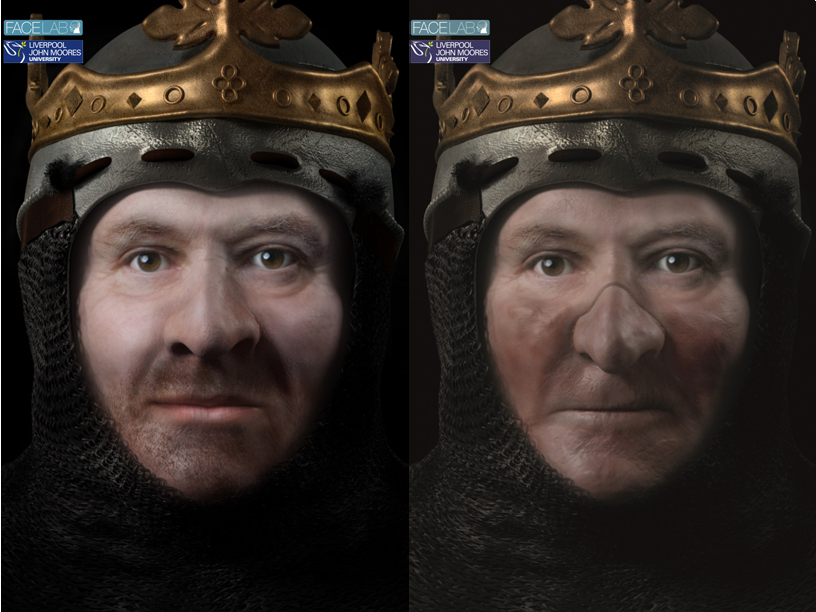
A thorough study of the model led Wilkinson and her colleagues to the conclusion that on the skull we can assume the presence of traces of leprosy. This is indicated by osteological changes in the area of the nose and upper jaw. But scientists refused to make the final conclusion, as they considered that they could be completely confident only after examining the bones themselves, and not their model. Therefore, Wilkinson performed two reconstruction options: a younger king without traces of illness and an older with signs of leprosy.
Two options for reconstruction of Robert Bruce's face
The king received brown eyes and light brown hair on the basis of an analysis of historical sources conducted by Martin McGregor and his colleagues. Professor Wilkinson is convinced that in the end it was possible to get the most realistic image of Robert Bruce based on available material.