
Translated material
IG again captured Palmyra
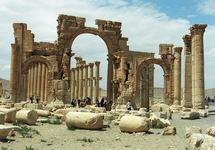
The militants of the Islamic State again captured the late -ant city of Palmyra in Muhafaz Homs, Central Syria. This was reported by AFP with reference to the Syrian Center for Human Rights Monitoring (SOHR). The troops of the dictator Bashar al -Assad moved south of the city.
Jihadists made a lightning rush on Palmyra, after they took control of the old fortress on the western outskirts of the city, built at the top of the hill, at a strategic height.
AMAQ, the official news agency, also stated that after taking the fortress, Islamists again completely control Palmyra.
As AFP explained in SOHR, jihadists, trying to minimize losses, use tactics of instant movements. They recede, hiding from aviation blows, and again attack when there is no threat from the air.
From Thursday, when IS began an attack on Palmyra simultaneously in several directions, about 100 military Assad died in battles. Jihadists captured the oil and gas deposits of Mahr and Shaar, Assad’s checkpoints, as well as the granary.
Earlier on Sunday, Interfax transmitted with reference to the Russian Ministry of Defense that up to 4 thousand Islamists participate in the attack on Palmyra. As stated, IS transferred large forces from the Rakka region, where "active hostilities against terrorists by groups, controlled by the United States and the International Coalition, were suspended this week," as well as from Deir Ez-Zora. From the area near Deir-Ez-Zor, IG armored vehicles also arrived, the Russian military claimed.
In Rakku and Deir ez-Zor, the Ministry of Defense also stated, before up to 5 thousand jihadists from Mosul in Iraq were redrawn.
At the same time, it was argued that Assad’s troops did not retreat, but continued fighting in the city. It was also stated that Russian aviation could not help them in this case, since "it does not inflict hit the city of Palmyra in the residential quarters of the city."
On the morning of December 11, it became known that Russia bombed Palmyra , captured on Saturday, Islamists. The Ministry of Defense stated that 64 beats were inflicted on the jihadists and more than 300 militants were killed as a result of these raids, and 11 units of tanks and BMPs, 31, equipped with large -caliber machine guns, were killed.
It was also reported that Assad forces, located in the vicinity of the city, received a large reinforcement.
Palmyra (modern Tadmur village) was under the control of IG for 10 months - from May 2015 to the end of March 2016. Islamists destroyed many ancient buildings, declaring them with symbols of paganism. The dictator Assad returned control over Palmyra with the support of the Russian military.
At the same time, Russia, intervening in the Syrian war, repeatedly bombed the Palmyra area. In November 2015, it was reported that at least eight bombs fell into the area of the old fortress, and Syrian activists did not exclude damage to the monument.
In mid-April 2016, it became known that Syria Prime Minister Vail al-Khalki invited to participate in the restoration of Palmyra Stroytransgaz , which is the co-owner of the oligarch Gennady Timchenko from the nearby circle of Vladimir Putin. On May 5, a concert of the Mariinsky Theater orchestra under the direction of Valery Gergiev was held in the amphitheater of Palmyra. Also in the concert, the cellist Sergei Roldugin, the owner of a number of offshore firms in which Russian officials and crime, withdrew money from the country, took part.
In mid -May, it was reported that Russia was building a military base in Palmyra inside the security zone established by UNESCO and without obtaining formal permission from Assad. At the same time, UNESCO stated that it was not yet clear whether the base is being built in the buffer zone adjacent to the monuments zone, but in any case, the presence of this object does not pose a threat to Palmyra.
At the same time, one of the opposition activists noted that the Russians placed their prefabricated buildings at the northern border of the monuments zone, several hundred meters from ancient temples and the triumphal arch. At the same time, in the immediate vicinity of the barracks there are a number of historical burials.